What You Need to Know About Water Quality Testing
Water plays a major part in everyone’s daily life, particularly in construction. It flows on construction sites into storm drains, in pipelines, adjacent to foundations, and around drilled piers. Untested runoff can impact infrastructure/communities. Rusty pipes, brittle concrete, and reliance on utilities are at risk.
Water quality testing involves gathering water samples and testing them for various physical, chemical, and biological characteristics. Analyze water to find out if it is safe to use and up to Government standards. Water quality testing is a first line of defense with regard to both the integrity of your structure and the safety of the public.
Why Water Quality is Important for Infrastructure?
Water is important because it affects the infrastructure, such as:
Corrosion
Harsh water chemistry quietly destroys buried infrastructure. Acidic water, high chloride, and high sulfates are detrimental to the durability of steel pipelines, driven piles, tie-back anchors, and rebar.
A soil and groundwater evaluation of corrosivity will help to decide what to do in the design phase. For instance, the need for protective coatings, cathodic protection, or other materials.
Concrete Damage
Groundwater loaded with sulfates is one of concrete’s worst enemies. Sulfate attack makes concrete swell, crack, and slowly fall apart — damaging foundations, drilled shafts, and buried structures. Testing the groundwater chemistry tells engineers which cement type and concrete mix to use. The report should include a water quality analysis where it indicates a high groundwater level.
Groundwater and Construction Dewatering
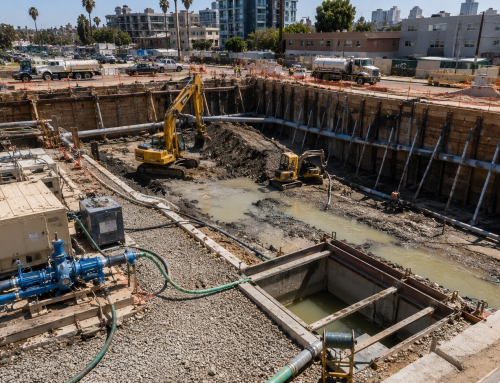
De-watering or pumping is necessary for deep excavations where water will be below the water level. However, the water cannot be pumped anywhere without treatment. Typically, discharge to storm drains or waterways requires permits and testing.
Water quality is assessed by testing and must comply with the quality limits. If this is not achieved, then the project may be held up in potentially costly delay; stop-work orders and fines may be issued.
The right environmental inspections prevents project delays and avoid risky project budget issues. Properly framed inspections safeguard schedules, jobs and your project budgets.
Significance of Water Quality Matters for Public Safety
The Centers for Disease Control and Prevention (CDC), however, offers guidance on private well testing and preventing waterborne diseases. EPA also provides current PFAS and drinking water information. The Safe Drinking Water Act establishes enforceable standards for public water systems set by the U.S. Environmental Protection Agency (EPA).
Water testing is important for public health too. Getting filthy drinking water with germs is a significant health threat. For example, E. coli or heavy metals, lead, PFAS,
Construction is a regulated source of water pollution in itself. Grading and digging can cause muddy runoff, which is detrimental to the storm and stream systems. Thus, construction sites greater than 1 acre will require stormwater permits under the EPA’s National Pollutant Discharge Elimination System. These rules are under the jurisdiction of the State Water Resources Control Board and its regional boards in California.
Old contamination comes on top. Past plumes can pollute groundwater and persist for decades. It generally comes as a consequence of former industrial sites, leaking underground storage tanks, or past dumping.
This is why, as part of a Phase II environmental site assessment, we take soil and groundwater samples. Typically, we need a Phase II assessment.
Appropriate wall type according to your property depends upon the slope shape, the soil, groundwater, and site access. A geotechnical investigation determines the above-mentioned parameters. On fire-scarred lots, do not assume a soils report written before the fire is still valid.
Burned slopes behave differently compared to the real conditions. So, most cities and counties will require an updated soils study before a new retaining wall approval.
Read more to find out why every natural disaster like wildfire and flooding requires a comprehensive structural and foundational analysis before any rebuild can occur. Especially when building a retaining wall for a hillside property in Los Angeles.
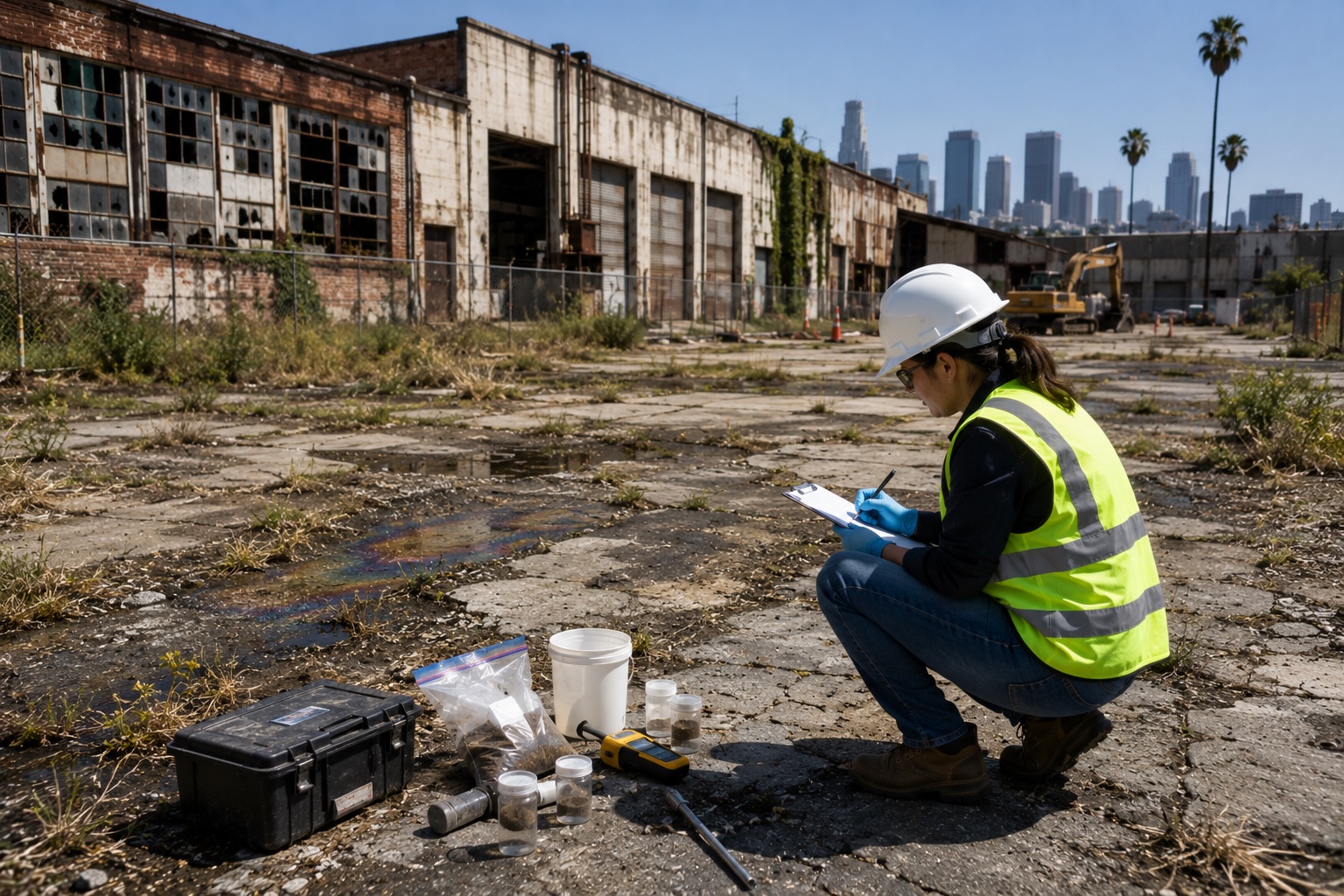
Environmental site assessment at a former Los Angeles industrial property before redevelopment, identifying potential soil contamination and environmental risks.
Key Water Quality Parameters and What They Tell You
|
Parameter |
What It Measures |
Why It Matters |
|
pH |
Acidity/alkalinity |
A decrease in pH will lead to more corrosion of metals and concrete |
|
Chlorides |
Salt content |
Attacks reinforcing steel and buried metal |
|
Sulfates |
Dissolved sulfate salts |
Causes sulfate attack on concrete foundations |
|
Total dissolved solids (TDS) |
Overall dissolved minerals |
Indicates general water quality and scaling potential |
|
Turbidity |
Suspended particles |
Key stormwater discharge and drinking water metric |
|
Heavy metals |
Lead, arsenic, chromium |
Direct human health hazards |
|
Coliform / E. coli |
Bacterial contamination |
Indicates pathogen risk in drinking water |
|
Nitrates |
Fertilizer/septic influence |
Health risk, especially for infants |
|
VOCs |
Industrial solvents, fuels |
Signals contamination from spills or leaking tanks |
Standard Methods for Water Quality Testing
For testing the water quality, you should follow the methods below:
Field testing
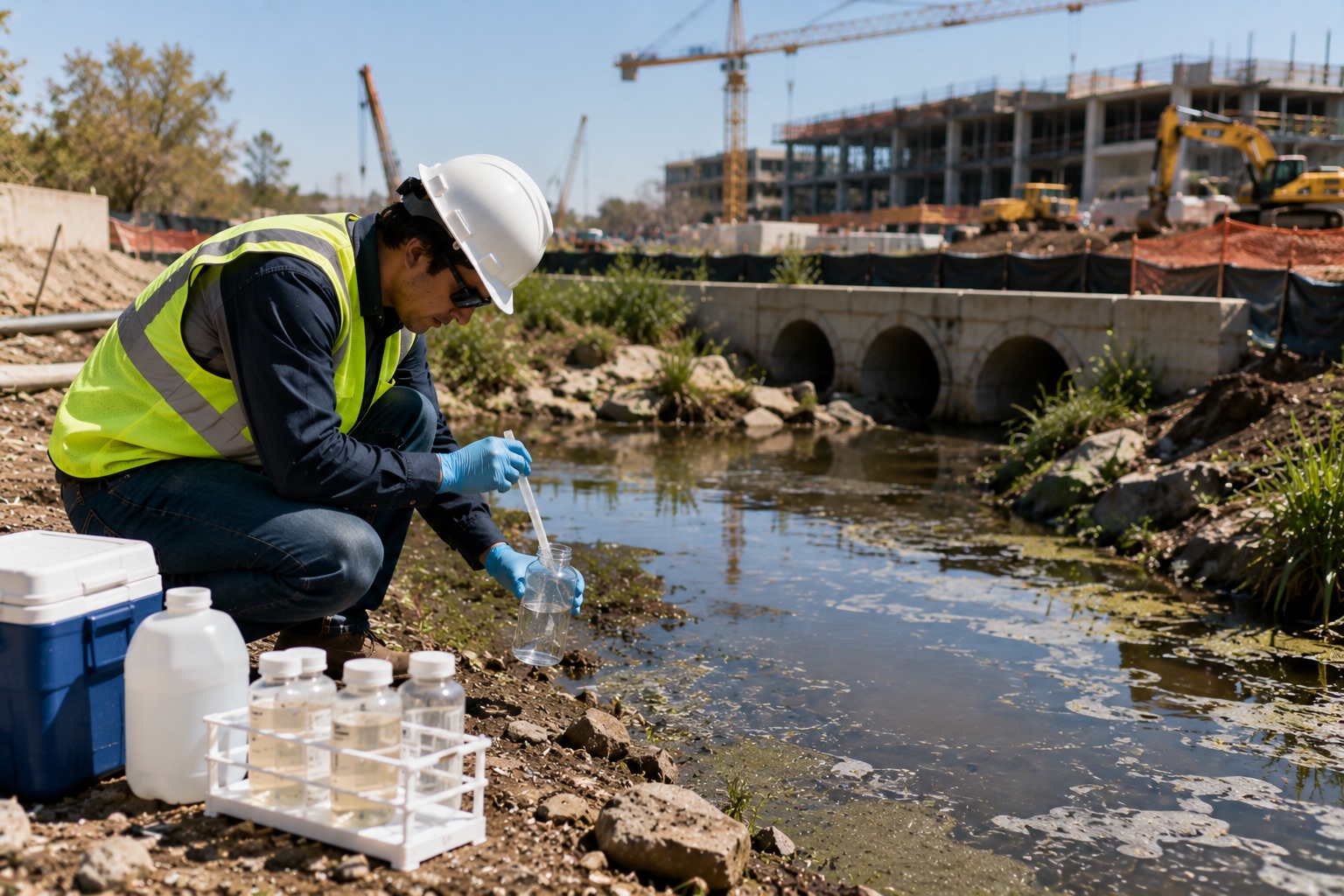
Field tests are straightforward, consisting of measurements of the pH, temperature, dissolved oxygen and turbidity using field pH, temperature, and turbidity meters and probes. Testing can be quick and can be helpful for initial assessment. But there is only an approximation of results and no real proof.
Groundwater monitoring wells
The monitoring wells enable multiple sampling from one point over time. Monitoring of contamination plumes, verifying cleanup effectiveness, and observing groundwater in deep excavations is possible with groundwater monitoring wells. The U.S. Geological Survey (USGS) has abundant groundwater data that are often used to supplement site-specific monitoring programs.
Laboratory Testing
For legal and/or engineering significance, results from certified laboratory analysis are preferred. We take samples in a controlled environment with compliance rules and document the chain of custody. We then perform analysis that uses EPA-approved methods at an accredited analytical laboratory. It is the standard to comply with for drinking water, discharge permits, and environmental site assessments.
Continuous instrumentation
Instrumentation includes in-line sensors and data loggers. These instruments provide real-time monitoring for treatment plants and critical infrastructure. They are able to detect water quality issues when they occur.
Regulatory Standards and Compliance
You should identify every authority over your project early. You will know the exact requirements from each of them, and it will not delay the project. Water testing requirements come from several overlapping authorities:
- Federal public water supplies are under the Safe Drinking Water Act. Surface Water discharge is regulated by the Clean Water Act and the NPDES program. The EPA operates both departments.
- State of California (California State Water Resources Control Board) has set the discharge permits and water quality goals. Nationwide, utilities follow industry standards as developed by organizations such as the American Water Works Association (AWWA).
- Transportation and public works: The agencies establish their own regulations concerning work in their area. Caltrans has comprehensive requirements regarding stormwater and water quality for development located in the State highway right of way. Every project should follow Los Angeles grading and drainage codes from LADBS and the city’s Stormwater Ordinance.
When Should You Order Water Quality Testing?
Consider professional testing in these situations:
- Before buying or developing property — as part of Phase I/II environmental due diligence
- Before foundation design in areas with shallow groundwater — to check for corrosion and sulfate exposure
- Before and during construction de-watering — to get and keep discharge permits
- After suspected contamination — nearby industrial activity, old tanks, or unusual odors and staining
- For ongoing permit compliance — scheduled sampling under NPDES or local discharge permits
- For private wells and small systems — routine yearly testing for bacteria and nitrates, following EPA guidance for private wells
How Professional Water Testing Works
A qualified environmental or geotechnical firm follows a defined process:
- Examine and devise a sampling plan
- Correctly collect samples and maintain them appropriately
- Maintain chain of custody, submit samples to an approved laboratory
- Interpret the results
Without a professional engineer, raw lab data and design advice or compliance results don’t have value. Home test kits are suitable for basic well screening; however, you can’t obtain a permit based on the results.
Conclusion
Water quality testing is beneficial for waterproofing systems and the communities above. Certified testing provides engineering decisions from an unknown situation. Such as for selecting sites for a foundation, dewatering program, or simply conducting a due diligence survey
Do you need water quality testing, groundwater monitoring, or environmental compliance support at your project? Call in our group of accredited Engineers or Environmental experts today for a cost-free expert consultation and estimate. We will develop a sampling program that meets all the agencies’ requirements and have a voice in your project.
F.A.Q.s
How much time does it take to test?
Field tests provide results immediately. However, the standard laboratory usually takes 5 to 10 business days, with rush options available.
What are your costs for water quality testing?
Basic lab panels start at a few hundred dollars. Full contamination assessments with monitoring wells cost more. Either way, testing is always cheaper than the failure or violation it prevents.
Do I need water testing for a construction project?
If your project involves dewatering, shallow groundwater, stormwater permits, or an environmental site assessment — yes.
Can water quality really affect my foundation?
Absolutely. Sulfate attack and chloride-driven corrosion are leading causes of early foundation and buried-utility failure.
Build with knowledge. Build with confidence. Build smart from the ground up.