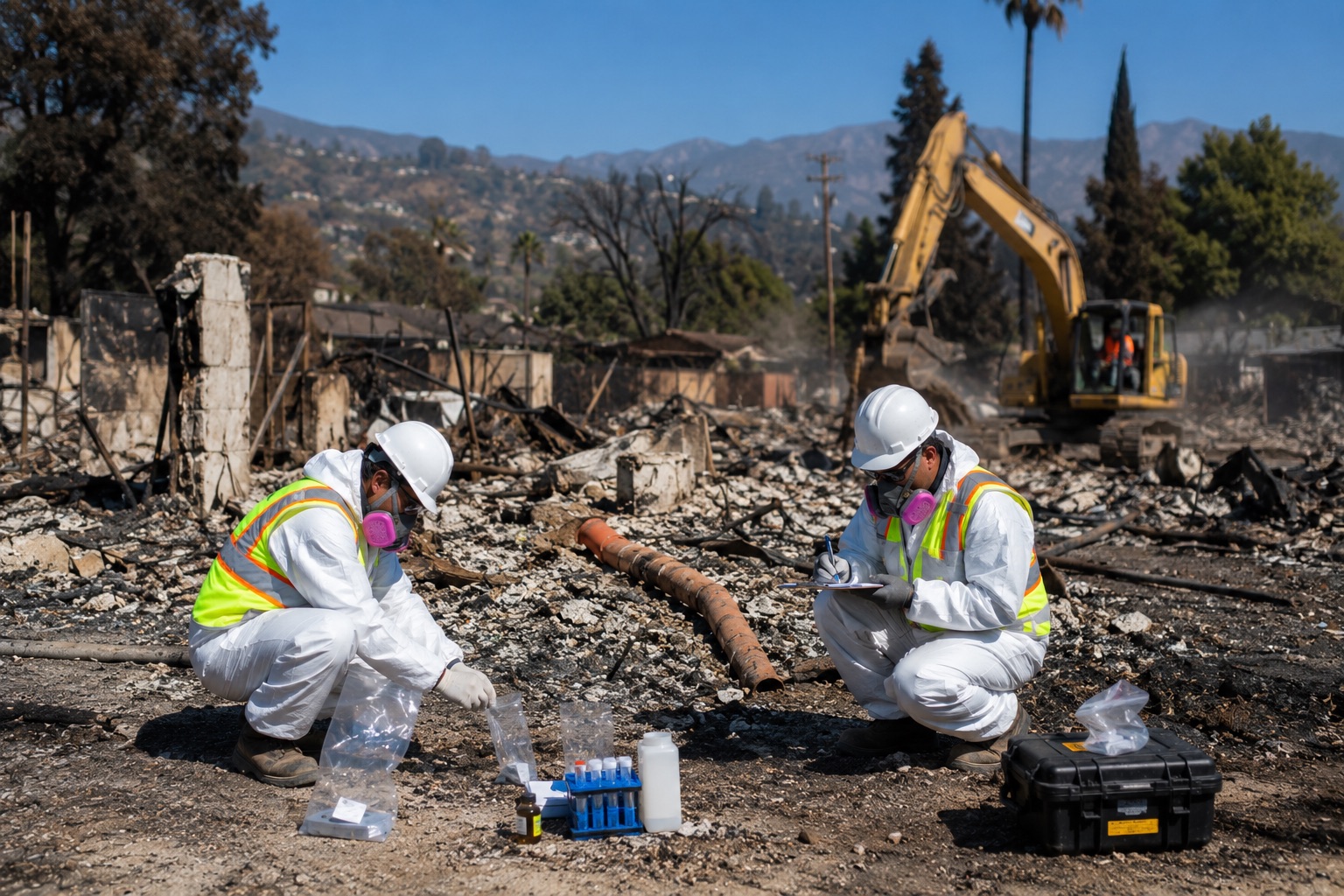
Post-Wildfires EPA Methane Cleanup and New Technologies
Introduction
Wildfires not only damage landscaping and property but also create air quality issues and soil problems. The residents must resolve the environmental issues during rebuilding before safe building can commence.
Soil contamination is a key part of the recovery from wildfires, as is methane emission. Actual and potentially heavy metals (including lead) are released from buildings and household items and fall to the ground. Landfill sites, aging infrastructure, and organic debris that produce methane can be environmental and safety problems.
California’s recent progress in the recovery from wildfires is evident. The U.S. EPA reported in May 2026 that the crews had finished 98% cleanup in the Eaton Fire burn area. The main purpose of this cleanup was to achieve Federal subsurface standards.
Fuels, wildfire, methane, and soil remediation are important for property owners and developers, engineers, and communities, for safe and sustainable rebuilding after a wildfire.
Understanding Post-Wildfire Environmental Risks
Wildfires cause massive destruction, other than what appears on the surface. Fire’s high temperature results in soil and environmental changes with contamination.
The pollutants released by fires may be a threat to people’s health and the environment. Rainwater and wind transport pollutants into water bodies and also pollute the neighboring areas.
A possible risk with wildfires is the underground systems. Underground pipelines, buried waste, and organic material are the major sources of methane production. These emissions are important for environmental recovery as methane is a powerful greenhouse gas. Trained remediation companies manage contaminated sites with proper assessments, cleanups, and remediation.
Why Soil Remediation Is Critical After Wildfires
Soil remediation is essential following wildfires for several reasons. For several reasons, soil remediation is crucial after wildfires. Soil remediation includes the identification, extraction, and treatment of contaminated soil.
Contaminated soils may contain higher levels of contamination after fire. Uncontrolled, these contaminants can impact future homebuyers, residents, and workers in restored homes. U.S. EPA, FEMA (Federal Emergency Management Agency), USACE (U.S. Army Corps of Engineers) participate in the post-wildfire soil remediation, and this fact proves its significance.
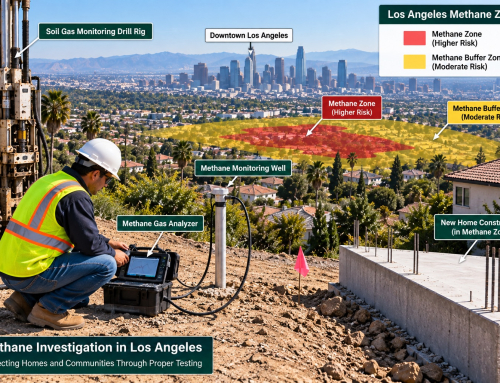
Discover how post-wildfire methane testing for properties in Los Angeles County. Learn about early detection testing, risk assessment, and safe design practices for methane soils, a common occurrence in Los Angeles. The Los Angeles Department of Building and Safety says hiring a Geotechnical Engineer or Environmental Engineer in Los Angeles is essential to your construction site safety.
Read more to find out why it’s important to retain a Geotechnical Engineer on-site for your construction projects to help properly develop a property and construction stability, along with avoiding health concerns.
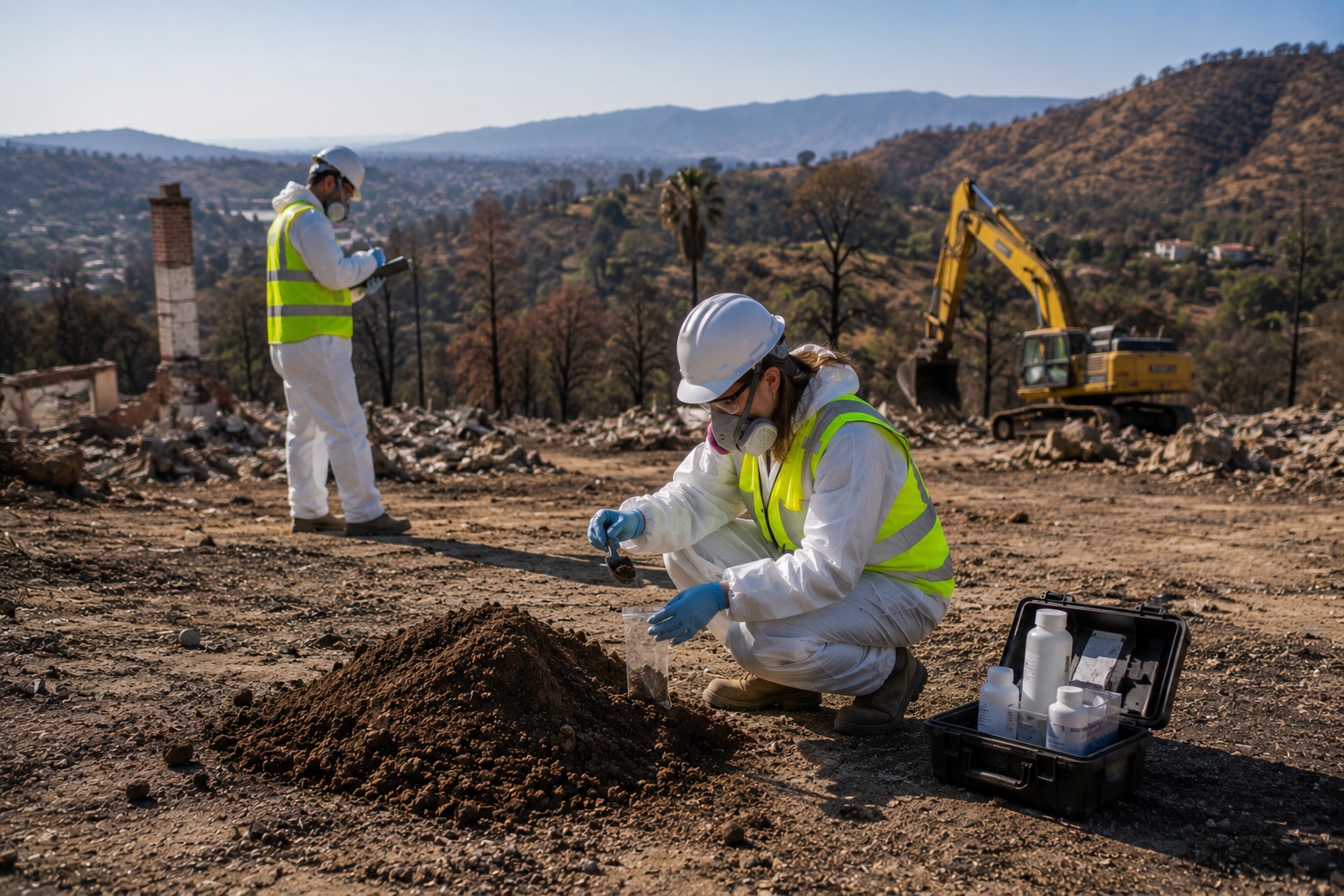
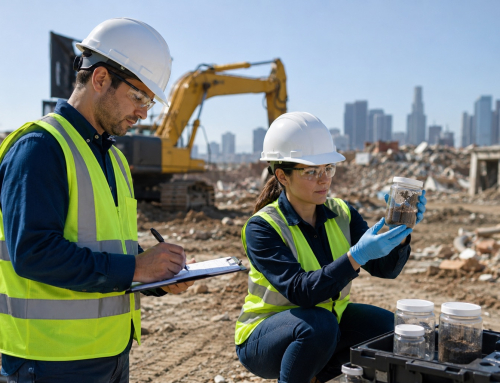
Environmental professionals in protective equipment collecting soil samples at a wildfire-damaged site while heavy equipment removes debris in the background.
Human Health Protection
Lead contamination is a major issue associated with urban wildfire. Lead exposure affects the nervous system and also results in other long-term developmental and health issues. The contaminated soil removal minimizes direct exposure and improves conditions for reconstruction.
Supporting Construction Activities
Proper soil conditions are vital to construction projects. Before foundation, retaining walls, roads, and utilities, the site needs to be clear of environmental hazards. Remediation assists in soil conditions conducive to the environment and for development.
Meeting Regulatory Requirements
Many reconstruction efforts use environmental assessments before issuing official permits. Soil remediation aids in meeting federal, state, and local requirements for property owners. Environmental cleanup also diminishes potential liabilities of contaminated properties.
EPA Success in the Eaton Fire Burn Zone
The Eaton Fire Burn Zone (EFBZ) was successful in implementing the following actions:
- The Eaton Fire caused extensive damage and concerns for soil contamination in impacted communities.
- To address this, researchers conducted environmental studies to measure contamination levels and check the results of clean-up actions.
During testing in May 2026, EPA results indicate that the cleanup meets the federal standards. Almost 98% of properties in the Eaton Fire zone have been tested by the EPA.
Soil sampling, lab testing, debris removal, and excavation of contaminated soil were key parts of the remediation process. The Eaton Fire recovery process such as LA county Recovery is also a helpful example for other wildfire response programs in California and beyond.
Common Soil Remediation Methods Used After Wildfires
After a wildfire, common soil remediation methods that are used include:
Soil Excavation and Removal
Depending on the level of contamination and site conditions, several remediation methods can be applied. They remove the excavated soil from the site.
A popular way to do this is to remove polluted soil from the impacted zones. They will remove excavated material and dispose of it at approved disposal sites. We use this technique when contamination is higher than regulatory levels.
Soil Replacement
We remove contaminated soil and then add clean fill material to the site. Replacement soil restores site conditions and assists in future construction activities. A compacted and graded soil will function as desired.
Soil Stabilization
Sometimes, treatment of contaminants does not require the removal of substantial amounts of soil. Chemical stabilization reduces pollutants, which can minimize the site disturbance and project costs.
Long-Term Monitoring
Sometimes, you need continuous environmental monitoring after remediation for satisfaction. In this regard, a periodical inspection and sampling can further confirm that the contamination level is within acceptable ranges.
Understanding Methane Emissions After Wildfires
The study of Eaton fires reviews methane emissions from wildfires and suggests ways to understand them better.
Methane is a naturally occurring gas and also forms by organic decomposition. Moreover, energy infrastructure, wastewater systems, and landfills are also possible sources.
During a wildfire, infrastructure damage, and environmental changes can increase the methane emissions. Monitoring and controlling Methane in the reconstruction process after wildfires is important. Generally, methane has two significant issues.
- Climate impact
Carbon dioxide is not as effective a greenhouse gas as methane over short time scales.
- Safety
High levels of methane gas can ignite explosion hazards in enclosed areas.
Advanced Methane Oxidation Technologies
Common practices of methane management include collection systems and flaring operations. Although they work in certain situations, they may not be effective in covering all emissions. Newly introduced technologies are under development for more options in methane oxidation reduction.
Specialized micro-organisms convert methane to carbon dioxide and water, a process known as ‘methane oxidation’. We can convert a lot of CO2s, which minimizes the greenhouse gases’ effect since methane has a much higher effect on warming.
Biological Oxidation Systems
Biofilters and bio covers rely on the naturally occurring micro-organisms to eat up the methane emissions. Usually found in systems over landfill and contaminated fields. Before methane reaches the atmosphere, the micro-organisms break it.
Engineered Oxidation Technologies
Advanced materials and optimized biological processes drive improvement in methane treatment efficiency with new engineered systems.
Research and Innovation
Engineers intend to research technologies for various environmental conditions. The University of California, Riverside, received a development $7.5 million grant for methane oxidation systems.
The objective of this research is to develop methane reduction technology for use in environmental remediation projects. The innovations in these examples have an impact on the future recovery of wildfires. It also helps in promoting sustainable community redevelopment, while cutting emissions.
Integrating Soil and Methane Remediation
Managing several issues simultaneously is best for addressing environmental recovery. cleanup methods, it shows a clearer view of site restoration. For example, one method is removal, and another is methane control.
Site Investigation
Environmental professionals start with a detailed examination of the site. Sampling programs help find contamination sources. They also evaluate the risk of contamination from methane and decide which team to send to solve the issue.
Risk Assessment
The potential human health, groundwater, air quality, and future development impacts are taken into account. This information can reduce remediation costs and can assist the owner in meeting regulatory requirements.
Recovery Planning
Long-term sustainability goals always go hand-in-hand with integrated remediation. Reducing contamination and reducing emissions of greenhouse gases simultaneously can benefit the environment. It can also help to create communities that are more resilient.
Regulatory Agencies
Cleanup standards are developed by federal, state, and local governments, and compliance is monitored. They are responsible for assuring that the remediation activities are safe for public health and the environment.
CalEPA, also known as California Environmental Protection Agency, County Department of Public Health, Resource Conservation and Recovery Act (RCRA), Department of Public Health, and Water Resources Control Board provide guidelines for methane eradication and soil remediation.
Future Trends in Wildfire Remediation
Planning for future wildfire remediation, all the way from implementation to legal and policy review!
New testing technologies can detect contaminants, enabling faster contaminant identification. Information from remote sensing systems and geographic information systems helps to inform the clean-up.
AI and environmental modeling also help engineers predict contamination patterns. They help engineers decide the best way to clean up contamination.
In the meantime, there is growing attention on sustainability problems and the appearance of low-carbon remediation technologies. The importance of Methane oxidation systems and Renewable energy treatment processes is increasing. Nature-based solutions are also gaining importance.
Such innovations will improve community recovery and limit the impact on the environment for years to come.
Conclusion
Wildfire produces environmental problems that go beyond the actual effects of fire damage. Soil damage or methane emissions can harm public health. They can also slow down rebuilding for years after a disaster.
The successful cleanup of the Eaton Fire burn zone is proof that comprehensive soil cleanup programs are highly valuable. Federal letter to local communities shows strong environmental management support for safe rebuilding and community recovery. It meets federal standards at 98% of tested properties.
Concurrently, new opportunities for reducing GHGs and benefiting environmental restoration are emerging through developments in methane oxidation technologies. However, as fire recovery continues, methane and soil cleanup plans will be significant.
Build with knowledge. Build with confidence. Build smart from the ground up.