What are Soil Compaction Test Curves & Pavement Stability Testing
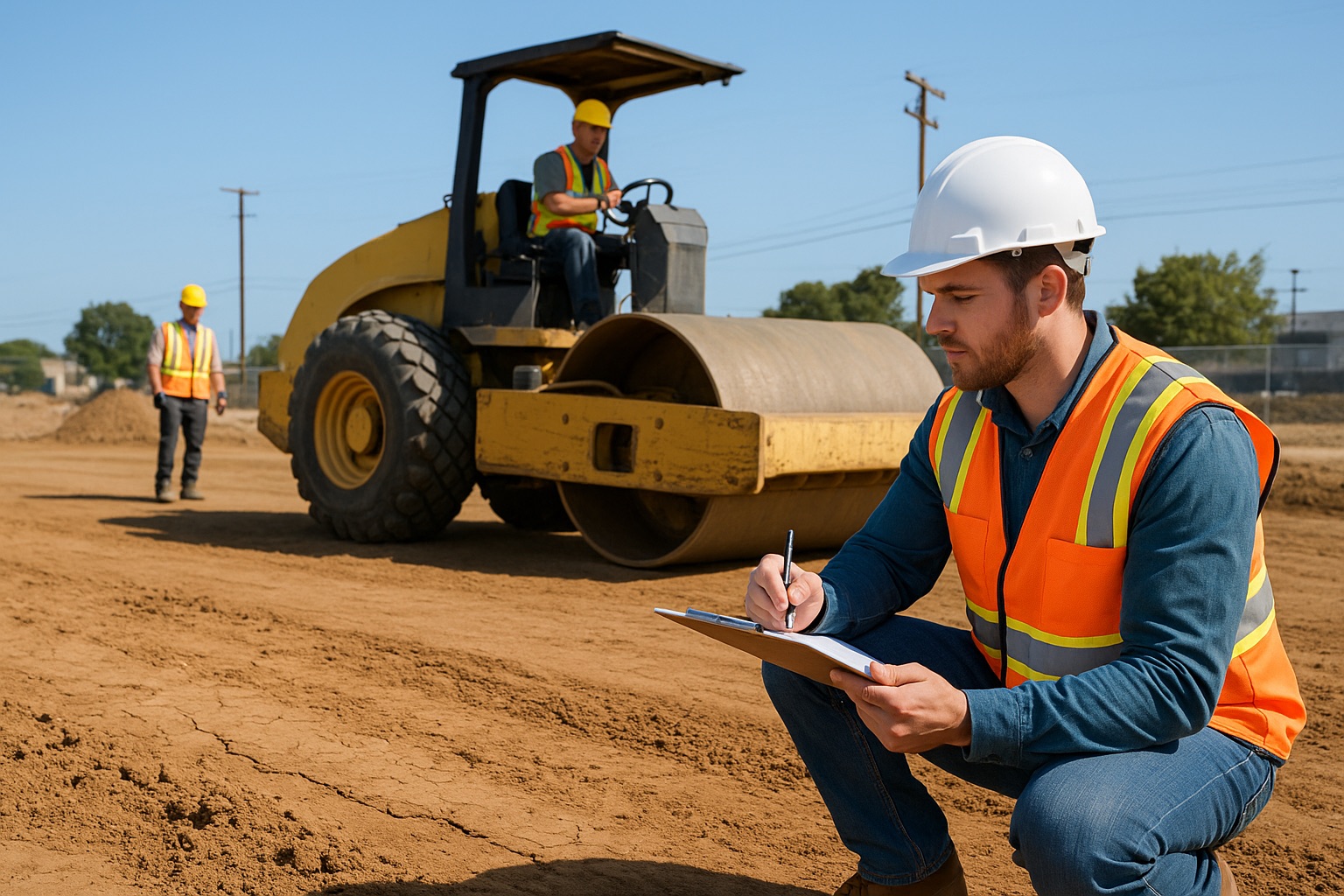
You have probably seen a heavy roller go back and forth over bare dirt before asphalt is laid in a pavement structure. It might look almost mindless, but it is not. Under that repeated roller pass is a full discipline based on curves, density, and moisture levels. It explains why some roads and driveways last decades, while others crack and dip after a few winters.
You can learn here what actually keeps construction projects going. California cares more than most places. This is because of stricter rules, and because you are responsible for certain steps. You must complete them before you can legally pour a slab.
Why This Matters More Here Than Almost Anywhere Else?
Not only is there dirt in a road project, but it is also dusty, and the dust contains small air pockets. It has an irregular density, and this irregularity needs shifting, settling, and washing away over time. When the soil under the road or foundation settles unevenly, you are left with stress in the structure, dips, and cracking. This is a last-minute nuisance to correct and can certainly be hazardous if left untreated.
Between the seismic activity, the wildfire-then-flood cycle hits certain areas almost every year, and the native soil. Expansive clay out in the Inland Empire, and the loose sandy fill near the coast. The ground behaves completely differently depending on where you’re standing.
That’s the whole reason compaction testing isn’t a suggestion here. You must obtain permits for grading, roadwork, basically anything that touches the dirt before construction starts.
What a Soil Compaction Curve Is?
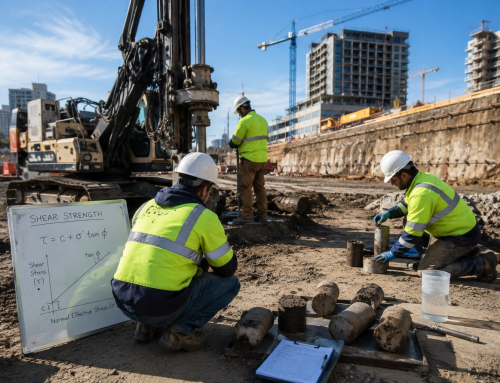
Most soil compaction curve testing uses a Proctor compaction test. Engineers take a subgrade compaction sample and perform soil compaction testing.
Most technicians use the Proctor test for compaction testing. They provide a standard amount of water and compaction effort to reduce air voids in the soil sample.
Then weigh and measure each one and plot the results. The curve shows density changes as moisture changes. Start dry, add water, and density climbs, because the water helps particles slide into tighter arrangements.
At some point, at the optimal moisture content, you hit the peak, called the maximum dry density. By adding water after OMC, the density actually starts dropping again. The extra water occupies space that soil particles would otherwise fill.
What that one curve tells a contractor is simple: the exact amount of water required for the best compaction results. If you miss this laboratory test, you will not achieve the required density.
Checking Compaction in the Field
Knowing the target density from a lab curve is only half the job. Somebody needs to confirm the soil’s actual compaction level on site. Relative compaction is the ratio of the lab-obtained to actual site compaction. Engineers generally express relative compaction as a percentage.
In California, projects typically require 90% to 95% relative compaction. However, it depends on the filling material and depth. Caltrans runs the standardized testing here. California Test 216 is for lab compaction.
California Test 231 for field verification uses nuclear density gauges. The gauges measure density and moisture without digging the compacted soil back up and destroying it. Field crews generally lean on one of two methods. Nuclear density gauges are fast and non-destructive, estimating density based on how radiation scatters through the soil.
The sand cone test procedure is an older, but more hands-on approach. You physically measure the volume and weight of an excavated sample. Different tools, same question: does this soil actually match what the lab curve said it should be?
Where Pavement Stability Testing Comes In?
Compaction tells you how dense the soil is. It doesn’t tell you how well that soil, and everything built on top of it, will actually hold up under years of traffic. The California-specific tool most people run into here is the R-value test. Caltrans developed it and still uses it to measure how much a soil resists deforming under load.
The result of this test is directly used to design pavement thickness. The thicker the asphalt needed, the lower the subgrade quality or strength. Soils with lower R-value require a thicker asphalt layer to provide adequate support. Similarly, soils with higher R-value require a thinner asphalt layer.
Other tests are also used alongside R-value. For example, California Bearing Ratio checks subgrade strength for roads and airport pavements. Plate load tests measure how much a soil surface actually deflects under a controlled load, which is a nice real-world strength, precision, and accuracy check. Atterberg limits classify soil types and predict soil behavior – For example: wet soil versus dry soil – and the potential effects of those conditions for a soil compaction test in Los Angeles.
Compaction curves and other tests collectively show engineers a complete soil picture. Details include the required soil density, soil behavior under traffic loads, and required pavement thickness.
Our soil testing and geotechnical laboratory services in Los Angeles help achieve your construction goals by avoiding risky project decisions that can cause massive construction issues. Properly framed inspections safeguard schedules, jobs and your project budgets.
Enforcing Authority in Southern California
None of these runs on the honor system. Several different agencies have a say depending on where you’re building and what kind of project it is.
Caltrans sets the statewide standard for highway and transportation earthwork. LADBS wants compaction reports and soils engineering sign-off before issuing a grading permit. For fills, hillside builds, or anything tied to post-wildfire rebuilding, these tests are a must.
LA County Public Works runs a similar process, with continuous inspection required for deep or steep fill slopes. LA Metro applies its own pavement and subgrade testing standards to transit corridor and rail work across the region.
The California Geological Survey, under the state’s Department of Conservation, supplies the geologic and soil hazard mapping. The site-specific engineering decisions lean on this map, particularly for expansive soil or landslide-risk zones.
California building standards set the baseline, and each local jurisdiction then adds its own rules on top. Engineers adopt the standards through the California Building Standards Commission,
Since these requirements can change by city, county, and project type, it is worth a call. Call the office that permits your specific site. Do not assume the last project rules still apply to the new one.
Find out why every property undergoing construction in Los Angeles requires soils report and soil analysis as it can heavily affect your construction, especially when building a permitted foundation for a property in Southern California where underground corrosion can cost you more than just money, it can cost your life!
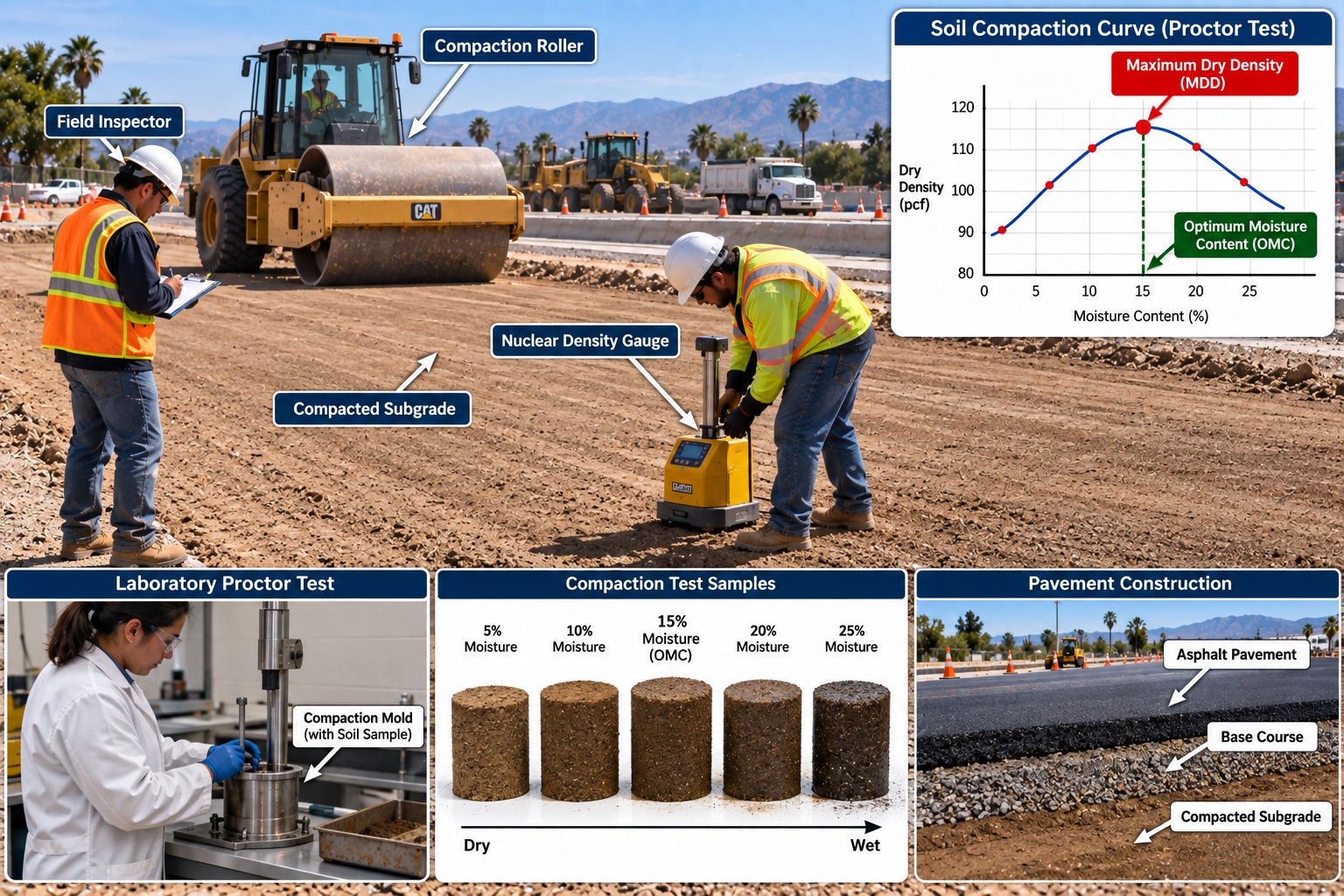
Soil compaction testing for California road construction, showing a Proctor compaction curve, optimum moisture content, maximum dry density, field nuclear density testing, compacted subgrade, and pavement construction.
What If You Are the One Building Something?
Hire a geotechnical or soils engineer to run a compaction curve early. Do it during the site investigation phase if possible. This helps you know the target density and moisture range before work starts.
You need to budget your time and money for field checks. Inspectors will test relative compaction at several points and depths. Failure will require re-compaction, and that will always be more expensive than doing it right at first.
If your project involves roads or real traffic, do not skip pavement testing. R-value or CBR results can change the needed pavement thickness. Skipping tests may lead to cracking or rutting later.
Check with the agency that permits your project early. The compaction testing procedures differ between the City of LA, the County, and your municipality.
Conclusion
Strip away the jargon, and this topic comes down to one idea. Get the soil to the right density and moisture. Then you need to prove that it can support the desired building load.
In a place as geologically varied and seismically active as Southern California, skipping that is not just a risk. Bring in a geotechnical engineer. Confirm requirements with the right agency before you start. This helps you avoid headaches mid-project.
F.A.Q.s
What’s the difference between a standard and modified Proctor test?
Standard and modified Proctor tests differ because of the load. Modified applies more load to match heavier modern equipment. That’s why Caltrans and highway work usually rely on it.
How often do we need soil retesting during a project?
Soil needs testing throughout the project. Crews check it at intervals as fill is placed layer by layer.
What happens if a spot fails the test?
If soil fails the test, it will get fixed immediately with any method. Either it will be recompacted with adjusted moisture or replaced, then retested until it passes.
Do I need a soils report for a small residential job?
Many cities and counties, including LA and LA County, still require soil reports for even small residential jobs. They require it mainly for fill, hillside work, or higher-risk ground, even on regular house lots.
Does repaving a driveway require retesting?
You can skip retesting only if the existing pavement is genuinely stable. Conditions like new base material, real excavation, or past cracking require retesting.
Build with knowledge. Build with confidence. Build smart from the ground up.