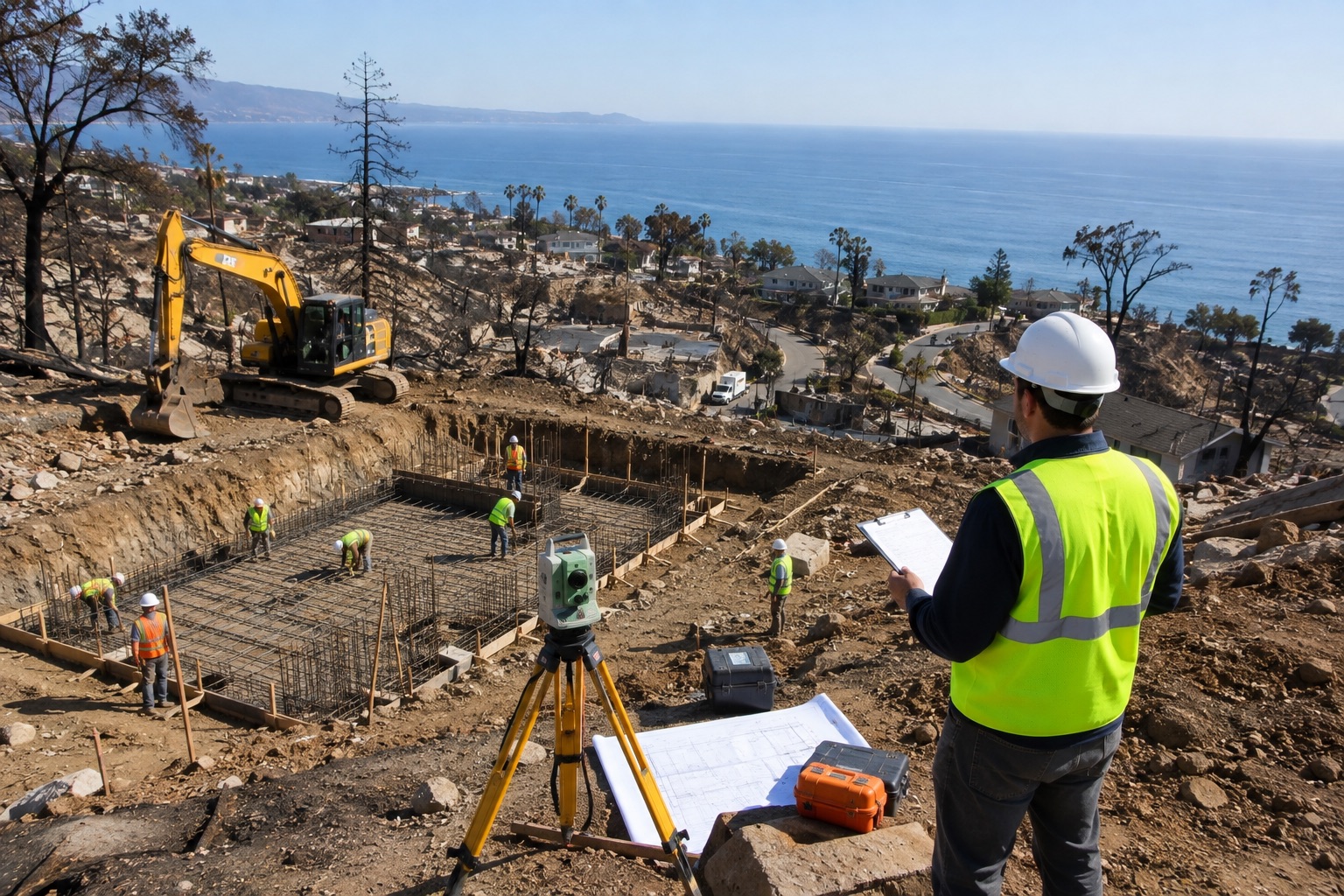
Geotechnical Drilling Services in Los Angeles: What to Expect On-Site
Thousands of homes were destroyed during the Palisades and Eaton fires in January 2025 in the most difficult terrain in Los Angeles. These include coastal bluffs, canyon edges and steep hillside lots. Now, a year on and 12,000 rebuilding projects still under the permitting process, the rebuild is a massive multi-year process.
For every project, the same question comes before architecture, framing, anything above the ground: “What does the soil require”?
Fire doesn’t just burn structures in this case, but it changes the ground itself, and Los Angeles’ rebuild rules recognize that.
This article explains when you need a soils report and what the special fire-area zones mean. It also elaborates whether old foundation reuse after fire is possible, and how to get through the geotechnical side of you rebuild without losing months.
Do You Need a Soils Report to Rebuild?
Here’s the short version of the quick answer to this important question:
Flat lot, outside any geologically sensitive area
You often will not need a full new geology and soils testing report for a like-for-like rebuild. Especially if a previously approved report already covers seismic hazards for your site, you don’t need a fresh one.
Hillside lot, geologically sensitive area, or PGRAZ zone
You may require a combined geology and soils report, and it must be approved by the LADBS Grading Division before the permitting process.
Any grading on a designated hillside lot requires soils report
It is classified as “engineered grading” under the city code no matter how small the volume is. It means engineering plans and geotechnical involvement.
Los Angeles has streamlined like-for-like rebuilds through emergency executive orders. The eligible rebuild projects skip Coastal Review and Environmental Review entirely, and homeowners can even add an ADU. However, there is one thing the streamlining never waives, which is geotechnical safety review. Property owners need to have a soil inspection either way.
Our soil testing and geotechnical laboratory services in Los Angeles help achieve your construction goals by avoiding risky project decisions that can cause massive construction issues. Properly framed inspections safeguard schedules, jobs and your project budgets.
How Fire Changes the Ground Beneath You
Why does a burned lot need special soil attention when the same lot was fine for decades? Because intense fire genuinely changes soil behavior.
Find out why every property undergoing construction in Los Angeles requires soils report and soil analysis as it can heavily affect your construction, especially when building a permitted foundation for a property in Southern California where underground corrosion can cost you more than just money, it can cost your life!
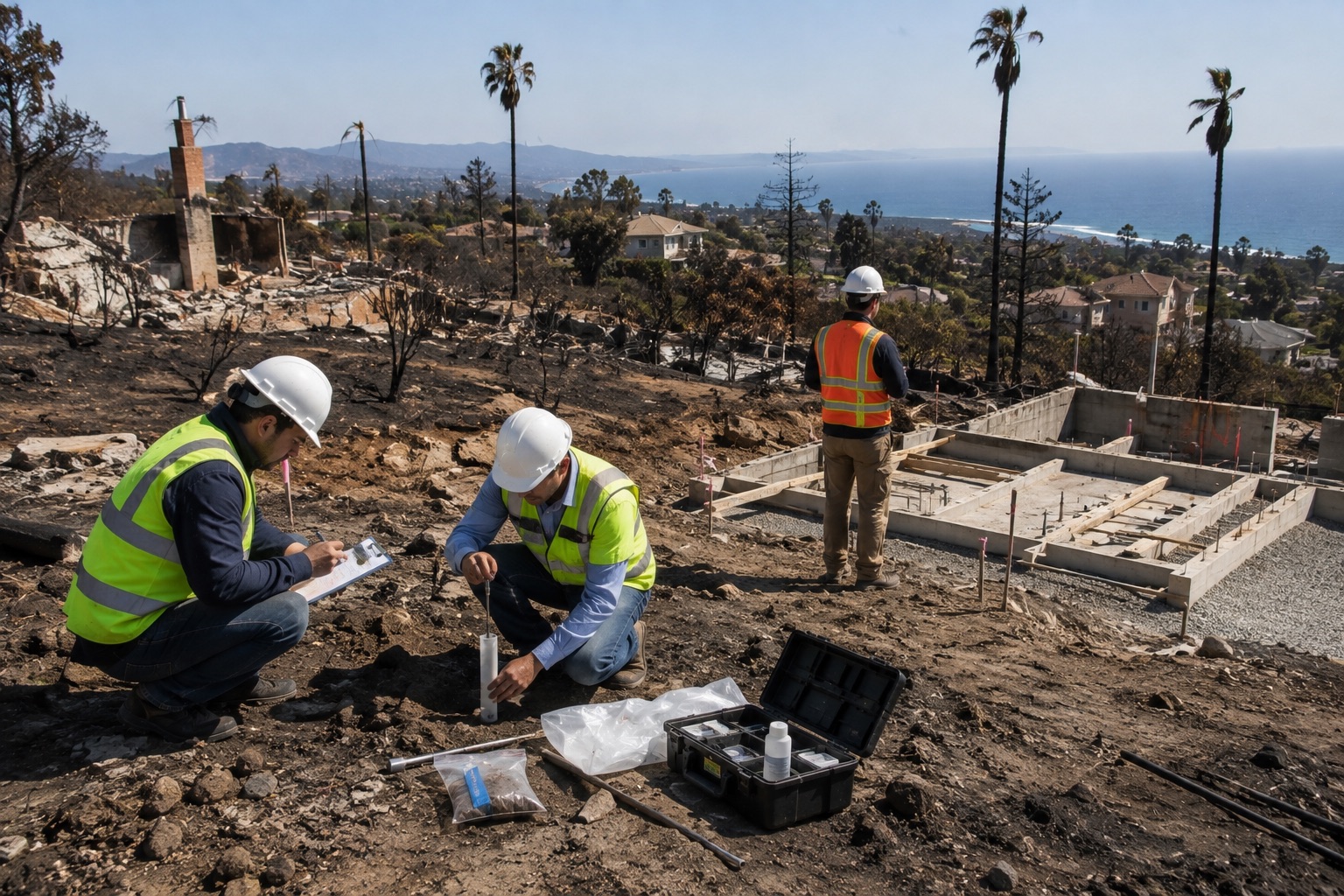
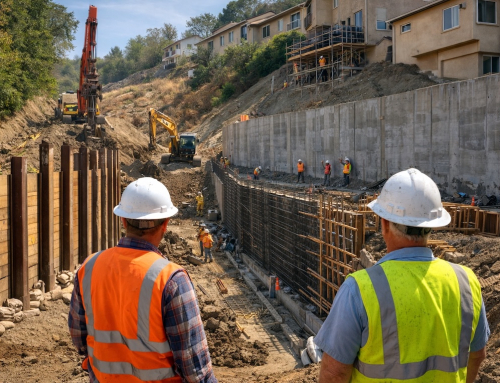
Geotechnical engineers conduct post-wildfire soil investigations on a fire-damaged Los Angeles hillside to assess foundation reuse, slope stability, burned soil conditions, and geotechnical requirements before residential rebuilding begins.
Hydrophobic Soil Layers
Hydrophobic (Water-Repellent) Soil Layers are layers in soils that are repellent to water. A thin, waxy layer may form in the soil under extreme heat to resist absorbing water. The previously percolating rain now flows out on the surface, and forms erosion gully systems and debris flows. The U.S. Geological Survey keeps track of burn areas because debris flows are the biggest danger during the first few rainy seasons following a fire.
Lost Vegetation and Root Strength
On hillsides, plant roots act like natural soil reinforcement. Once fire has destroyed the vegetation, it will lose that reinforcement the following years. Even if nothing moves on a slope, it may have a reduced factor of safety now as compared to 2024. Establishing vegetation can take years, while burn scars will be unstable for that period of time.
Heat-Damaged Foundations and Disturbed Ground
A single-family home’s fire can push concrete slabs and footings past temperatures. It may damage the concrete itself, produce surface spalling, microcracking, and weakened reinforcement bond. On top of that, the debris removal process disturbs the upper soil.
It can affect any old fill under the home, so civil engineers need to evaluate this before building again. Hazard mapping and post-fire guidance produced by the California Geological Survey directly impacts these evaluations.
The Regulatory Framework
City of Los Angeles (Palisades): LADBS Rules
Rebuilds in the Palisades are under the jurisdiction of the https://dbs.lacity.gov/ Los Angeles Department of Building and Safety. It has issued a dedicated information bulletin — P/BC 2026-157, “Compaction, Soils and Geological Reports for Rebuilding in the Palisades Fire Area” (reissued in February 2026). It exactly lays out which properties need what.
Key points from the city’s framework for Palisades Fire rebuild soils report, summarized on the LA Strong recovery portal:
- Homes in geologically sensitive areas require a LADBS geology and soils report. You must submit it to the LADBS Grading Section, addressing slope stability and risk mitigation.
- Geologically sensitive areas do not qualify for the streamlined Self-Certification program — those projects go through full geotechnical review.
- All rebuilds must meet the 2022 California Building Code as amended by the city.
- In some cases, compaction reports can be self-certified by the project’s geotechnical engineer. Then it can be submitted to the Grading Division for the record. Hence, it is one of several time-saving measures built into the rebuild rules.
PGRAZ Zones: The Special Fire-Area Designations
LADBS mapped the Palisades fire area into PGRAZ zones. It is a designated geologic review area with its own report requirements, published as zone maps and address lists in the information bulletin. Properties in the mapped orange and yellow zones face defined geotechnical report requirements before rebuilding.
One-point trips up many owners that fire damage does not waive PGRAZ requirements. If anything, the fire is why the zones exist. Burned hillsides act differently. The city wants a licensed professional to review that, not assume it away.
LA County Eaton Fire rebuild requirements
Rebuilds in unincorporated Altadena and other county areas go through LA County’s recovery program and County Building and Safety. The county runs its own streamlined rebuild pathway and tracks thousands of projects through a public permitting dashboard.
The geotechnical logic is the same for hillside and hazard-zone properties that need soils and geology reports. It states that flat and low-risk lots move faster.
Los Angeles Emergency Executive Orders
Mayoral Emergency Executive Orders 1 and 8 created the fast lane. The eligible like-for-like rebuilds (plus up to 10% larger) skip discretionary reviews. Similarly, ADUs can be permitted before or alongside the main home. The process got streamlined, but structural and geotechnical code compliance still applies in full.
Can You Reuse Your Existing Foundation?
This is one of the most common and most hopeful questions after a fire. A quick answer to it is “sometimes”.
If a California-licensed engineer affirms the satisfactory condition, the city permits reuse of an existing slab and foundation. You can submit it with documentation (observations and possibly testing) to LADBS for approval. For properties in PGRAZ zones, you may require an additional soil or geotechnical investigation for a reuse permit.
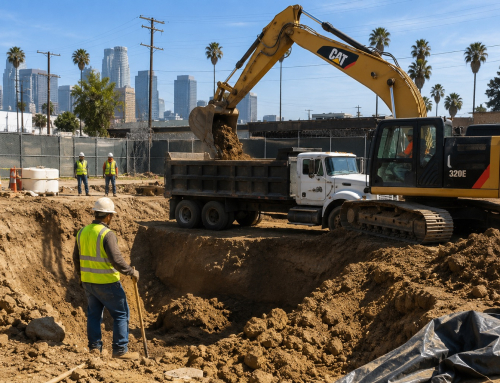
In practice, many foundations don’t pass the evaluation. Structure fires burn hot enough to damage concrete, slabs crack during collapse, and debris removal. So, the modern code requirements often don’t match a 1960s footing anyway practically.
There is also a specific rule for old ground, i.e., fills placed before April 25, 1963. The geotechnical engineer must investigate it unless the consultants determine the fill is suitable for the new construction. The honest advice most engineers give is to hope for reuse, budget for replacement.
What does a Fire-Rebuild Geotechnical Investigation Include?
If your lot needs a report, here are the steps you actually need to follow:
Site reconnaissance
The geotechnical engineer and geologist observe the property, mapping slopes and burn severity, erosion channels, drainage changes, and signs of ground movement.
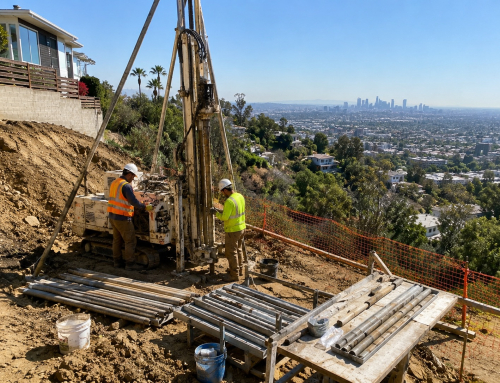
Geotechnical Drilling Company in Los Angeles
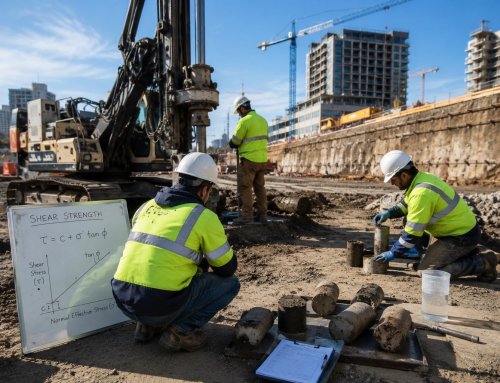
Borings or test pits sample the soil below the disturbed surface. The lab then measures the properties that drive design, i.e., density, moisture, and shear strength. These are the property that ultimately controls bearing capacity and slope stability. Compaction testing checks ground disturbed by debris removal.
Hazard Evaluation
Slope stability, post-fire debris flow potential, liquefaction, and seismic hazards are addressed. The sites in proximity to the active faults necessitate further geologic study, in coordination with LADBS geologists.
The Report and Certifications
You would need to compile everything into a combined geology and soils report following LADBS guidelines. It is then submitted to the Grading Division for review. After grading, compaction reports document that fills were placed correctly, self-certified by the soils engineer where the rules allow.
Timeline and Cost Realities
Designing before you have it invites expensive redesign. The single biggest mistake in fire rebuilds is treating geotechnical work as a box to check after design. It belongs to foundation type, grading plan, drainage, and even the buildable footprint all depend on what the soils report says.
Budget-wise, a residential geotechnical investigation typically runs a small fraction of one percent of total rebuild cost. Compared with re-engineering a foundation mid-permit, or repairing a slope failure after the first wet winter, it is the cheapest insurance in the entire project.
Practical Steps for Homeowners
Confirm your zone status first
Check whether your address falls in a PGRAZ zone or geologically sensitive area before hiring designers — it changes your entire permitting path.
Hire local experience
Choose a California-licensed geotechnical engineer like Marshall Geoscience who regularly works with LADBS or County Building and Safety. Familiarity with the fire-area bulletins saves review cycles and Marshall Geoscience is leading the charge on the fire rebuilding soils reports in Los Angeles.
Hire local experience
Check whether your address falls in a PGRAZ zone or geologically sensitive area before hiring designers — it changes your entire permitting path.
Keep your debris-removal records
Documentation from the Phase 2 cleanup helps the soils engineer understand what was disturbed and how deep.
Ask About Foundation Reuse Early
A quick evaluation up front tells you whether to design around the old slab or plan a fresh start.
Consider Possible Water Usage
Until vegetation returns, keep runoff water controlled on and around your property in Los Angeles; erosion protection now prevents bigger problems later, especially areas heavily affected by Liquefaction in LA.
Conclusion
Rebuilding after the LA fires starts below grade. The flames changed the soil, its strength, its drainage, its stability. The city and county have written rules to face that reality, and not to slow you down.
A thorough geotechnical investigation is not the obstacle between you and your permit. However, if you do it early, it is the fastest and safest route through it.
If you’re rebuilding in the Palisades, Altadena, or any fire-affected hillside area, bring a licensed geotechnical engineer onto your team before the first drawing is made. Keep solid ground first and everything else follows.
Build with knowledge. Build with confidence. Build smart from the ground up.