Soil Shear Strength: Why It Determines What You Can Build
Most people think a construction project lives or die by the materials above ground, i.e, the steel, the concrete, the design. But experienced engineers know the real gatekeeper is what’s underneath. Specifically, it is a single soil property factor that quietly controls every decision from foundation to slope angle to wall design.
That property factor is soil shear strength during soil testing, and if you have never heard of it, you have almost certainly felt its consequences.
What Is Soil Shear Strength?
Soil shear strength is simply the soil’s ability to resist sliding along internal surfaces within itself. When load is applied, soil doesn’t behave like a rock. Its soil particles want to slide past each other. When they run out of resistance to do that, the soil mass moves, and whatever is sitting on top moves with it.
This is why geotechnical engineers say soils “fail in shear.” Almost every ground failure, such as bearing failures, landslides, and wall collapses, is fundamentally shear. Understanding where shear strength comes from, and how to measure it, is the foundation of all soil mechanics.
Where Shear Strength Comes From?
Every soil gets its strength from two sources — and every soil has some mix of both.
Cohesion
Cohesion is the natural stickiness between soil particles. Clay particles are tiny and electrically charged. This means they bond together even without any external load pressing on them. That’s why you can cut a clean vertical face in stiff clay, and it holds for a while.
This is why cohesion belongs mainly to clays. However, the apparent cohesion of sand particles is due to moisture tension, but when it dries up, it loses adhesion.
Friction Angle
The friction angle (φ) describes the interlocking and frictional resistance between particles when a load presses them together. Sands and gravels rely almost entirely on this. The angle is greater, the rougher and more densely packed the grains. Typically, loose sand is around 28°, and well-graded dense gravels can be over 40°.
Geotechnical engineers bring both into play in the Mohr-Coulomb equation:
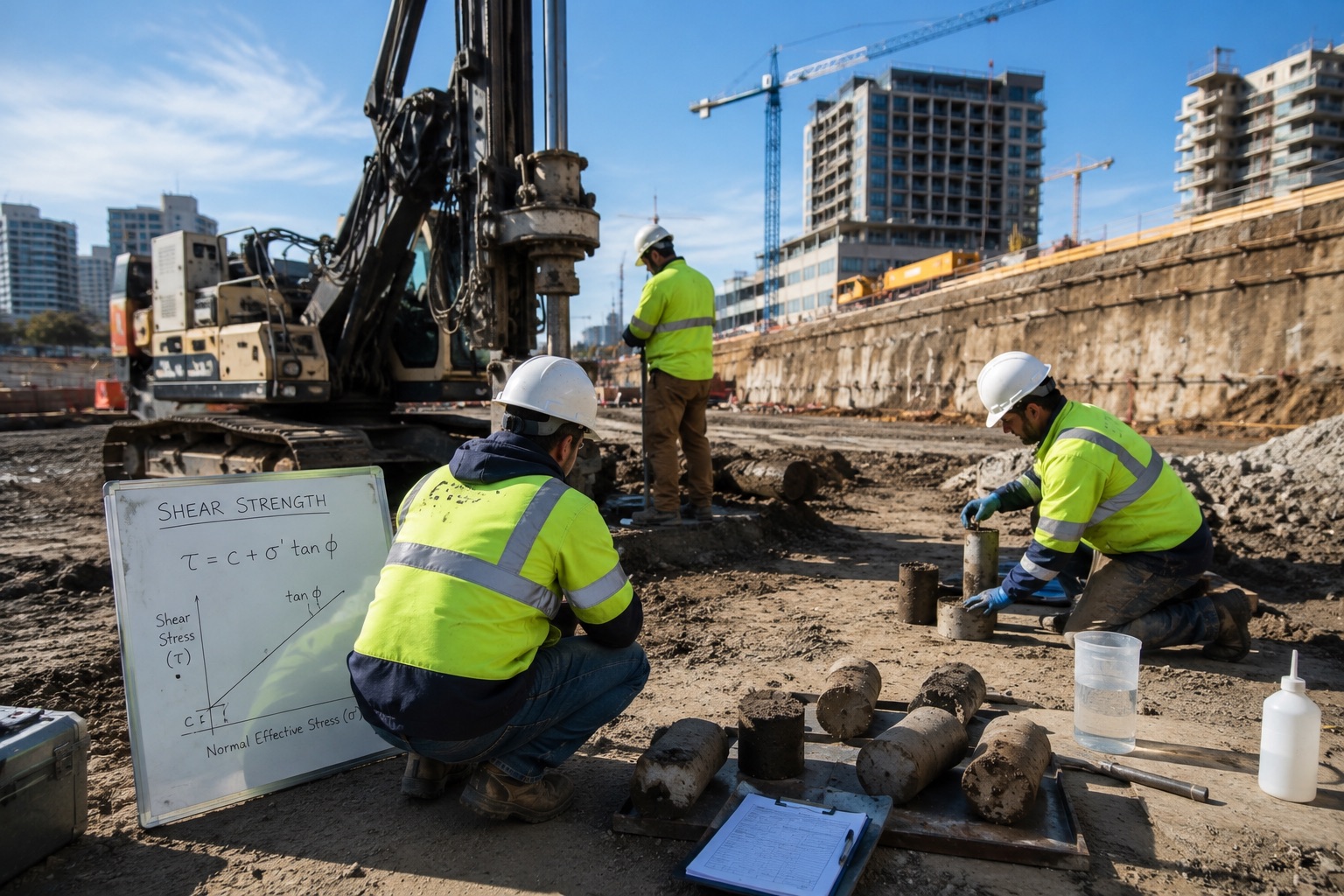
τ = c + σ’ tan φ
Where τ is shear strength, c is cohesion, σ’ is effective stress, and φ is the friction angle. More confining pressure means more frictional resistance. This is one reason deeper soil is generally stronger than soil near the surface.
Marshall Geoscience has the top soil shear strength testing and geotechnical laboratory services in Los Angeles help achieve your construction goals by avoiding risky project decisions that can cause massive construction issues. Properly framed inspections safeguard schedules, jobs and your project budgets.
Why Water Changes Everything?
Here’s where soil mechanics gets interesting — and where most failures actually originate.
The frictional strength in soil doesn’t come from total stress. It comes from effective stress — the stress that the soil skeleton actually carries after subtracting water pressure. Karl Terzaghi, the father of modern soil mechanics, described it simply:
Effective Stress = Total Stress − Pore Water Pressure
When the water table rises, or rain soaks into a slope, pore water pressure increases. Rising pore pressures push soil particles apart, reducing effective stress and directly reducing shear strength. This is the mechanism behind landslides. Monitoring rainfall-induced slope failures is therefore a public safety concern, and the U.S. Geological Survey (USGS) monitors it.
Water also explains the different behavior of clay in the short term versus the long term:
- Undrained (short-term): Load clay quickly, and trapped water can’t escape. The clay resists with its undrained strength, which often governs during construction itself.
- Drained (long-term): Water slowly drains out over months or longer; pore pressures rebalance; the frictional component takes over. A clay slope that stands perfectly today can fail years later as conditions change.
Engineers must check both cases on every construction project involving clay. Missing one of them is how projects fail long after everyone has moved on.
Find out why every property undergoing construction in Los Angeles requires soils report and soil shear strength test as it can heavily affect your construction, especially when building a permitted foundation for a property in Southern California where underground corrosion can cost you more than just money, it can cost your life!
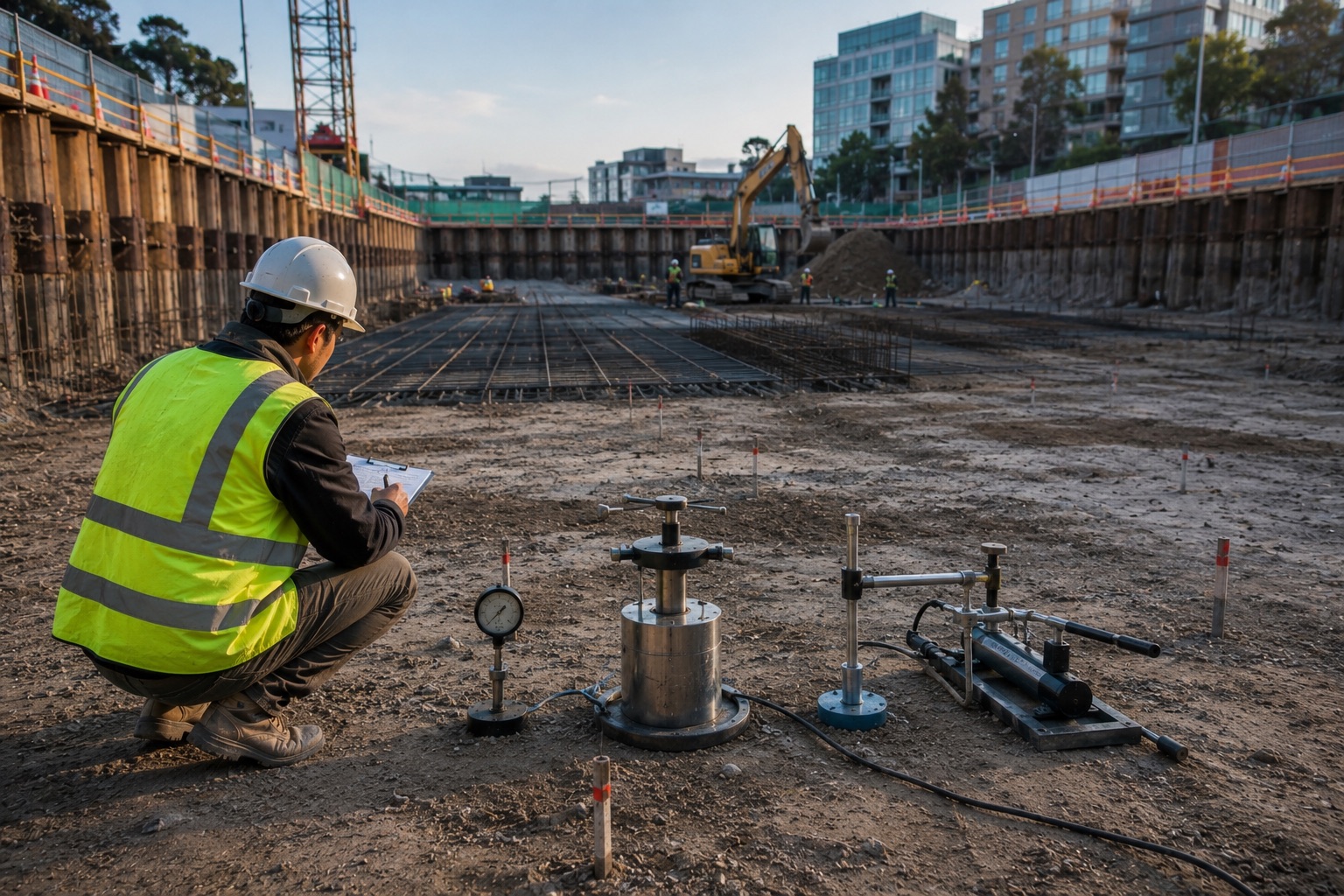
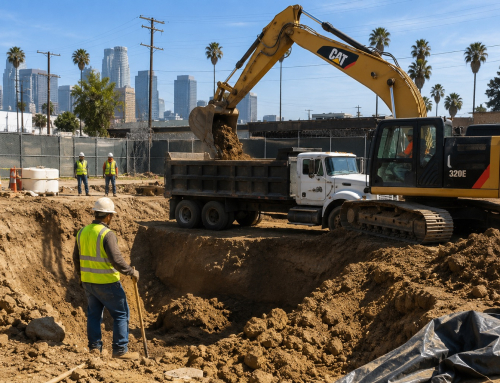
Geotechnical engineers perform in-situ soil testing inside a deep foundation excavation to evaluate soil shear strength, bearing capacity, and ground stability before foundation construction begins.
How Engineers Actually Measure It?
You can’t design on assumptions. Shear strength has to be measured as part of a proper geotechnical investigation in the field and in the lab. Here are the methods that matter.
Field Tests
SPT – Standard Penetration Test
A weighted hammer drives a sampler into a borehole, and the blow count gives a practical index of soil density and strength. It is simple, economical, and the most widely used method.
CPT- Cone Penetration Test
An instrumented cone is pushed continuously into the ground while resistance is recorded in real time. Faster and more detailed than SPT, and particularly well-suited to soft soils where SPT resolution is limited.
Vane Shear Test
A four-bladed vane is rotated in soft clay to directly measure undrained shear strength in place. Reliable, straightforward, and doesn’t require bringing a soil sample to the surface first.
Laboratory Testing
Direct Shear Test
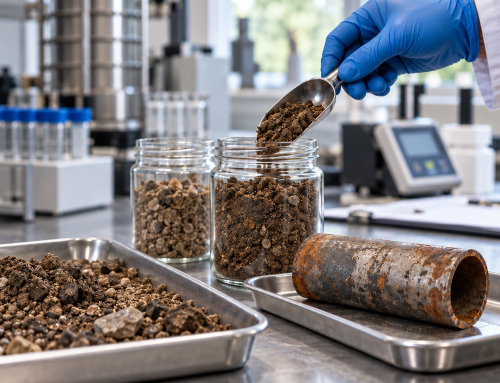
A soil sample sits in a split box, and the top half is pushed sideways until the sample shears. Clean, direct results for cohesion and friction angle — which is why it remains a staple of routine laboratory testing.
Triaxial Test
A cylindrical sample is placed in a fluid pressure chamber and loaded vertically until failure. The triaxial test is the most versatile and controlled option available. You can control drainage conditions, and confining pressures can be set to replicate actual field conditions. For critical foundation design or slope stability work, this is usually the test that matters most.
Unconfined Compression Test
It is a quick test for clay. A cylindrical sample is loaded vertically without any confinement until it fails. Gives an approximate undrained strength rapidly, which is useful for preliminary assessments.
Why Do These Numbers Control What You Can Build?
Typical values engineers work with:
| Soil Type | Cohesion (c) | Friction Angle (φ) |
| Loose sand | ~0 | 28–30° |
| Dense sand | ~0 | 35–40° |
| Soft clay | 10–25 kPa | ~0 (undrained) |
| Stiff clay | 50–100+ kPa | ~0 (undrained) |
These aren’t just academic numbers — they feed directly into every design calculation that follows.
Bearing Capacity and Foundation Design
Bearing capacity
The load the ground can carry without failing is calculated directly from cohesion and friction angle. Strong soil means compact, economical spread footings. Weak soil means oversized footings, mat foundations, or deep foundation systems driven down to better material.
A site with soft clays and low shear strength can completely transform a project budget. What should be a simple footing job can become a pile-driving operation that costs several times more. The Federal Highway Administration (FHWA) builds its entire foundation design guidance around these strength parameters for exactly this reason.
Slope Stability
Every cut, fill, and embankment is a balance between gravity pulling the soil downhill and shear strength holding it in place. Engineers express this as a factor of safety — resisting strength divided by driving forces. A high friction angle allows slopes as steep as 1.5H:1V. Soft or wet clay may require slopes flatter than 3H:1V, or reinforcement to make them workable at all.
Slope stability analysis is not a task that can be copied and pasted from site to site. Even the same geometry will not work in dense sand and saturated clay.
Retaining Walls and Excavations
Lateral earth pressure is the force soil pushes against a wall. It depends heavily on the friction angle of the retained soil. Lower φ values translate directly to higher wall forces. It means thicker walls, larger footings, more tiebacks, and higher costs.
Retaining walls in soft clay are among the most challenging problems in applied soil mechanics. In soft ground, excavation creates a risk of base heave. The soil essentially tries to flow back into the cut from beneath.
Long-Term Settlement and Behavior
Weak soils don’t always fail suddenly. They creep and consolidate for years, causing structures to settle unevenly and progressively. A warehouse floor that’s perfectly level at handover can develop differential settlement significant enough to cause structural problems a decade later.
Proper shear strength testing during the geotechnical investigation identifies these soils early. The response options are still cost-effective, such as preloading, ground improvement, bypassing the weak layer with a deep foundation, or redesigning the structure entirely.
What Happens When It Gets Ignored
The Leaning Tower of Pisa is the world’s most famous shear strength lesson. It was built on soft, uneven clay that began failing during construction in the 1170s.
The cost of a geotechnical investigation is typically less than one percent of a project’s total budget. The cost of foundation repair routinely exceeds the cost of original construction. Organizations like the ASCE Geo-Institute and the USDA Natural Resources Conservation Service publish resources on exactly this gap. It remains a persistent problem across the industry.
Points to Ponder
- Always commission a geotechnical report before design begins: it is the least expensive risk management available on any construction project
- Take seriously the conditions found at high-risk sites: soft clay, high water, sloping sites, old uncompacted fill, and sites near water.
- Poor soil can be overcome: compaction, drainage improvement, soil stabilization, geosynthetics, deep foundation systems are all options that can overcome poor soil when identified early.
- Always consider water management: irrigation against retaining walls, blocked ditches and broken drains all contribute to an increase in pore pressure and decrease in shear strength over time.
Geotechnical Drilling Company in Los Angeles
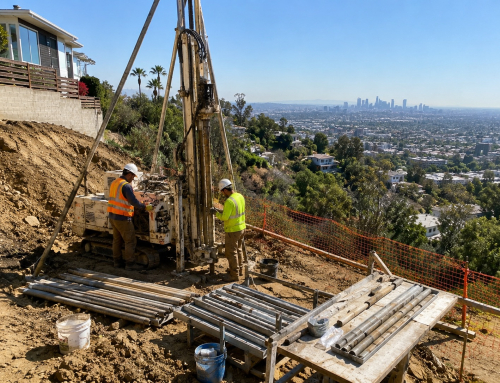
Borings or test pits sample the soil below the disturbed surface. The lab then measures the properties that drive design, i.e., density, moisture, and shear strength. These are the property that ultimately controls bearing capacity and slope stability. Compaction testing checks ground disturbed by debris removal.
Timeline and Cost Realities
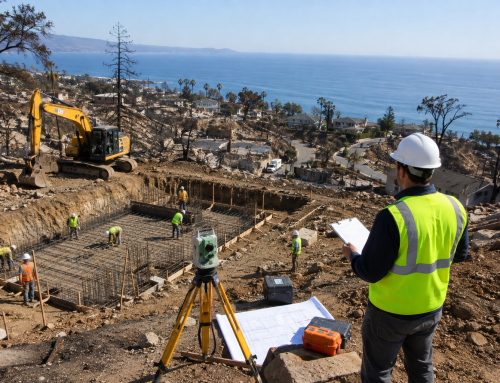
Designing before you have it invites expensive redesign. The single biggest mistake in fire rebuilds is treating geotechnical work as a box to check after design. It belongs to foundation type, grading plan, drainage, and even the buildable footprint all depend on what the soils report says.
Budget-wise, a residential geotechnical investigation typically runs a small fraction of one percent of total rebuild cost. Compared with re-engineering a foundation mid-permit, or repairing a slope failure after the first wet winter, it is the cheapest insurance in the entire project.
Hire local experience
A quick evaluation up front tells you whether to design around the old slab or plan a fresh start.
The Bottom Line
Soil shear strength is the gatekeeper of every construction project. It determines your foundation type and cost, the steepness of your slopes, the design of your retaining walls, and the long-term behavior of everything you build.
You can’t design soil the way you design a beam. Every site is different, every soil profile is different, and the only way to know what you’re working with is to measure it properly and respect what the numbers say. Contact us today to get started at Marshall Geoscience.
Build with knowledge. Build with confidence. Build smart from the ground up.