Geotechnical Drilling Services in Los Angeles: What to Expect On-Site
When you’re about to construct something in LA what takes place underground is as crucial as what your architect draws on top of it. So, between earthquake faults, hillside lots and soil which is expanding or contracting with the seasons, LA presents some real challenge to builders.
This is why geotechnical drilling services in Los Angeles projects will virtually always begin with. Before putting down one yard of concrete you must ascertain existing conditions down there.
If you have never drill rig ever visit your property. So, here’s a walk-through of what really was said when the phone was first used until the crew was ready to pack up and hit the road.
Wondering what happens during geotechnical drilling in Los Angeles?
Los Angeles sits in one of the more seismically active corners of the country. State law requires special fault studies for anything built near a known active fault. For example, the Alquist-Priolo Earthquake Fault Zoning Act.
Large portions of the city lie within liquefaction or landslide areas. The California Geological Survey has outlined such areas. Then there’s the soil, which suffer, realistically, as much day-to-day headaches as the faults do.
The bulk of the LA Basin is underlain by expansive clay which expands with moisture and contracts when dry. A foundation not designed with knowledge that behavior over time may cause cracking, tilting or settling.
Add hillside neighborhoods like the Hollywood Hills or Pacific Palisades into the mix. After that you will have slope stability to worry about too. This is why a proper geotechnical site investigation is not optional here as compared to the flatter and less complicated parts of the country.
The Los Angeles Department of Building and Safety will not issue permits without a geotechnical report. This rule is applicable for new construction, additions, retaining walls, or hillside grading. The report always starts with drilling at the site.
Prerequisites Before the Rig Soil Drilling Rig Process
A decent drilling contractor does a fair amount of homework before anyone breaks ground. We’re going to run through the requirements and prerequisites for Los Angeles County Homeowners in Southern California.
Geotechnical Engineers Begin to Mark the Utilities Locations
Any digging in California takes 2 working day call to DigAlert (Underground Service Alert) as per state law. Next, a crew from the gas, water, and electric companies come out and place paint or flags on where it has been determined that gas, water and electric lines are located. Many geotechnical drilling firms also will have a third-party locator on standby. Since the public locators generally only mark lines up to your property line and stop there.
Check if the construction site is accessible to the drill crew
Not all lots will accommodate full size truck rigs. Such factors as width of driveway, low power lines, tree canopy, gateways, and steepness of slope will be examined by your contractor. Whatever they find determines what kind of drilling rig services California crews will actually bring out.
Our geotechnical drilling services in Los Angeles help achieve your construction goals by avoiding risky project decisions that can cause massive construction issues. Properly framed inspections safeguard schedules, jobs and your project budgets.
Sorting Out Permits with City Authorities
Boring and drilling in a sidewalk or street city easements require an encroachment permit. Borings that hit groundwater need a county permit too, sometimes through the Los Angeles County Department of Public Works.
Usually, your drilling contractor takes care of permits but it is worth just asking upfront who is actually handling it. Marshall Geosciences helps achieve these goals for your construction site by streamlining the process for you with the proper reports and soil analysis to achieve a timely permitting process.
Find out why every property undergoing construction in Los Angeles requires soil corrosivity test and soil analysis as it can heavily affect your construction, especially when building a permitted foundation for a property in Southern California where underground corrosion can cost you more than just money, it can cost your life!
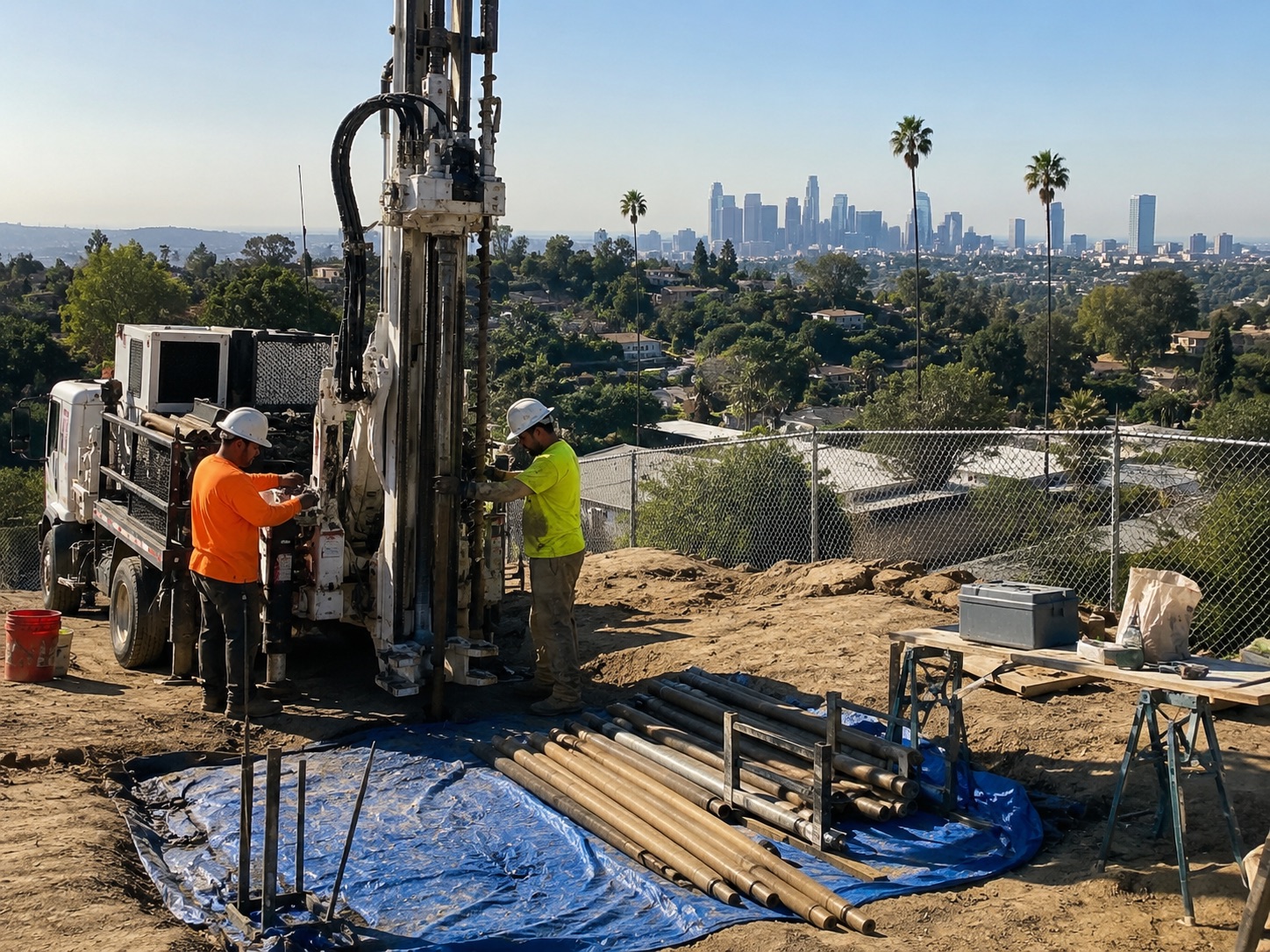
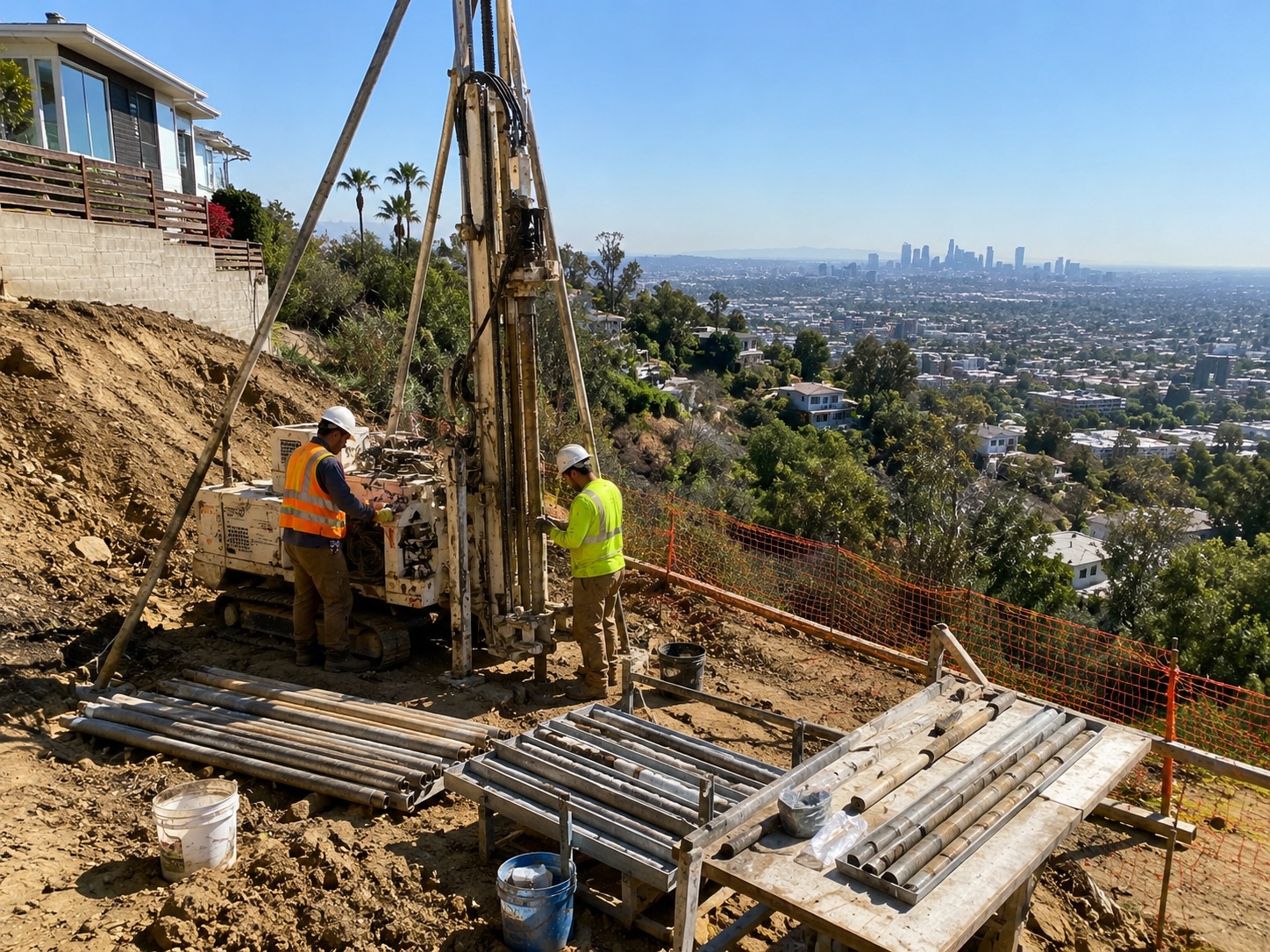
Geotechnical drilling crew performing soil boring and subsurface investigation on a Los Angeles hillside construction site to support foundation design, seismic analysis, and safe project development with our Geotechnical Drilling Services in LA
What Type of Rig is Required for Geotechnical Drilling
Rigs depend on your site and the fact that how deep the investigation needs to go. For example:
- Hollow stem auger rigs are the ones you will see most often around Southern California. These truck-mounted rigs drill with a big screw-like auger. The auger has a hollow center, letting the crew pull soil samples as they go. Most residential and light commercial soil boring Los Angeles jobs use this method as it’s fast, and it works for most soil types.
- For deeper borings or tougher ground, crews switch to mud rotary or air rotary drilling. Mud rotary circulates fluid to keep the borehole from collapsing, which helps a lot in sandy or loose soil.
- Air rotary is used when you hit the bedrock. Both methods let crews get to depths an auger just can’t reach.
- And then there are the limited-access rigs such as tripod rigs, track-mounted units, and portable equipment. It solves the toughest problems of Los Angeles.
Alongside the drill itself, there’s usually a support truck, sample boxes, and sometimes a water tank on-site. A typical crew is just a driller, a helper, and a field geologist. Moreover, you may need an engineer keeping an eye on everything.
A Typical Day on Site
First Step – Morning Setup
Crews generally roll in between 7 and 8 a.m. They will do a quick safety huddle, double-check the utility markings, and get the rig positioned over the first of the planned boring locations. This setup usually takes 30 to 60 minutes.
Drilling and Soil Sample Analysis
Once the auger starts turning, the crew pulls soil samples at set intervals — often every five feet. The following are two prominent methods for drilling and sampling, for example:
- The Standard Penetration Test drives a split-spoon sampler into the ground with a standardized hammer. The resulting blow counts tell engineers how dense or stiff the soil actually is. These penetration tests, or SPT, feed directly into how engineers calculate bearing capacity later.
- The locally popular California modified sampler pulls larger, relatively undisturbed samples in brass rings for the lab. For softer clay, crews sometimes push thin-walled Shelby tubes instead.
Logging Soil Sample Data
This log is the backbone of the whole report. It gives the geotechnical engineers something solid to work from once the samples reach the lab. While the driller works, the field geologist is logging every single sample for:
- soil type
- color
- moisture
- groundwater condition such
anything odd like old fill material or debris
Cleaning up a Drill Rig Site
The crew starts backfilling the boring once it hits the target depth. The filling material may be the original cuttings, bentonite, or cement grout. If they drilled through concrete or asphalt, they’ll patch it. A good crew leaves your construction site looking almost exactly like it did before they arrived, aside from a small patched circle or two. When you work with Marshall Geoscience, these are guarantees you get with our on-site crews.
How Long Does Geotechnical Drilling Actually Take?
A good geotechnical engineering contractor like Marshall Geoscience in Los Angeles does most residential jobs in a single day. A typical single-family home investigation is one to three borings, each of them being somewhere between 20 and 50 feet deep. Bigger commercial jobs, or a larger infrastructure project, can take several days depending on scope.
A few things can push the timeline out, which means physically moving the rig around. For example, hard conditions, tight-access sites, slower equipment, or hillside projects that need borings at different elevations.
A good contractor will give a realistic, cost-effective schedule during the proposal stage. So, you are not caught off guard mid-project.
What About the Noise?
Drill rigs are not silent, but they are not as disruptive as people expect either. You can think of a large diesel truck idling, with some hammering during sampling. Work should be within the hours set by the City of Los Angeles noise ordinance. It generally keeps construction noise to daytime hours on weekdays and Saturdays.
Each boring needs roughly a 10 by 25 foot working area for a truck rig, plus room for support vehicles to park. Crews try to be careful around landscaping, but some disturbance is just part of the process. It is worth asking earlier how they will protect sprinkler lines, pavers, or plants near the boring locations.
After the Drilling: Soil Samples Become a Soil Analysis Report
Drilling is actually half of the job. Technicians run laboratory testing for moisture content, density, shear strength, consolidation, and expansion index. This soil testing tells engineers how the ground will actually behave under your structure. It provides insights for not just after construction, but over the long term.
The geotechnical engineer compiles a formal report with the lab results, field logs, and existing geologic data. It’ll include foundation design recommendations, grading guidance, seismic design parameters, and whatever special measures your particular site needs.
Most geotechnical reports take two to four weeks to finish, though rush turnarounds exist if your timelines are tight. Your architect and structural engineer will lean on this report throughout the foundation drilling LA design process. LADBS will review it during plan check before anything moves forward.
Choosing the Right Geotechnical Engineer in Los Angeles
You cannot expect the same experience from all the contractors. You must check the validity of their license with the Contractors State License Board, and make sure they have insurance. Local experience counts here, because the geology in LA can shift from block to block. So, the requirements can also shift from one jurisdiction to the next.
A contractor who answers clearly and puts it in writing is generally trustworthy. Before you hire anyone, it is worth asking a few direct questions such as:
- Have you worked in this neighborhood before?
- What equipment do you plan to bring for my site?
- Who’s handling permits and utility clearance?
- How will you protect my property, and how do your soil sampling services scale if the project grows?
Geotechnical Drilling Company in Los Angeles
Geotechnical drilling may appear as a hurdle from the street, but it is generally quicker, cleaner, and more organized. You may save years of foundation issues while avoiding unnecessary delays on your project for the LA permit process.
If you know the expectations, there will not be any unwelcome surprises when the rig finally rolls up your street. Looking to get started? Contact a Los Angeles geotechnical drilling company like Marshall Geoscience for your site-specific consultation and simple estimates for your project.
Build with knowledge. Build with confidence. Build smart from the ground up.