7 Steps to Prepare a Burned Hillside Before Winter Rains
If your hillside burned this year, you probably already know the rain is coming. Although the time for preparation is less. Once the soil is wet, most of the protective work becomes impossible.
So, prepare your burned hillside before winter rains today. This article guides you through preparing the burned hillside for winter rains.
You can learn here what actually keeps construction projects going. California cares more than most places. This is because of stricter rules, and because you are responsible for certain steps. You must complete them before you can legally pour a slab.
What does wildfire do to your hillside property in Los Angeles?
A healthy slope needs a lot of things to maintain it. Leaves and brush reduce the rain impact. Roots keep the soil particles together, and water has time to soak in. However, a wildfire can disrupt the process in hours.
High temperatures dry the plants as oils volatilize, condense, and are absorbed under the topsoil. These oils form a hydrophobic layer under the topsoil, causing rain to flow laterally.
That’s why burned soil can behave almost like a parking lot in a storm because loose ash and dirt run along the rainwater. Heat also burns the organic matter that supports soil structure, so recovery is slow.
Along these steep canyons in Southern California, heavy rains could fall quickly during the winter storms. With only a small amount of rain, runoff can be higher over the burn scars. As after the first major storm, it is mostly cleanup, the suitable time for erosion control is before the storm hit.
Post-Wildfire Risks Associated with Winter Rains
As rain can happen throughout the winter season, it brings several risks to burned hillsides. Post-wildfire landslide risks are higher in the initial rain seasons. Some major problems associated with the winter rains are as follows:
- Soil erosion occurs over time as water washes away soil particles. It begins in thin strips, progresses to rills and gullies. Topsoil can take a long time to develop – it is easy to lose.
- Flash flooding is the fast one. Burned watersheds can’t hold water, so creeks and channels rise in minutes. Water carrying ash and sediment compromises the downstream water quality. They can directly access local water supplies and increase health risks.
- Debris flows are the most dangerous hazard on burned hillsides, a rapid flow of mud, rocks, burned trees, and other debris. It can create a rift valley within the Canyon without warning.
Step 1: Walk the slope in dry condition
First, identify steep slopes, bare spots, and channels in your surroundings, picture a heavy rain, and trace runoff downhill. Check for a culvert below and whether it’s clogged with ash.
A crack in the ground or a retaining wall tells you about the potential risk. Take photos with dates on them. If you ever file an insurance claim, you’ll be glad you did.
A few free resources help for LA fire erosion control. National Weather Service in Los Angeles issues flood alerts and forecasts. The CGS provides hazard and burn severity maps that show the impact in your area.
You must not try to fix a moving ground, looming steep slopes, or damaged walls or foundations. Call a geotechnical engineer.
Step 2: Clear out the drains
Drains are relatively inexpensive to clean compared to the disaster they can cause. Water will flow in the least resistant channel. This can force water to take an alternate path in an ash-filled drain.
Regulate the downspout flow away from bare slopes and clear the culverts, ditches, swales, and storm inlets of loose debris. After the first rain, repeat checking. Sediment quickly refills the voids.
If the debris basins are not working well, LA County Public Works has debris basins and advice for residents with larger drainage problems.
Step 3: Cover the bare ground
As a single solution can work for burned slope stabilization. Focus on a water-repellent soil approach and remove all water from burned areas.
Usually straw or wood mulch is used, but it should be certified weed-free straw. Use a heavy and thick layer, but make sure it doesn’t wash away in rain. Lose mulches move on truly steep slopes; thus, on steep ground, non-sliding mulch is an option.
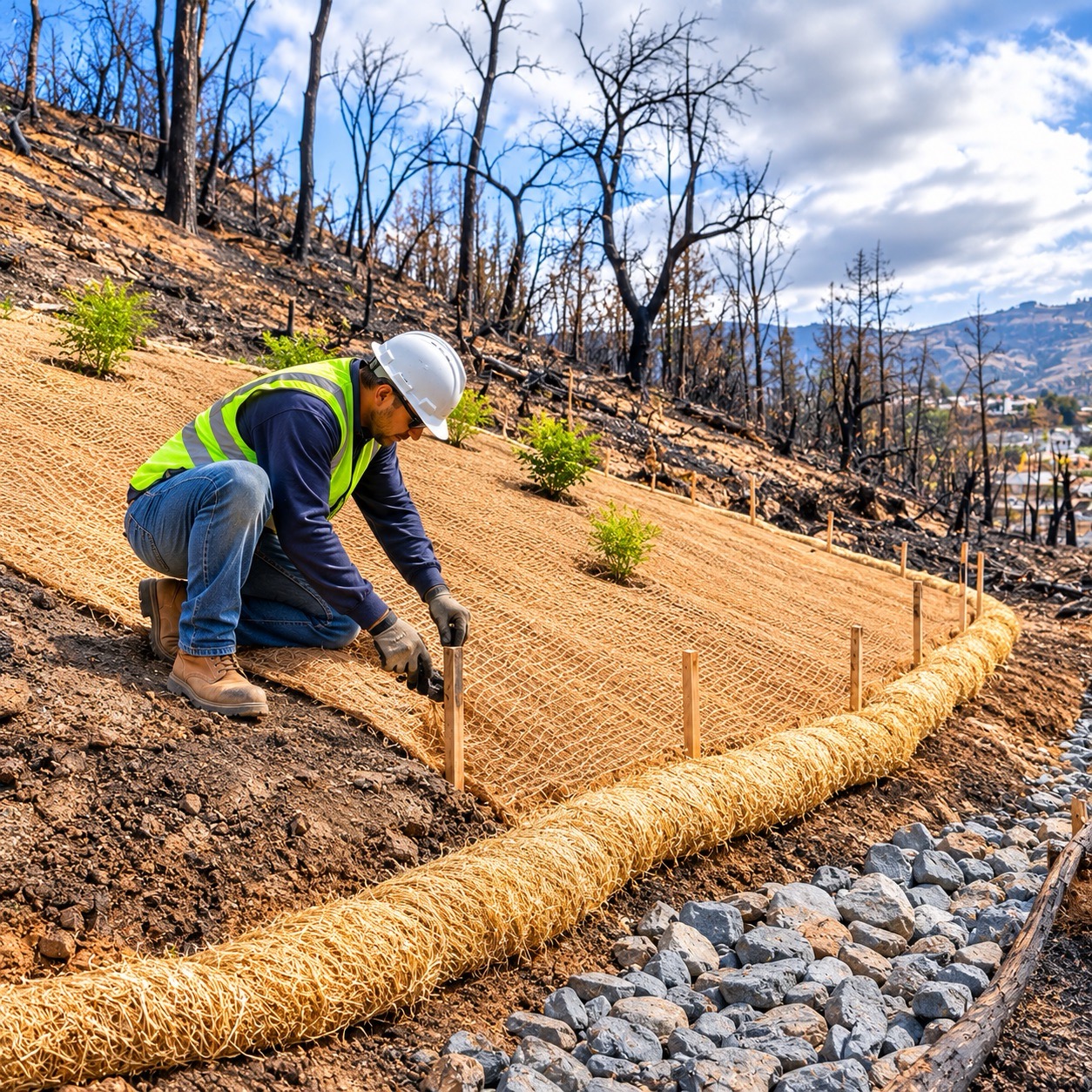
That’s where erosion control blankets and netting come in. They lock soil and seed in steep or high-risk areas.
The hydro-seeding procedure is essentially spraying a mix of seed, mulch, and a glue-type binder that helps establish a root system. Native seed mixes are the best suited. You should not expect to keep a slope of just seed this first season, as it needs time.
Step 4: Break up the long slope
Water speeds up the farther it runs. A long, uninterrupted slope lets it build real force. You’re looking to cut that run into smaller pieces.
Straw wattles are quite effective if installed properly. Install them in shallow trenches along the slope contour. Stake and plant them closer on steep slopes.
You can control the surface water speed by establishing small check dams, sandbags, and silt fences. Monitor these measures alongside storms. Mitigation measures help to secure the hillside, but are not a replacement for ground cover.
Step 5: Locate the water passage
Surface water makes its way down anyway, so plan for it accordingly. You can not stop or block the water passage but guide it by using sandbags or barriers. Place these barriers around doors, garages, and foundations, and leave a clear way past the house. Move cars and anything valuable out of low spots before a storm hits.
However, if the slope is straight to your home, sandbags would not help. You would need engineered walls, benches, or a drainage system. Here, wildfire debris flow prevention becomes an engineering job.
Effective stabilization requires mixed approaches according to the soil and slope grade. Only licensed professionals can design it. The following are some common stabilization methods, especially for LA fires.
Matching the Measure to the Site
|
Method |
Best Use |
Relative Cost |
Maintenance |
|
Mulch/straw |
Gentle to moderate slopes |
Low |
Reapply as needed |
|
Hydroseeding |
Revegetation, with other controls |
Low to moderate |
Moderate |
|
Wattles/fiber rolls |
Contour slope breaks |
Low to moderate |
Check after storms |
|
Blankets/netting |
Steeper slopes |
Moderate |
Inspect for lifting |
|
Silt fence/sandbags |
Diverting flow, protecting structures |
Low |
High |
|
Engineered structures |
High-risk slopes |
High |
Periodic review |
Not sure how stable your slope is? Marshall Geo specializes in hillside development. They assess the hillside and suggest suitable burn scar erosion-control options.
Step 6: Permits and funding
LADBS requires mandatory approvals for certain tasks of hillside erosion control after fire. Requesting a grading and retention wall permit application is best, however. If your project is outside the City, you can also call your local building department.
Los Angeles Regional Water Quality Control Board provides information on stormwater requirements. Funding available – see current opportunities with the Natural Resources Conservation Service and FEMA. Caltrans is responsible for the slopes along the state highways. Save all receipts and take a picture of the site before and after.
Step 7: Have a plan for the people, not just the slope
Before the storm, complete your preparations, clean up drains again, and have an exit plan. Create alerts at NotifyLA or Ready LA County. Decide a safe place for your family to meet if you are separated.
For storm updates, check the forecast and evacuate when the Los Angeles Fire Department tells you. Please don’t wait for the worst to happen, and prepare your hillside.
Walking on burned slopes in the wet condition is dangerous. So you should make repairs when it is safe. Remove sediments and search for other cracks.
Silt will fill drains and wattles will dry it. So, check if the wattles are dry or silt has blocked the drains. In short, LA needs ongoing, seasonal fire erosion control.
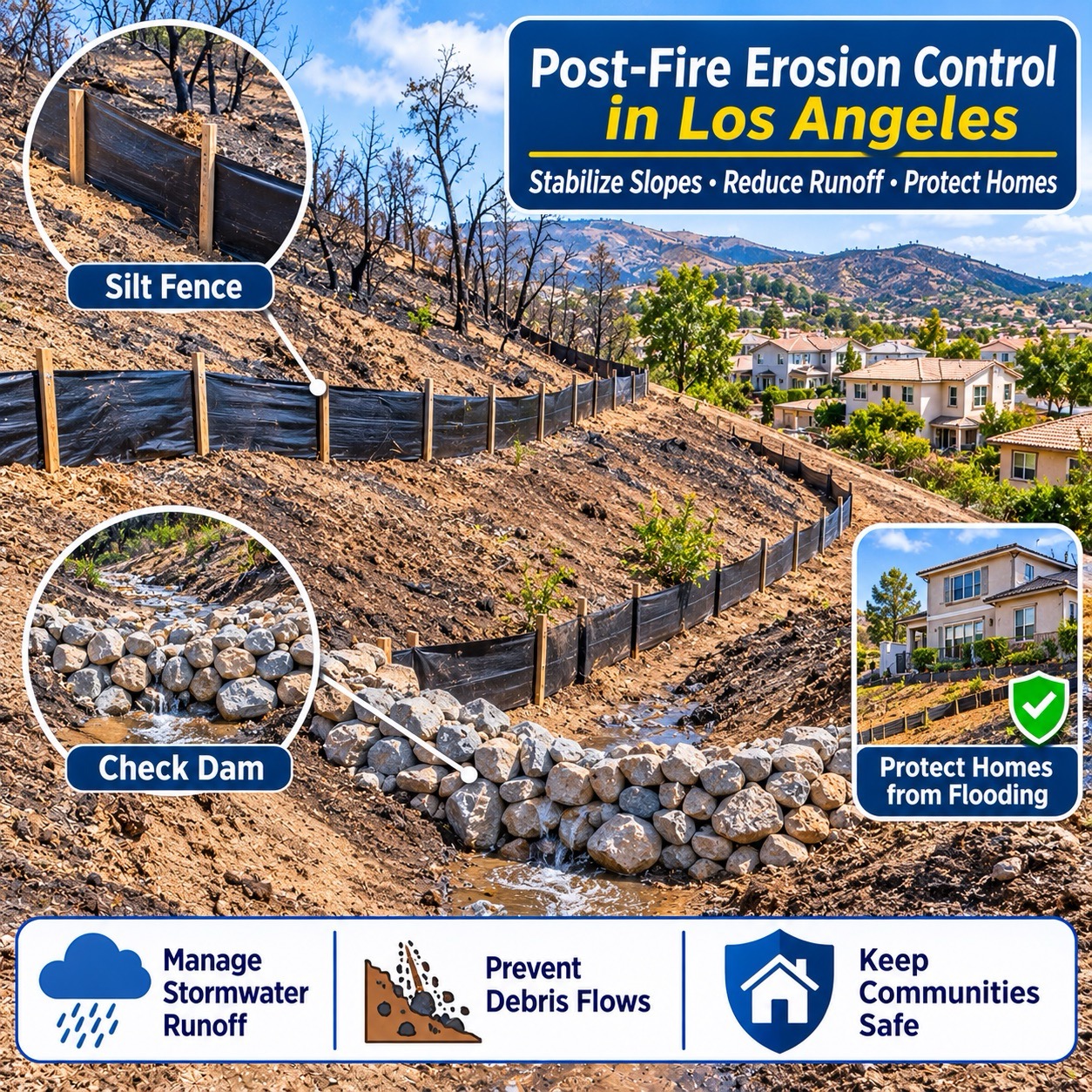
Post-fire erosion control in LA using silt fences, and check dams to stabilize burned slopes, reduce stormwater runoff, and protect homes from flooding and debris flows.
Our soil testing and geotechnical laboratory services in Los Angeles help achieve your construction goals by avoiding risky project decisions that can cause massive construction issues. Properly framed inspections safeguard schedules, jobs and your project budgets.
Can you prepare the hillside in LA for winter rains?
A lot of it, if it’s a slight incline. Projects like spreading out mulch, installing wattles, and clearing drains are all good weekend tasks. For steep slopes, large areas, and anything structural, the whole case is different.
Often, repairing a slope costs more than protecting it. However, repair costs depend on the slope size, accessibility, and the technical help required. So, get several quotes and evaluate them for licenses and insurance coverage as well.
Deep root systems bring long-term stability, which are mostly natives. Monitor whenever plants regrow, following defensible space principles. Monitor the slope and new plantings of water-stressed vegetation. These measures help you survive the winter rains and buy time, but do not cure the hillside.
Burned hillsides don’t wait for a good time to fail. If you’d like a professional opinion on yours, visit Marshallgeo.com and request a site assessment.
Find out why every property undergoing construction in Los Angeles requires soils report and soil analysis as it can heavily affect your construction, especially when building a permitted foundation for a property in Southern California where underground corrosion can cost you more than just money, it can cost your life!
F.A.Q.s
When should I start preparing hillside for winter rains?
Start as early as possible, because everything gets harder to find once rain is in the forecast.
Can mulch only be enough for hillside stabilization?
On a mild slope, it’s a good start. On anything steep, add wattles or blankets.
Can I work on it during rain?
No. A soaked, burned slope can let go without warning.
When do I need an engineer?
If the slope is steep, your house is below it, or you’re seeing cracks, sinking, or wall damage.
Build with knowledge. Build with confidence. Build smart from the ground up.