Introduction to Landslides & Soil Failures
Wildfires are a life hazardous. But the risk does not end after the fire is extinguished. Hillsides become weak after a fire. Soil can slide. Debris and mud may be deposited downward. In most cases, it is the rain that triggers the event.
Even minor storms may cause damage to burnt slopes (USGS – Wildfire Debris Flow Hazards). There are plenty of steep hills in Los Angeles. The Santa Monica Mountains, San Gabriel Mountains, Malibu Hills, and Hollywood Hills are fire-prone.
Houses and highways are built on these slopes. The vegetation that holds soil can be destroyed by fire. When the ground is bare, it becomes unstable. This paper describes the mechanisms by which wildfires increase the risk of landslides. It also describes the duration of the threat. Lastly, it addresses how we can mitigate the risks and secure the people and property.
Why Los Angeles is Vulnerable After Wildfires
Los Angeles is not flat or even terrain. The majority of the areas are mountainous or hilly. Upon that, houses, roads, and infrastructure are constructed. on these slopes. These regions are prone to sliding. They become unstable due to fire.
Many neighborhoods lie within the wildland-urban interface (WUI). This means homes meet wildlands. Vegetation burns fast here. After the fire, the slopes are bare. Loose soil and ash remain. When rain falls, it can move quickly downhill.
Some slopes have older retaining walls. Some have old grading work. They may not be built to handle post-fire rainfall. These structures can fail. Agencies such as LADBS and LA County Public Works monitor these areas to mitigate hazards.
How Do Wildfires Change Soil?
Plant roots and minerals bind soil particles. Fire burns roots. Soil loses cohesion. Loose soil moves easily.
Fire also changes the soil itself. It can make a hydrophobic layer. This means soil repels water. Rain cannot soak in. Water runs off quickly. It collects dirt, dust, and debris (California Geological Survey – Burned Watershed Geohazards).
The weaker soil lacks plant and root cover. Runoff, landslides, and debris flows can be the result. Soil is left to be brittle unless the vegetation is regrown or the soil is stabilized.
The soil analysis for construction helps prevent project delays and closures. Proper soil stability inspections safeguard schedules, jobs and project budgets. The Los Angeles Department of Building and Safety says soil tests help catch early problems.
Burn Scars and Hydrophobic Soil
A soil burn scar is a residual soil condition left by a wildfire. The vegetation is stripped off, and ash covers the site. It is plowed soil and burnt vegetation. Specifically in Los Angeles, The 2025 Wildfires ravaged through key areas leaving heavy soil burn scars.
Burn scars often repel water, rendering the soil hydrophobic. Usually, a hydrophobic soil becomes fast-flowing. This may result in mudflows, flash floods, and debris flows. The events can be caused by a mere shower of rain.
Rainfall as low as 0.3 inches in 30 minutes is sufficient to trigger debris flows in Southern California (USGS).
Debris moving is hazardous and quick. They carry mud, rocks, ash, and burnt trees. They have enough strength to destroy homes, roads, and cars.
Read more to find out why a soil report can help properly develop a property and construction for slop and soil stability.
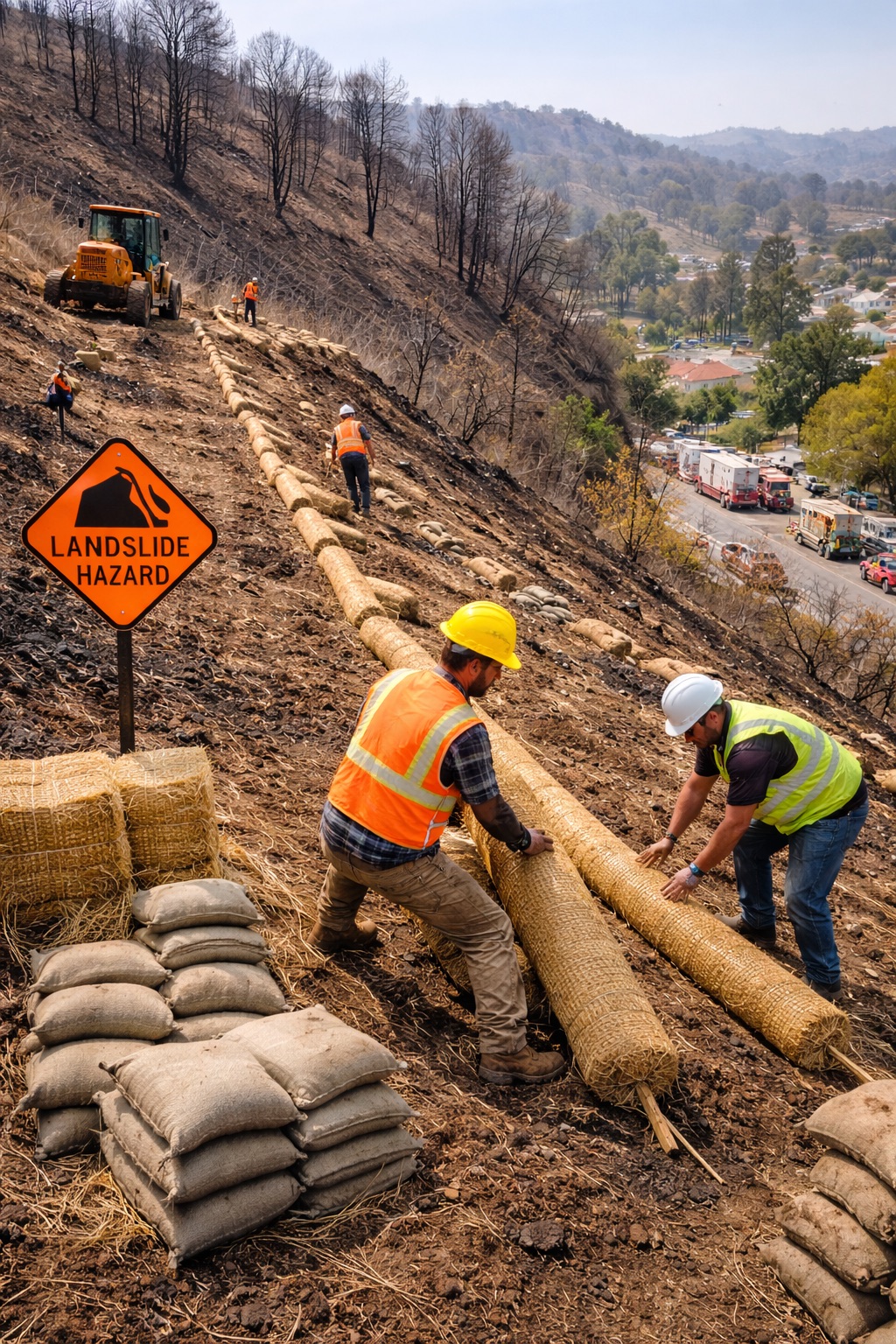
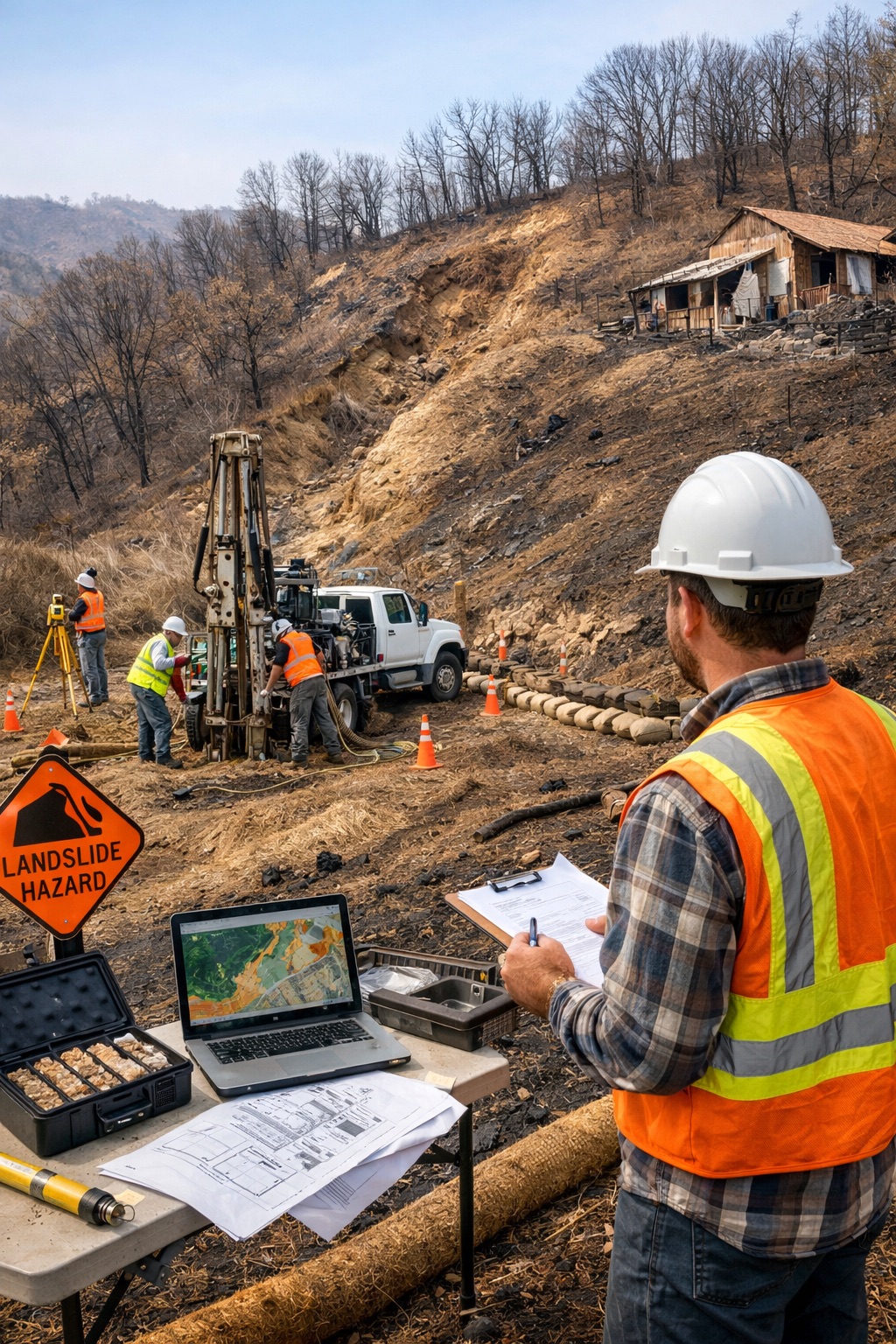
Los Angeles hillside recovery after wildfire, showing emergency erosion control and landslide hazard prevention.
Landslide Triggers and Rainfall
Not all rain is the same. Scientists look at intensity and duration. Los Angeles is subject to short, heavy storms.
Immediately after a fire, the first rainy season is the most perilous one. Hydrophobic soil is fresh. There is a lack of vegetation regrowth. Slides and debris flows can result from heavy rain. Risk continues for years. Burn scars take a long time to heal (California Geological Survey).
A landslide is a movement of soil down the slope. A debris flow is a water-saturated mixture of soil and debris moving at a rapid speed similar to a river. Debris flows are typically faster and more destructive.
Types of Post-Fire Soil Failures
Soil failure following fire occurs in a number of ways:
Shallow landslides: The upper soil layer slides downwards. These slides usually occur when it is deep into the downpour. They mostly include loose soil covered with ash and weak root support.
Debris flows: A swirling stream of water, soil, rocks, and ash. They are able to move far and hit without much notice. As debris flow moves down slope, it increases in velocity and volume.
Sheet Erosion or Slope wash: Small channels are cut in the soil by rainwater. These channels erosively damage the whole slope in the long run. Storms will continually cause minor rills to become bigger erosion channels.
Retaining wall failures: Walls can be brought down by moist soil. This usually occurs when drainage systems are obstructed or busted. Wall backfill and footing support may also be weakened by fire (Caltrans).
Impacts on Infrastructure
Failure of soil within the post-fire environment may be disastrous. Mountains are prone to destabilization and can slip. Mud, rocks, and debris may block the roads. Basins of houses and constructions may move or break.
During rain, it may overflow the drainage systems. Slopes can be characterized as slippery construction sites for a short period.
The LADBS and LA County Public Works are the agencies that intensify the post-wildfire inspections. This inspection is intended for the verification of slopes, retaining walls, and drainage.
After the fire, geotechnical investigations may be needed prior to repair or new construction. Such studies are useful to enable engineers to plan safely. It aims to prevent failures in people, houses, and roads in the future.
How Long Does Risk Last?
The time of risk in a wildfire is 1-5 years. The most vulnerable ones are on steep slopes as well as in chaparral regions. It also takes a long time to regrow the vegetation.
Having no roots makes the soil weak and vulnerable. The soil may further weaken with each rainy season. It will increase the risk of landslides (California Geological Survey).
Risk Reduction Measures
There are ways of minimizing post-fire soil risks:
Erosion Control
Straw wattles or sandbags are used to slow down the water. So, they prevent soil from washing away when storms occur.
Mulching and hydroseeding:
These are used to cover the soil and help in the growth of plants. Vegetation then holds the soil together.
Debris basins and check dams:
These are used to catch the universal mud, rocks, and much debris before it reaches the home or road. This is for the protection of people and property.
Slope stabilization
Retaining walls and soil anchors are used for the support of the weak slopes. They reduce the possibility of landslides.
Geotechnical evaluations:
Engineers investigate slopes, as well as soil properties. Their reports help to direct safe construction/repairs. It is very important to assess early. Local programs, such as the California Geological Survey Burned Watershed Geohazards Program, help plan mitigation. They also educate residents about potential hazards before the rainy season.
When a Geotechnical Investigation Is Needed
A geotechnical study is required in the following:
Construction of a new structure:
Engineers must ensure that the soil is safe to support the structure as well as resist further movement in the past. The effects of seismic movements and rainfall are also evaluated.
Repeat Failure due to Hidden Soils:
Weaknesses hidden in soils can result in repeated failures. New drainage and erosion risks must be taken into account in relation to repairs. Temporary solutions to a problem are not always effective.
Grading work:
A change in slope geometry can cause landslides if soil strength has been reduced by fire. Slope angles and reinforcing are very important.
In most cases, local agencies would request these reports before granting permission. For example, such as LADBS and LA County Public Works
Conclusion
Wildfires cause a permanent imprint on the ground. Vegetation and soil strength are lost on the burnt hillsides.
It will lead to landslides, runoff, and other failures. Even several months or years after a fire, the primary stimulus is rain.
The greatest risk occurs on steep slopes, in chaparral regions, and during the first rainy season. The positive side is that the dangers of landslides are foreseeable.
Property and lives can be protected through early testing and assessment. Emergency measures, erosion control, and appropriate engineering can also control the potential loss.
Agencies offer guidance and supervision. Such as LADBS and LA County Public Works enable communities to take action prior to a disaster.
F.A.Q.s
Why do landslides happen months after wildfires?
Because soil loses roots and cohesion. Vegetation needs time to grow back.
How much rain can trigger debris flows?
Short bursts of 0.3 inches in 30 minutes can trigger flows (USGS).
Are all burned hillsides unstable?
Most are, especially steep slopes with hydrophobic soil.
How long are burn scars dangerous?
Up to 1–5 years, depending on slope, vegetation, and rain (California Geological Survey).
Who evaluates post-fire landslide risk in Los Angeles?
Geotechnical engineers, LADBS, LA County Public Works, and California Geological Survey.
Build with knowledge. Build with confidence. Build smart from the ground up.