Introduction: Why Smart Site Selection Matters
Site selection and evaluation are the first steps in construction. It is an early and essential step for any project. It sets the project’s direction. It helps in understanding the site and then designing and permitting.
This step mitigates risk and is necessary for on-site safety during and after construction. It controls cost and keeps the project within budget.
Every site has limits which may be environmental, physical, or even legal. Similarly, each site has its own pros and cons as well as certain conditions.
Ignoring site limits creates problems later. Design changes can lead to over costing and resource waste. Permits and the project get delayed.
In California, risk is higher due to frequent earthquakes. There are floods in many areas and slopes fail with rains. Meanwhile, wild fires make soil more prone to erosion. Due to this, it needs a careful site selection.
What Is Site Selection and Evaluation?
Site selection and evaluation are checks to determine whether the land is safe for construction. It studies land conditions, soil type, and expected hazards. It examines the rules and limitations applied to a specific site.
The goal of site evaluation and selection is simple as below:
- Reduce risk.
- Improve safety.
- Support approval.
This process assesses the site’s soil, water, terrain, and surroundings. It also examines zoning and access.
Many professionals are required for site evaluation and selection. Each plays an important role, and their review supports the next steps.
Architects review the layout and access of the proposed site. Civil engineers review grading and drainage. Geotechnical engineers test soil. Environmental consultants review history. Planners check zoning.
In California, agencies require reports to permit construction. The Los Angeles Department of Building and Safety reviews the technical studies. Whereas the LA County offices review the land use.
Early evaluation saves time, money, and resources. It reduces redesign attempts and prevents surprises.
Common Risky Building Zones
Some zones carry a higher construction risk. These zones need careful review. Many failures start in these areas.
Floodwater can enter buildings quickly; therefore, flood-prone areas are risky. Foundations weaken over time. Slabs crack after repeated wetting. Repairs happen again and again. Insurance costs increase.
Seismic zones increase the risk of failure. Fault movement can be sudden. Ground rupture breaks foundations. Structural alignment is lost.
Liquefaction weakens soil during shaking. Soil loses strength and buildings settle unevenly. Pavements sink, and roads deform after earthquakes.
Steep slopes are by their very nature unstable. Constant pressure is applied by gravity. Soil slowly creeps downhill. Rain adds weight to the soil. Retaining systems may fail. All repairs are complex and are costly.
Contaminated sites have an impact on health and safety. Soil can include heavy metals and chemicals from the previous industrialization.
Wetlands limit development potential. These areas control natural drainage. Permits are difficult to obtain. Environmental review takes time. Mitigation is often required.
Expansive soils move over time. Clay shrinks when dry. This cycle repeats every season. Foundations lift and settle. Slabs crack slowly. Walls show movement. Pavements deform. Repairs never fully stop.
Each risky zone must be identified early. Some sites contain multiple hazards. Combined risks are beyond increasing the chances of failure. Sometimes the best choice is not to do it. Early decisions save cost, ensure safety and schedules.
The soil testing analysis for construction helps prevent project delays and closures. Properly framed inspections safeguard schedules, jobs and project budgets. The Los Angeles Department of Building and Safety says visual checks help catch early problems.
Key Criteria for Safe Site Selection
Here are some main points to consider while choosing a construction site.
- Topography plays an important role in site safety as well as the overall project cost. Flat sites usually require minimal soil grading. It reduced the amount of earthwork required, construction time, and costs. View zoning rules explained by LADBS.
- Sloping grounds often need extensive excavation. It is used to create level platforms for buildings. Poor grading can cause erosion. It can also lead to slope failure and ongoing maintenance problems.
- Natural drainage paths must stay open. Blocked drainage causes water buildup. It leads to surface damage and local flooding.
- Soil bearing capacity controls foundation design. Strong soils can support shallow foundations. This simplifies construction and keeps costs lower.
- Deep foundations transfer loads to the stronger layers beneath weak or compressible soils. Unless properly analyzed, low soil strength can cause excessive settlement. Further, it leads to structural failure.
- Another important factor is groundwater depth. When the groundwater level is high, excavation and foundation work will take time. It may increase the instability and also complicate construction sequencing.
- Dewatering is necessary to control water flow. It prevents delays in project time and cost. Early awareness helps engineers plan the most appropriate construction method.
Read more to find out why a soil report and a smart site selection can help develop the proper plan for construction.
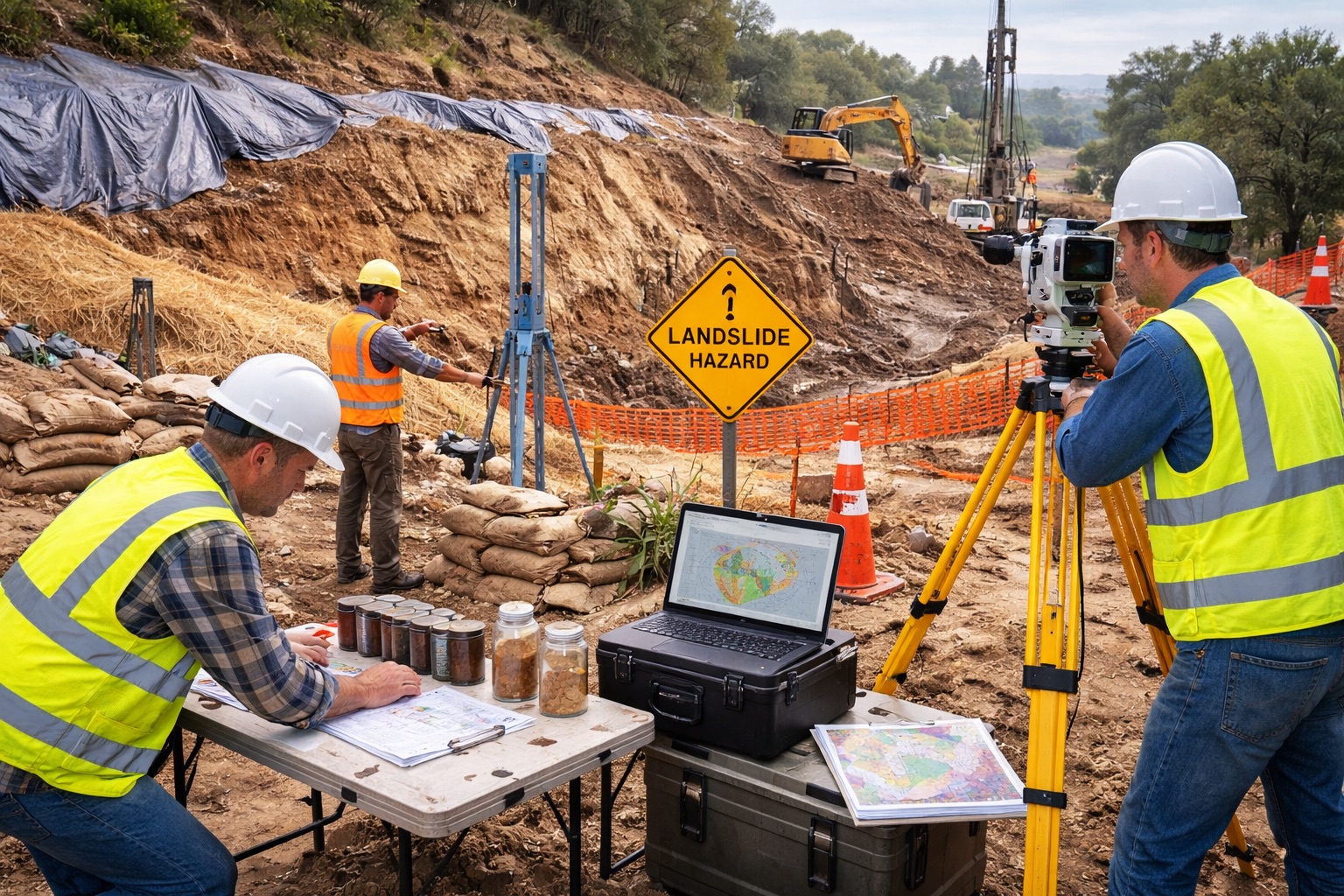
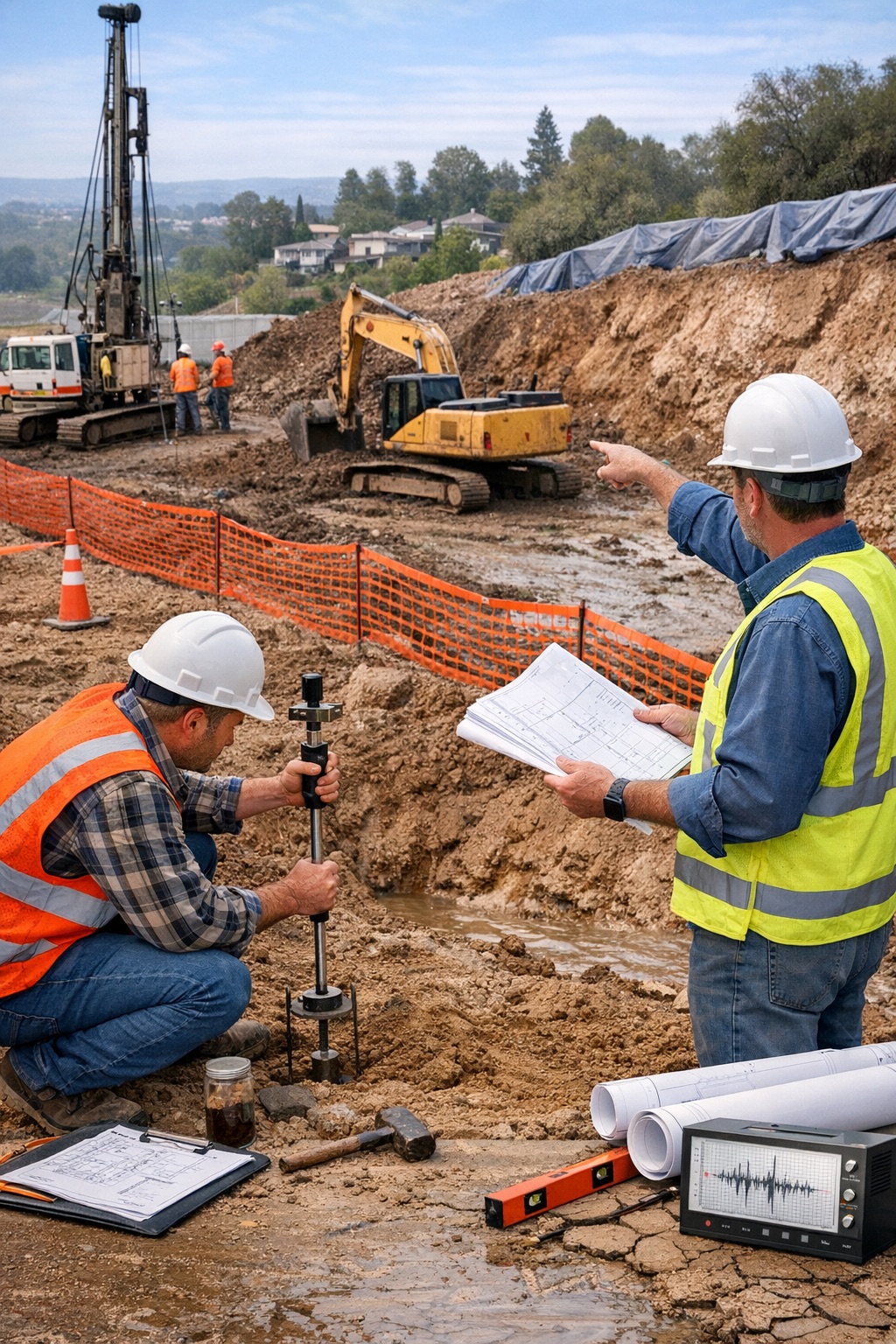
On-site geotechnical survey in Los Angeles ensuring foundation stability and safe construction in a hillside area.
Tools and Methods for Site Evaluation
Site evaluation relies on thorough data collection and testing. Both are essential for safe and effective project planning.
- Fieldwork comes first, with boreholes drilled and soil and groundwater samples collected. These provide critical information about the site’s physical conditions.
- Laboratory tests measure soil geotechnical properties. The results guide foundation design, retaining structures, and construction safety.
- The study of the environment is supported by examining the site’s history. It also analyses possible risks. It also attests to compliance with environmental regulations and helps reduce risk.
- It is not possible to make planning without the geological maps. Fault zones are displayed on seismic maps while flood-prone areas are displayed on flood maps. Topographic maps – these show changes in elevation. These support the risk evaluation and decision-making.
- There are restrictions regarding development on the local and zoning regulations. The project is reviewed by the planners which can cause costly delays to the project.
- The information from several sources is combined using the geographical information system (GIS) tools.
Planners and engineers are able to make safe, efficient, and informed decisions on the site location. They can integrate fieldwork, laboratory findings, environmental investigations, maps, and GIS data. California Geological Survey guides soil checks for free.
Site Evaluation in High-Risk Areas
Even risky locations may be created, although they require additional work. It is also necessary to use engineering controls to minimize potential hazards.
A foundation is usually required to be strong enough to safely support a building. Structural elements can be strengthened, and building materials selected appropriately.
Slopes and embankments require special attention. Permanent systems inhibit soil migration and landslides. These can be anchors, walls, and reinforced earth structures.
Drainage should be done to decongested hydrostatic pressure and level water instability. Soils may undergo treatment, i.e., chemical stabilization or geotechnical treatment.
Compaction makes the soil stronger. It reduces settlement and ground movement. Together, these measures improve long-term stability. High-risk sites must be carefully regulated.
These include geotechnical studies, structural designs and mitigation plans. Approval depends upon meeting safety, building and environmental standards.
Check with LADBS for plan stamps, CEQA for green nods, FEMA for flood lifts, and Caltrans on road cuts.
Best Practices and Final Recommendations
Site evaluation should start early. Do not wait until later stages. Delays cause problems. Designs may change. Costs can increase. Safety may be affected.
- Early checks help spot risks. Risks can be managed on time. Better decisions can be made.
- The site should be checked carefully. Walk the land. Look at the surroundings. Review maps. Topographic and seismic maps show hidden issues.
- Hire the right people. Experience matters. Certified experts know what to look for. Geotechnical engineers study the soil. Environmental consultants review past use. Planners check rules. Their input helps avoid mistakes and saves time.
- Valid licensing and local experience support the administration of assessments and regulatory compliance.
- Reliability is enhanced by using multiple data sources. Using a single report or test may fail to identify important risks.
- Site evaluation helps compare the possible locations. There are risks that are very costly to control, and they may even exceed the value of the land.
- Lastly, the agency conducts easy reviews, minimizes revisions, and approves projects timely.
Once testing results are available, mitigation is designed based on hazard level.
Conclusion
Site selection and evaluation are the foundation of every construction project. They protect people, buildings, and public infrastructure. It reduces the risk and prevents future problems.
In California, site evaluation is critical. Common risks are earthquakes, floods, landslides, wildfires, and soil movement. You need to identify these risks in time through testing and professional work.
Proper site selection limits failures and reduces design changes. It helps control construction costs and avoids delays. Agencies expect clear and complete evaluations before approval.
Good site evaluation improves long-term performance. Buildings last longer. Foundations stay stable. Maintenance and insurance costs are lower.
Early evaluation costs little compared to repairs or legal issues. It is a smart and important decision to select a construction site.
F.A.Q.s
- Why are site selection and evaluation important?
Site selection and evaluation are important because they reduce risk. It supports safe design. It helps permit.
- Which agencies review site conditions in California?
LADBS, county agencies, FEMA, and state departments review site risks.
- What studies are usually required?
Geotechnical studies, environmental reviews, and zoning checks.
- Can risky land still be developed?
Yes. Mitigation may allow construction with approval.
- When should site evaluation start?
Before land purchase, whenever possible.
Build with knowledge. Build with confidence. Build smart from the ground up.