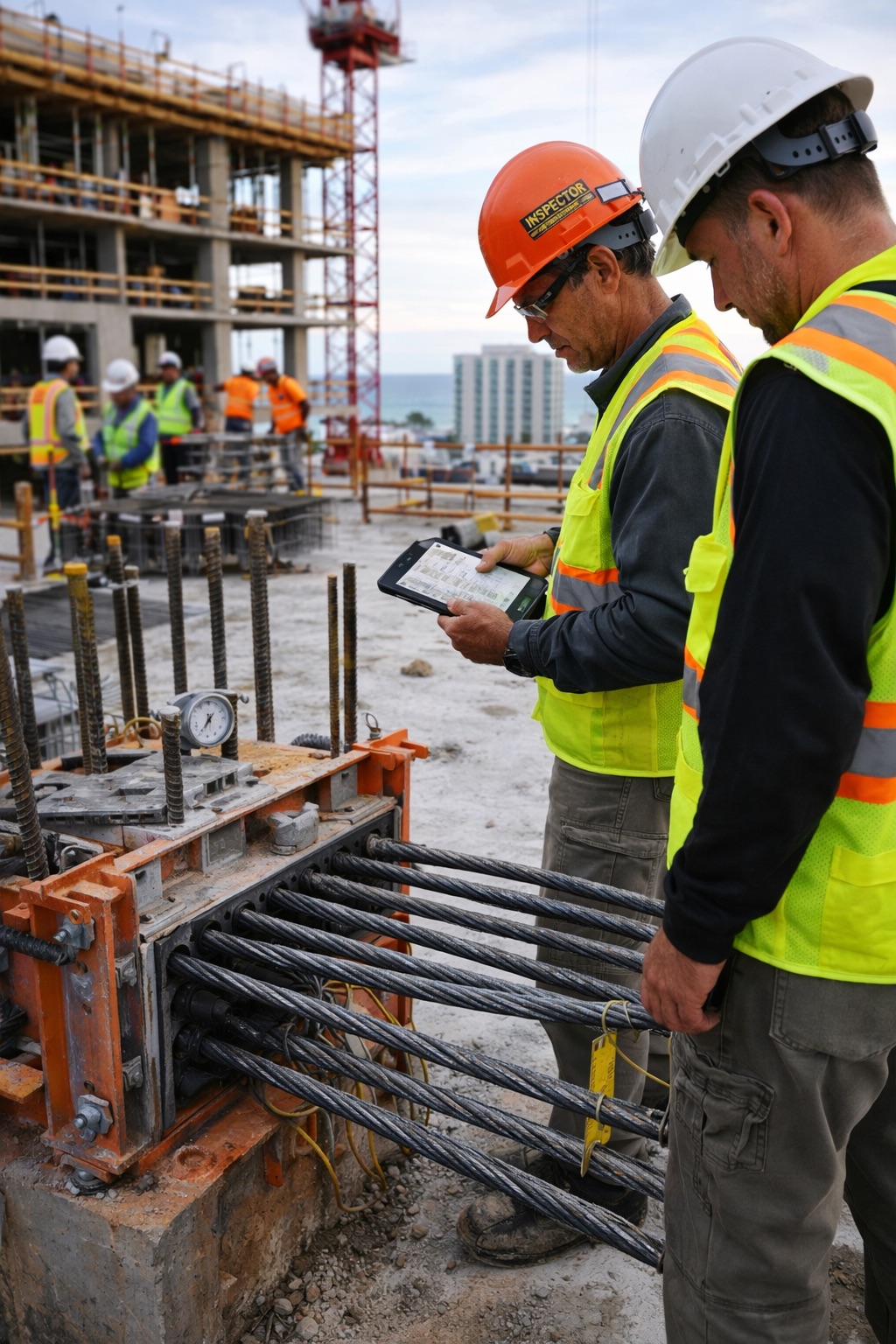
Pre-Stressed and Post-Tensioned Concrete Inspection Services
Introduction
Concrete is not only a building material. Nowadays, it is designed to transport heavy loads and work for decades. This is possible in two contemporary systems.
These are pre-stressed concrete and post-tensioned concrete. These systems will be found on bridges, buildings, parking decks, and large slabs. They aid in alleviating cracks. They improve strength. They also make structures more efficient.
But one thing is important. These systems operate at elevated internal pressure. When something wrong happens, it might not be evident on the surface. This is the reason why inspection is very important.
Inspection services are used to ensure that engineers inspect what goes on inside the concrete. They ensure that nothing dangerous occurs. They also ensure the structure is doing as intended. We will explain everything in this article in a very basic, practical manner.
Pre-Stressed and Post-Tensioned Concrete
Pre-Stressed Concrete Explained
Pre-stressed concrete is not ready when it is being used. First are the steel tendons. Then they are surrounded by concrete. When the concrete hardens, the tension is released.
This provides a compressive force within concrete. It strengthens the structure. It also lessens cracking. This technique is primarily applied to factory-made elements. For example, beams and bridge girders,
Pre-Stressed Concrete Explained
Concrete is slightly different. First poured is the concrete. Steel tendons are installed inside it. Once the concrete has reached sufficient strength, the tendons are pulled. This exerts pressure on the structure.
It aids in managing cracks. It enhances load capacity as well. This system is quite widespread in slabs. It can be seen in high-rise buildings and parking structures.
The Phase 1 testing for construction helps prevent project delays and closures. Properly framed inspections safeguard schedules, jobs and project budgets. The Los Angeles Department of Building and Safety says visual checks help catch early problems.
Read more to find out why it’s important to retain a Geotechnical Engineer on-site for your construction projects to help properly develop a property and construction stability, along with avoiding health concerns.
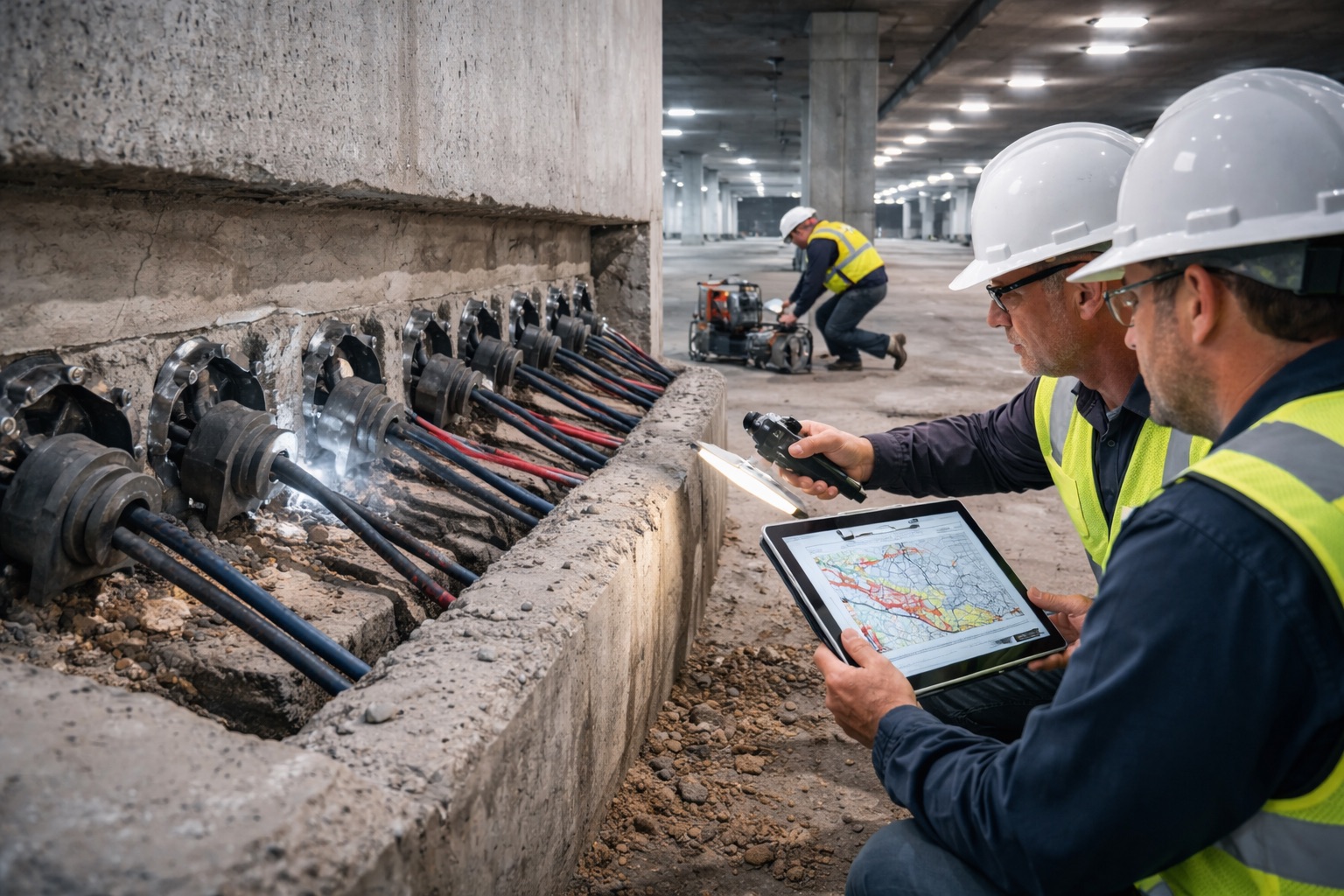
Engineers performing pre-stressed and post-tensioned concrete inspection using GPR scanning and visual checks at a parking structure, evaluating tendon anchorages, slab condition, and structural performance for construction quality and safety.
Post-tension vs. Pre-stressed Concrete
Concrete is slightly different. First poured is the concrete. Steel tendons are installed inside it. Once the concrete has reached sufficient strength, the tendons are pulled. This exerts pressure on the structure. It aids in managing cracks. It enhances load capacity as well. This system is quite widespread in slabs. It can be seen in high-rise buildings and parking structures.
Post-tension vs Pre-stressed Concrete
Primarily, the difference between the two types of concrete is the timing. Pre-stressing is done before casting concrete. However, post-tensioning happens after it has hardened.
Another difference is location. Pre-stressed elements are often made in factories. Post-tensioned systems are usually built on site.
Both systems are strong and reliable. But both need proper inspection to stay safe.
Why Inspection Services Are Important Construction?
All the concrete structures require inspection for:
Ensuring Structural Safety
Concrete may look fine, apparently. But problems can develop inside. Tendons may corrode. Stress may be reduced. Cracks may grow slowly.
Inspection helps find these hidden issues early. It prevents sudden failures. This is very important for public safety.
Maintaining Design Performance
Every structure is designed for a purpose. It must carry certain loads. Inspection checks if the structure is still performing as expected. It ensures that the stress inside the concrete is correct. Any mistake can be fixed before it becomes serious.
Compliance with Standards
Building work needs to be carried out in accordance with strict codes. ACI, PTI, and ASTM codes are the essential standards for construction.
Moreover, in California, there are agencies that oversee structural compliance and inspection. It may be that the California Geological Survey and Caltrans are important in states like California.
Most importantly, these standards are not optional. It is required.
Common Issues
As pre-stressed and post-tensioned concrete are special, they may have the following issues.
Tendon Corrosion
Steel tendons are the heart of these systems. If they rust, the structure weakens. Water and air can enter through cracks. Poor grouting also increases the risk. Corrosion is one of the most serious problems.
Cracking and Spalling
Small cracks are common in concrete. But large cracks are dangerous. Spalling happens when pieces of concrete break off. This exposes the steel inside. Once steel is exposed, corrosion starts faster.
Anchorage Zone Failures
Anchorage zones hold the stressed tendons in place. These areas carry very high forces. If something goes wrong here, it can lead to failure. That is why these zones need careful inspection.
Loss of Pre-stress
Over time, the tension in the tendons may reduce. This can happen due to material behavior or poor installation. When pre-stress is lost, the structure cannot perform properly.
Inspection Methods
For inspecting concrete structures, the following procedures are suitable.
Visual Inspection
Visual inspection is the first and simplest step. Engineers look for visible signs. These signs may be any cracks, stains, or surface damage. No doubt, even small changes can give important clues.
Non-Destructive Testing
NDT is very useful. It helps look inside the concrete without breaking it. Common methods include:
- Ground Penetrating Radar or GPR
- Ultrasonic testing
- Impact echo
These tools help locate tendons. They also detect voids and defects.
Destructive Testing
Sometimes, a deeper investigation is required. Engineers may take core samples. They may also perform load tests. These methods give accurate results. But they are used carefully.
Post-Tensioned Concrete Inspection Process
Inspecting post-tensioned concrete is an organized process. It needs to follow the steps below:
Pre-Inspection Review
Inspection starts with documents. Engineers study design drawings. They check tensioning records. This helps them understand the structure before visiting the site.
Field Inspection
Next comes the site visit. Engineers check tendon locations. They inspect anchor heads. They specifically inspect structures for cracks and damage.
Stress Testing and Monitoring
Special tools are used to measure stress. Deflection is also checked. This ensures the system is working as intended.
Pre-Stressed Concrete Inspection Process
A geotechnical consultant provides comprehensive support throughout the process of pre-stressed concrete inspection.
Manufacturing Stage Inspection
Inspection begins in the factory. Materials are tested. Stressing procedures are monitored. Quality control is very important at this stage.
Transportation and Handling Checks
Precast elements are transported to the site. They may get damaged during movement. Inspection ensures they remain safe.
Installation Inspection
Once on site, elements must be placed correctly. Alignment is checked. Connections are inspected. Proper installation is critical for performance.
Role of Non-Destructive Testing (NDT)
NDT allows engineers to see inside concrete. It does not damage the structure. It is fast and reliable.
Common NDT Techniques
These are some of the common NDT Techniques:
- GPR for locating tendons
- Ultrasonic pulse velocity for quality
- Half-cell potential for corrosion
These methods improve accuracy and confidence.
Standards and Guidelines for Inspection
Usually, the national codes are applicable to concrete. However, for accuracy and authentication, it is important to comply with international standards.
- ACI Standards
These provide rules for design and inspection. They are widely used in the industry.
- PTI Guidelines
These focus on post-tensioning systems. They provide detailed inspection steps.
- ASTM Standards
These define testing procedures. They ensure consistency. In California, authorities like the Los Angeles Department of Building and Safety and the State of California enforce these standards strictly.
Benefits of Professional Inspection Services
Professional inspection services are beneficial for construction. However, some of the prominent advantages are:
- Professional inspection gives peace of mind.
- It helps detect problems early. This saves money.
- It increases the life of the structure.
- It improves safety for everyone.
- It also ensures compliance with regulations.
Inspection Challenges for PT and Pre-Stressed Concrete
Inspection is not always simple. While inspecting a post-tensioned or pre-stressed concrete, we may face some challenges such as:
- Tendons are hidden inside concrete. They are hard to access.
- Structures are complex. Stress behavior is not easy to understand.
- Special tools and trained experts are required.
Choosing the Right Inspection Service Provider
While choosing a service provider, one should be very concerned. The following points must be considered during the process.
Professional Experience
A team with real experience and sound expertise is preferable. They should understand PT systems well.
Advanced Equipment
Modern tools improve results. NDT equipment is especially important. Choose a tea that has modern equipment with proper calibrations and certificates.
Certifications and Compliance
Make sure the provider follows standards. Certifications show reliability.
Future Trends in Concrete Inspection
Inspection is becoming smarter. AI is being used to detect cracks. Sensors are being placed inside structures. They provide real-time data.
Digital twins are also being developed. They help simulate behavior. These technologies are effective for improved safety and efficiency.
Final Words
Both structures, post-tensioned and pre-stressed concrete, are strong. They enable engineers to develop greater and more durable constructions.
These systems, however, require attention as well. Inspection is not a mere formality. It is a necessity. It aids in the discovery of latent issues. It ensures safety. It improves performance.
Modifications can avoid expensive maintenance. It may also save lives. Well, in plain terms, a good inspection is a safe structure before starting to develop on any property. Contact us at Marshall GeoScience to get started!
F.A.Q.s
What is post-tensioned concrete inspection?
It is the process of checking tendons, anchorages, and stress levels to make sure the structure is safe.
Why is inspection important for pre-stressed concrete?
It ensures the structure works as designed and helps avoid failures.
What methods are used in PT inspection?
Visual checks, non-destructive testing, and sometimes load testing.
How often should PT structures be inspected?
They should be inspected regularly. Critical structures need more frequent checks.
Build with knowledge. Build with confidence. Build smart from the ground up.