Permanent vs. Temporary Retaining Walls: What LA County Builders Must Know
Building a retaining wall in Los Angeles County is not easy. The land is not flat. Many sites sit on slopes. Some lots are narrow. Still others are near canyons or hillsides. In these areas, soil must be restrained. That is where the retaining walls come in. But not all retaining walls are all the same. Some are temporary. Some are permanent.
It is very critical to understand the difference. It affects permits. It affects design. It affects cost. It affects safety. In this LA County guide, we explain permanent vs temporary retaining walls in LA County.
We’re referring to such local government entities as the Los Angeles Department of Building and Safety and Los Angeles County Department of Public Works.
If you are building in Southern California, then this is of significant importance.
What Is a Temporary Retaining Wall?
A temporary retaining wall is constructed to be used for a short time. Providing support to the soil during the construction. It is not supposed to remain forever. These walls are not uncommon in the course of excavation.
For example, in the digging of a basement. Or in the installation of utilities. Or where cutting into a hill side Temporary walls are also referred to as shoring systems. You may hear terms like:
- Soldier piles
- Lagging
- Sheet piles
- Soil nail walls
- Tiebacks
They are used to holding soil in place while the work is underway. Once built, these may then be removed. Or they may remain buried but not work as the ultimate wall.
Temporary walls are included in excavation support. They reduce collapse risk. They protect workers. They are used to protect close buildings.
In LA County, temporary shoring is required to be engineered. It cannot be guessed. It must adhere to the rules of grading and excavation. The Los Angeles County Department of Public Works has grading guidelines.
Temporary walls are required to take into account:
- Soil type
- Groundwater
- Slope angle
- Nearby structures
- Seismic loads
California is a seismically active state. Design must be done for lateral earth pressure and seismic forces.
What Is a Permanent Retaining Wall?
A permanent retaining wall remains in place. It becomes a part of the final structure. It holds soil long term. These walls support:
- Roads
- Driveways
- Foundations
- Landscaped slopes
- Hillside homes.
Permanent walls need to meet building code. They require a permit and inspection. In the City of Los Angeles, retaining walls are the responsibility of the Los Angeles Department of Building and Safety.
Cites retaining walls can be permanent:
- Cast-in-place concrete
- Reinforced masonry
- Mechanically stabilized earth-(MSE)
- Segmental block walls
- Cantilever walls
- Counterfort walls
Design must be in accordance with the California Building Code. This code is based on the International Building Code with the state changes.
Seismic design is critical. The California Geological Survey hazard maps indicate areas of landslides as well as fault lines. Permanent walls must resist:
- Active earth pressure
- Surcharge loads
- Hydrostatic pressure
- Seismic forces
Drainage is very important. Water built up behind a wall increases pressure on the wall. Many wall failures are caused by bad drainage.
The soil report and slope analysis for retaining wall construction helps prevent project delays and closures. Properly framed inspections safeguard schedules, jobs and project budgets. The Los Angeles Department of Building and Safety says visual checks help catch early problems.
What is The Difference Between Temporary vs. Permanent Walls
The difference is more than time, however. It is design intent.
- Construction phases: Temporary walls are constructed for the construction phases. Permanent walls are constructed for long-term permanence.
- Temporary walls may provide greater movement. Permanent walls cannot be too open to movement.
- Temporary walls might not require an architectural finish. Permanent walls must be presentable.
- Temporary systems may be made up of steel piles and wood lagging. Permanent walls use Systems of Reinforced Concrete or white table concrete used as blocks.
- Permitting also differs. For this purpose, temporary shoring can be reviewed under permits for grading. Permanent walls must have building permits.
- Inspection levels differ. Permanent walls are inspected one last time before they are approved.
- Liability also changes. Permanent walls are indefinitely the responsibility of the owner.
For projects at Hillside, Los Angeles, there can be confusion between the two, which can cause delays. Builders sometimes attempt to use a temporary wall for permanent purposes. This often fails plan check. In the design, always define the type of wall.
Read more to find out why a soil reports and slope test helps to properly develop a property and construction stability, along with avoiding health concerns.
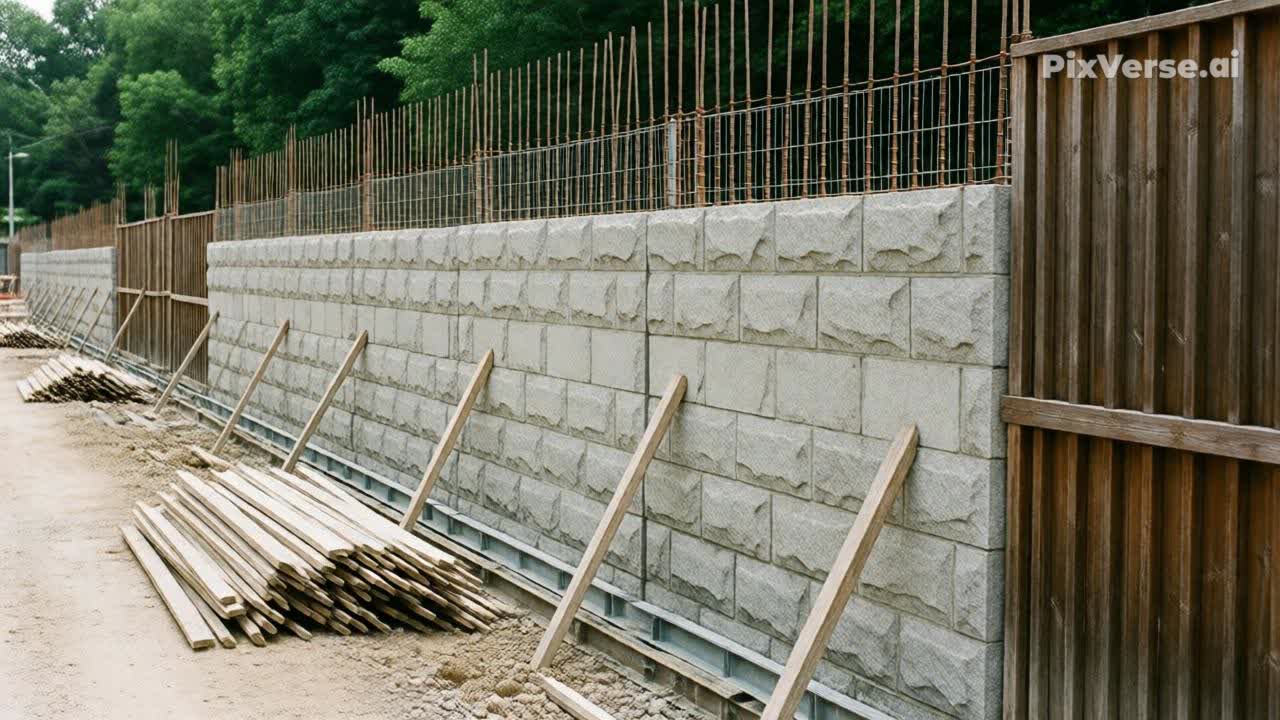
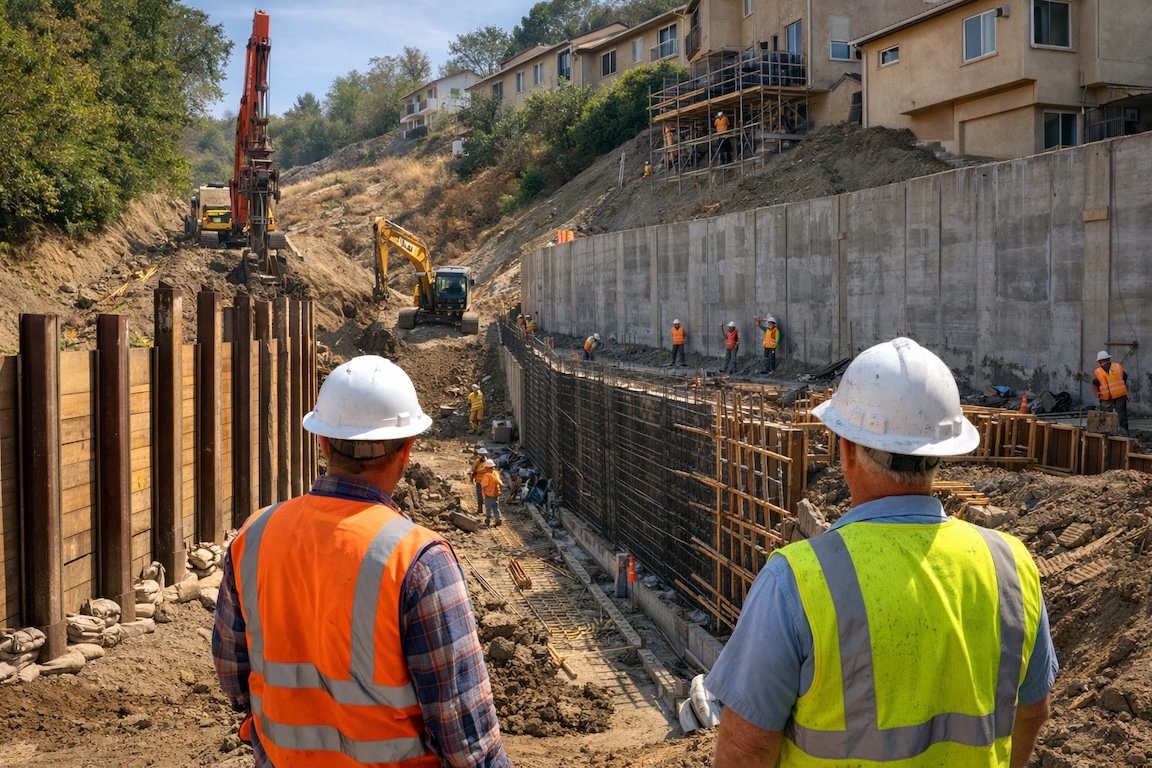
Permanent reinforced concrete retaining wall under construction with masonry block finish, vertical rebar extensions, and formwork support in hillside development projects.
LA County Building and Safety Requirements
Retaining walls in LA County do come under strict rules. The LADBS is in charge of grading within unincorporated areas. The City of Los Angeles employs this authority for safety.
In general, Walls more than 4 feet must be permitted. Surcharge conditions may require a permit even for less than 4 feet.
Calculations need to be done in engineering. Soil reports are often required in the hillside locations.
The California Geological Survey has Seismic Hazard Zones. If a project is in such a zone, then additional geotechnical review is required.
You may also need:
- Grading permit
- Building permit
- Haul route approval
- Stormwater compliance
Caltrans gets jurisdiction for projects close to highways. If near rail corridors, the Los Angeles County Metropolitan Transportation Authority could ask. Always look to determine what agency is controlling your site.
Required Inspections and Maintenance
Permanent retaining walls need to be inspected. Typical inspection stages:
- Footing excavation
- Reinforcement placement
- Drainage system
- Final wall completion
- Inspectors Control Dimensions
They control the size and spacing of steel. They check anchor systems. Temporary shoring is also to be monitored. Movement must be tracked. Tieback loads must be tested. Permanent walls have to be maintained after the construction. Check for:
- Cracks
- Bulging
- Water seepage
- Drain blockage
In Los Angeles hillside terrain locations, walls can become stressed by heavy rain. Post fire area is even more sensitive. The California Geological Survey provides landslide recommendations. Life and life usages like property should be protected from monitoring slope instability.
When to Use Temporary vs. Permanent Walls
Use temporary walls during:
- Deep excavation
- Basement construction
- Utility trenching
- Short-term slope cuts
Use permanent walls when:
- Final grade has soil retention
- Supporting a structure
- Supporting the driveway or road
- Presenting a Lots terraces
- Some of the Slopes
At many Los Angeles hillside homes, both types are used. First, temporary shoring wall supports excavation. Then, a wall of permanent foundation is constructed. Timing matters.
The coordination of design is important. Soil type will also impact the choice. Clay soils are not like sandy soils. Wildfire-burned hillside soils are some of the weakest after wildfire. Geotechnical engineers should guide decisions. Never rely on guesswork.
Common Mistakes and How to Avoid Them?
- Not to take drainage for suck. Water builds pressure. Install weep holes and sub-drains.
- The absence of a geotechnical report. The soil is very variable in Los Angeles. One lot may be different from the next lot.
- Underestimating the seismic loads. The California seismic forces are real. Walls have to counteract the pressure of an earthquake.
- Blending the temporary and the permanent functions. It is possible that a temporary wall may not be code-compliant for long-term use.
- Poor inspection control. Rebar should be inspected prior to the placement of the concrete. Drainage must be verified.
Cost and Schedule Impacts
Temporary walls increase the early construction cost. But they provide the possibility for deeper excavation. They accelerate the scheduling in tight sites.
Permanent walls are an added expense of material cost. The prices of concrete and steel fluctuate. Engineering costs are also added.
Delays in obtaining permits may drive up costs. Plan check may take weeks. There is poor coordination between grading and building permits, leading to gaps in time.
Using the right type of wall eliminates redesign. Redesign is expensive. It delays projects. One of the biggest cost items in LA County hillside construction is the retaining walls. Early planning saves money.
Southern California Conditions That Affect Design
Seismic risk is high. The California Geological Survey also provides fault zones maps. The rainfall is seasonal, but heavy. There must be control of the stormwater.
Wildfire altering strength of soils. Burned slopes erode faster. Urban density has surcharge loads. There is pressure placed on shoring systems by adjacent buildings.
All of these conditions have an effect on permanent vs temporary retaining walls in LA County. Design needs to point towards the reality of local people.
Conclusion
Retaining walls are not a simple thing that an individual can build themselves. They hold back tons of soil. They safeguard the lives and properties. The temporary retaining walls provide support to construction.
They are short-term systems. They are focused on excavation safety. Permanent retaining walls are permanent, even for decades naturally. They support the conclusion grade as well as the structures.
They have to comply with strict building codes. In LA County, rules are clear. Permits are required in numerous cases. Engineering is mandatory. Work with the help of licensed engineers.
Check with the LADBS and Caltrans or the Los Angeles County Metropolitan Transportation Authority, if necessary.
The difference between temporary and permanent walls affects safety. It affects permits, cost, and schedule. In construction on the hillside of Los Angeles, the right choice is for the protection of your project.
Build with knowledge. Build with confidence. Build smart from the ground up.