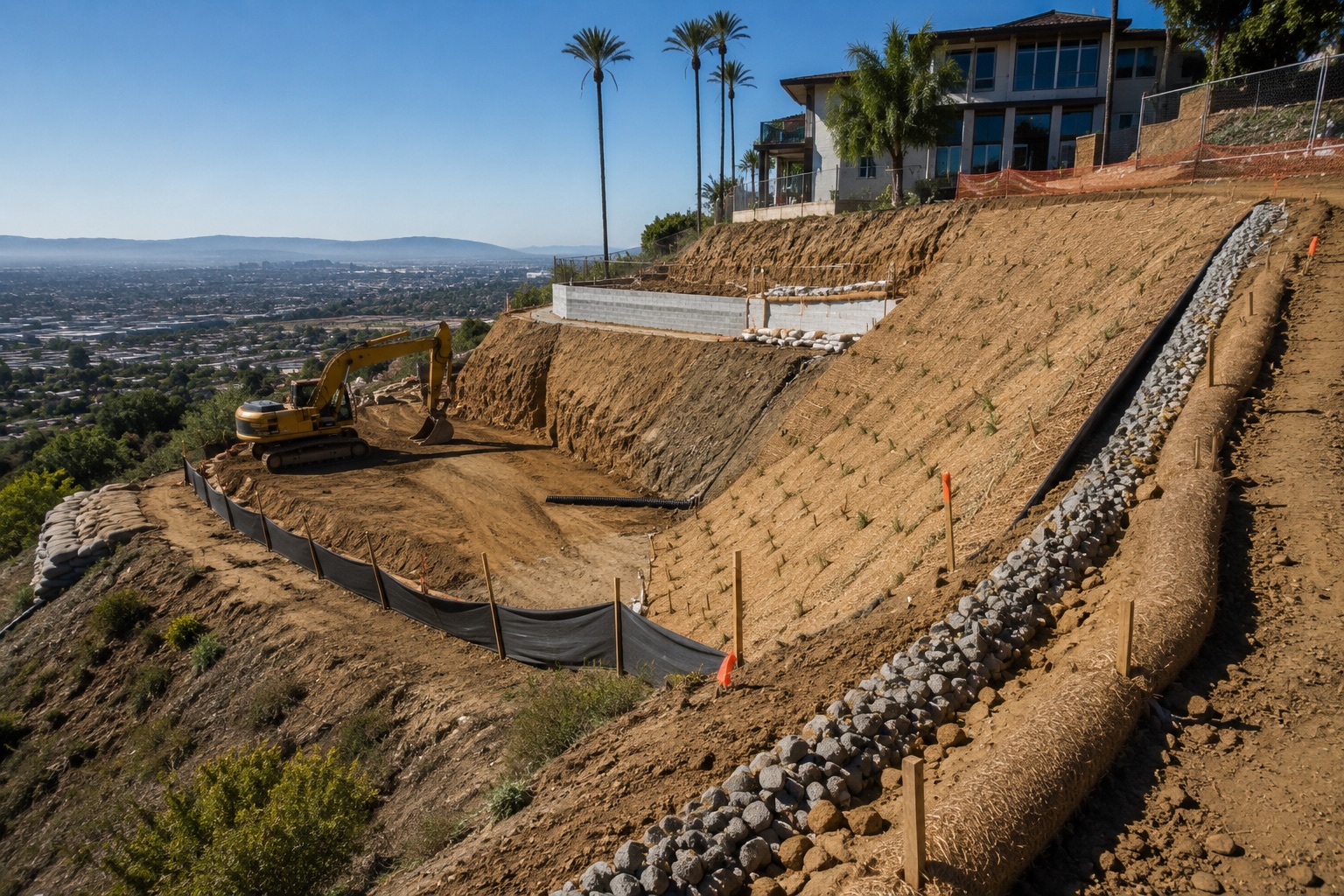
Erosion Control Design for Southern California Hillside
Erosion is an ongoing design problem on Southern California hillsides, especially in Los Angeles. Steep slopes and loose soils increase the risk; moreover, long dry months come after a few intense winter storms.Wildfires often remove plant cover right before rain. These conditions combine to make erosion a major problem. There are few places in the country where all four can be found.
The impacts of failure at the start of a hillside erosion control project can get worse fast. These can include red-tagged projects and agency stop-work orders. They can also include mud and sediment damaging downslope neighbors’ property. This can lead to lawsuits and remediation costs. These costs often far exceed what proper upfront design would have cost.
This guide introduces erosion control design. It explains potential erosion hazards in the region. It outlines regulatory requirements for all hillside projects. This guide will also cover key design components and BMPs for success. It highlights common pitfalls that can quickly undermine a hillside project.
What Is Erosion Control Design?
Erosion control design is the engineering practice of planning, specifying, and detailing the measures to prevent and transport soil from a site. Drainage devices, slope surface protection, sediment barriers, vegetation, and structural measures are some of these measures. On hillside projects, it is a required component of grading plans and stormwater permits, not an optional add-on.
Two categories run through every project. Temporary erosion control protects the disturbed soil during construction activity. For example, silt fences, fiber rolls, and the application of hydroseed before the rainy season.
Permanent erosion control lies in the finished project. For example, terrace drains, down drains, established vegetation, and treatment BMPs that function for the life of the development.
Both need a grading plan, the Stormwater Pollution Prevention Plan (SWPPP), and the soils report recommendations. As a drainage device that does not take into account the soils report, it is a failed device waiting for the first storm.
Why Southern California Hillsides Are Uniquely Vulnerable to Erosion
Understanding who regulates what is half the battle in LA. Three layers of government share and sometimes overlap in authority over environmental issues.the authority to administer the program, often with more stringent requirements.
Climate Pattern for Los Angeles
The region’s Mediterranean climate delivers six to eight bone-dry months. It then compresses most annual rainfall into a handful of intense storms. Increasingly, atmospheric river events drop several inches in a day. Slopes that survived all summer can fail in a single afternoon of high-intensity rainfall.
Geology and Soils in Los Angeles
Weathered granitic, soft marine sediments, colluvium, and decomposed granite underlie the hillsides and are easily eroded when disturbed. The California Geological Survey (CGS) maps landslide inventories and geologic hazard zones throughout the region and should be used for all hillside site investigations
The right environmental compliance assessments like Phase 1 and Phase 2 Environmental Site Assessments inspections prevent project delays by avoiding risky project decisions that can cause massive construction issues. Properly framed inspections safeguard schedules, jobs and your project budgets.
The Wildfire-Flood Cycle
Fire changes watershed behavior overnight. Burned soils will become hydrophobic, vegetation will die, and the load of sediment will increase severalfold and be extremely high. It leads to an increase in debris-flow hazard for two to five years following a fire. A hazard the U.S. Geological Survey models for major Southern California fires.
Find out why every property undergoing construction in Los Angeles requires a Phase I Environmental Site Assessment and how storm-water, and other environmental factors in Los Angeles, can affect your construction, especially when building a retaining wall for a hillside property in Los Angeles.
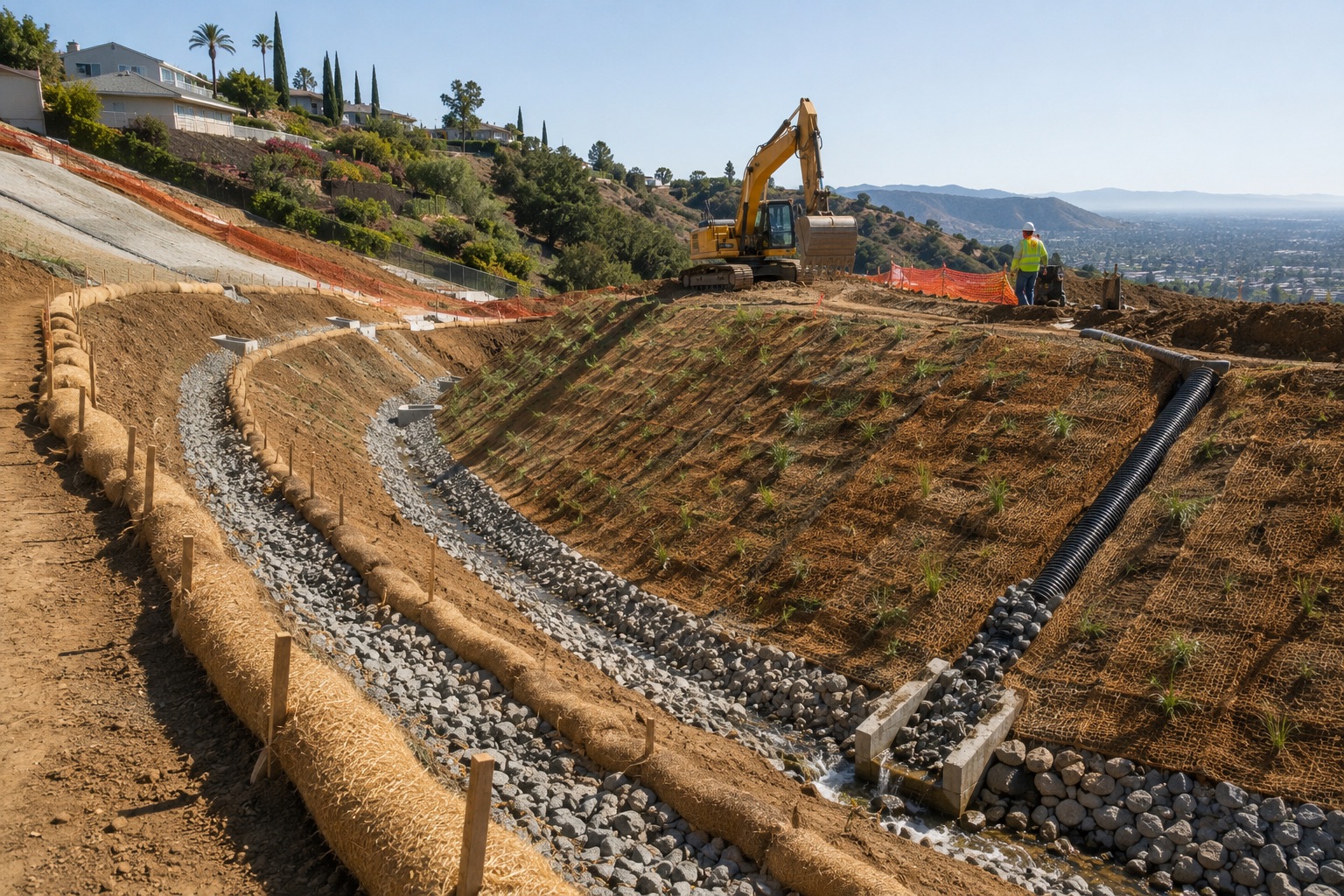
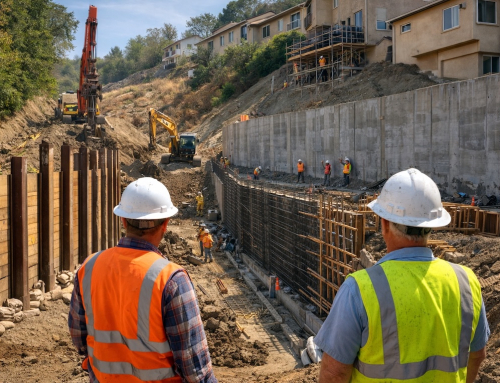
Engineered erosion control measures protecting a Southern California hillside construction project with slope stabilization, drainage systems, sediment control BMPs, and stormwater management for long-term site stability.
Steep Natural and Graded Slopes
Over the past several decades, hillsides have changed. Such as cut/fill transitions, over steepened graded slopes, and an urban-wildland interface.
Regulatory Framework You Must Design Around
Regulatory Framework Design for Los Angeles and Southern California is unique to this specific geological area.
California State Requirements for Slope Design
This is where most applications quietly fall apart. Hillside lots and properties in a Very High Fire Hazard Severity Zone always need a geotechnical and soils report.
For construction impacting 1 acre or more, you would require the State Water Resources Control Board Construction General Permit. A Qualified SWPPP Developer (QSD) must prepare a Qualified SWPP Professional to put into practice.
Sediment and receiving-water risk are the basis of project risk level 1-3. At steep hillsides, the level is 2 or 3, which necessitates sampling and documentation. In the region, the Los Angeles Regional Water Quality Control Board (Region 4) has enforcement authority.
Local Hillside Grading Ordinances
Cities and counties add their own grading codes to the state codes. In LA, the Department of Building and Safety (LADBS) enforces the Hillside grading regulations. Within the City of Los Angeles, LA County Public Works has similar programs. Similarly, neighboring counties (Orange, San Bernardino, and Riverside) also have programs.
A wet season, between October 1 and April 15, is a time to stabilize the disturbed slopes. Moreover, you must install erosion control devices and maintain them in most jurisdictions. You may require encroachment permits, and drainage coordination with Caltrans for projects located next to state highways.
MS4 Permits and Post-Construction Stormwater
Municipal MS4 permits permanently require new development to implement LID design, treatment BMPs, and hydro-modification controls. These are important to prevent post-project runoff creating channel instability at the downstream end of the project. You must build in the post-construction duties in the project from the beginning, rather than added at plan check.
Core Elements of Hillside Erosion Control Design
Hillside erosion control design is very important to understand and its unique affect on the residential living and building constructions in Los Angeles.
Drainage Devices
Engineered slopes exceeding about 30 feet in height generally need terrace drains spaced at vertical intervals, capturing runoff and conveying it to paved downhills. Brow ditches intercept run-on above cut slopes, while velocity reducers and energy dissipators protect outlets from scour. Undersize any link in this chain and the slope below it pays the price.
Slope Surface Protection
Bare soil is the enemy in construction projects. You can treat it with binders, erosion control blankets, and turf reinforcement on channelized surfaces. Moreover, straw or wood mulch also protect the surface until vegetation has established. Choose products that match the expected slope gradient, soil type, and flow.
Sediment Control BMPs3
Sediment control catches what erosion control keeps in place. Place silt fences and fiber rolls at the bottom of slopes and gravel bag barriers at inlets and along street frontages. Construction crews use stabilized access points to reduce track-out.
For sediment control on larger sites, use desilting and sediment basins. The California Stormwater Quality Association (CASQA) BMP handbooks are the de facto design standard.
Vegetation and Landscape Design
Long-term surface protection comes from deep-rooted and drought-tolerant native and drought-tolerant plants. For example, coastal sage scrub and native grasses.
They also help to reduce water requirements, as overwatering of slopes can lead to surface failure. Plant Palettes in Fire Hazard Areas should comply with Defensible Space requirements. These rules are in place by CAL FIRE and local fire authorities like the LAFD.
Structural Measures
Where surface measures are not enough, design escalates to retaining walls, buttress fills, and subdrain systems to relieve groundwater. Moreover, debris barriers or deflection walls below burn-prone watersheds can be used.
Differences between Temporary & Permanent Erosion Control
| Aspect | Temporary | Permanent |
| What it is | Short-term BMPs during active grading — silt fences, hydroseed, portable sediment basins | Long-term infrastructure — terrace drains, debris basins, established planting, treatment BMPs |
| When | Installed before the rainy season; phased with grading to limit exposed area | Come online as construction winds down and permanent drainage is functional |
| Who maintains it | Contractor — inspect and repair after each storm | HOA or property owner — long-term cleaning and upkeep |
| Key risk | Installing too late — slopes must be stabilized before storms, not scrambled over when rain is forecast | Skipping the handoff — maintenance obligations must be formally documented and transferred at closeout |
| End state | Removed once permanent drainage functions and vegetation is established | Operates indefinitely; only effective if someone is responsible for ongoing maintenance |
Post-Fire Erosion Control Measures
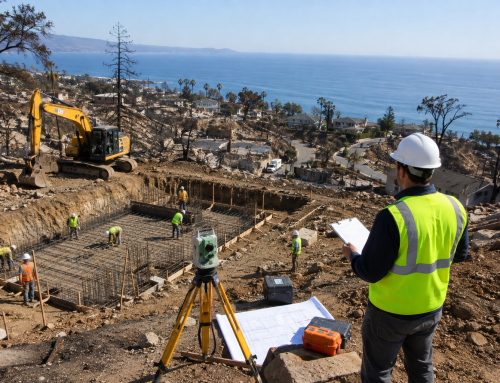
After a burn, design assumptions change for construction projects in that area. Runoff peaks multiply, flows bulk with ash and sediment, and debris flows can initiate on slopes. You must take emergency measures, i.e., k-rails, sandbag barriers, debris racks, and temporary basins. Furthermore, buy protection while watersheds recover.
Property owners and design teams should contact the LA County Public Works. Additionally, they should coordinate with federal recovery programs, and use USGS and CGS post-fire debris-flow hazard maps as the basis for protection.
Common Design Mistakes on Hillside Projects
- Terrace drains and outlets that are designed for the design storm, but do not consider run-on from slope areas above the terrace.
- Using vegetation as the main erosion control and assuming its protection before establishment
- Installing drains in areas where they are not regularly accessible for maintenance
- Using surface erosion analysis as a solution to geotechnical analysis – surface erosion is a different mode of failure to deep-seated slope instability, and a solution to one problem does not solve the other.
How Erosion Control Integrates with Geotechnical Engineering
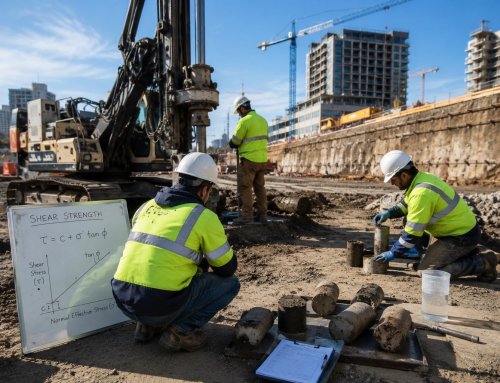
Erosion control design cannot stand alone on a hillside. The geotechnical report sets slope ratios, keyway and benching needs, subdrain locations, and compaction rules for stability. Erosion control then protects the surface of that stable slope.
Effective hillside projects bring civil, geotechnical, and landscape teams together from early design. This helps drainage devices, planting plans, and slope geometry support each other.
Conclusion
Effective erosion control on Southern California hillsides is proactive and integrated. It is built for the region’s fire-and-flood reality and not copied from a flatland template. It begins with geology.
It follows the wet-season schedule and meets state and local rules. It combines strong drainage tools with surface protection and is easy to maintain.
Planning a hillside project? Request an erosion control plan review or a hillside development consult before the wet season arrives. The cheapest storm damage is the kind you design out months in advance.
F.A.Q.s
When is an erosion control plan required in Southern California?
Whenever a grading permit is issued, most jurisdictions require an erosion control plan. This applies when work continues into the wet season. State SWPPP requirements apply to any project that disturbs one acre or more.
What is the rainy season for grading in California?
Most Southern California areas define it as October 1 through April 15. Exact dates can vary by city and county. Disturbed slopes must be stabilized before it begins.
What BMPs are required on hillside construction sites?
Typical minimums include slope protection (hydroseed, blankets, or mulch). They also include perimeter sediment controls (silt fence, fiber rolls, gravel bags).
They include stabilized entrances and inlet protection. On larger sites, they may include desilting basins. All items are documented in the SWPPP or local erosion control plan.
Who prepares a SWPPP, and do I need a QSD?
Yes — under California’s Construction General Permit, a certified QSD must prepare the SWPPP. A QSP must oversee field implementation.
Build with knowledge. Build with confidence. Build smart from the ground up.