What is a Soil Consolidation Test?
Soil supports everything we build such as Houses. High-rise buildings. Bridges. Roads. Every load from a structure moves down into the ground. The soil takes that load. How it reacts matters.
Soil is not rigid. It is not perfectly stable. It changes when stress is applied. Some soils compress quickly. Others compress slowly. Some keep compressing for years.
This compression causes settlement. Settlement is not always a problem. But uncontrolled settlement is. Too much settlement causes cracks. Walls shift. Floors slope. Pipes break. These problems are expensive. They are also avoidable.
Engineers working under agencies such as LADBS, Los Angeles County Public Works, Caltrans, LA Metro, and guidance from the California Geological Survey do not guess settlement. They test for it.
This information is critical for foundation settlement prediction. The test is especially important for clay soils. Clay changes slowly. Its effects appear long after construction ends.
What Is Soil Consolidation?
Soil consolidation is a slow volume change process. It happens in saturated soils. It occurs when load is applied and held constant.
At first, soil cannot react fully. Water inside the pores carries the load. Pore water pressure increases. With time, water begins to escape. It drains through the soil. This drainage takes time.
As water leaves, soil particles move closer. Effective stress increases. The soil skeleton compresses. That compression is settlement. Different soils behave differently.
Sand drains fast. Settlement happens almost immediately. Time is usually ignored. Clay drains slowly. Its pores are tiny. Water moves with difficulty.
Because of this, clay settlement is delayed. This delayed behavior is consolidation. There are two stages. Both stages matter in design reviewed by LADBS and Caltrans. Here are the stages defined as:
- Primary consolidation This stage depends on drainage. Water leaves the soil. Pore pressure drops. Most settlement occurs here. Engineers can predict this stage fairly well.
- Secondary consolidation This stage starts after drainage ends. No excess pore pressure remains. Soil particles continue to adjust. Creep occurs. Settlement slows but does not stop. This stage affects long-term serviceability.
Purpose of a Soil Consolidation Test
The soil consolidation test exists for one reason. To reduce uncertainty. Foundations are expensive. Failures are even more expensive. This test helps engineers understand how soil reacts to load and time. The test helps engineers to:
- Evaluate soil compress-ability – This shows how much the soil will compress under load. Soft soils compress more. Stiff soils compress less.
- Estimate consolidation settlement – Engineers calculate how much a foundation will sink. This helps check allowable limits.
- Determine time rate of settlement – Some projects can tolerate slow settlement. Others cannot. Timing matters.
- Identify soil stress history – Some soils were loaded in the past. These soils behave differently today.
- Classify soil as normally or overconsolidated – This classification affects stiffness and settlement. It also influences foundation type.
Without this test, engineers rely on assumptions. Assumptions increase risk. The consolidation settlement test replaces guesswork with data. The consolidation settlement test replaces guesswork with data used by Los Angeles County Public Works and LA Metro projects.
The right soil consolidation test helps prevent project delays. Properly framed inspections safeguard schedules, jobs and project budgets. The Los Angeles Department of Building and Safety says these soil consolidation tests help catch early problems.
Apparatus and Test Setup
The test is performed using the oedometer test setup. The idea is simple. Allow vertical movement. Prevent sideways movement. This mimics real foundation conditions.
Main components
Main components of consolidation test apparatus are as follows:
- Consolidation ring This holds the soil sample firmly. It keeps the sample diameter constant. Lateral strain is prevented.
- Porous stones These sit above and below the sample. They allow water to drain freely. Good drainage is essential.
- Loading frame This applies vertical stress. Loads are added carefully and evenly.
- Dial gauge or digital sensor This measures settlement. Movements are small. Accuracy matters.
- Water reservoir This keeps the soil saturated. Dry soil invalidates results.
The soil sample is small. But it represents a much larger soil mass. Undisturbed samples are preferred. They preserve natural structure. Disturbed samples often compress more than they should. Sampling quality affects everything.
Read more to find out why a soil report can help properly develop a property and construction stability.
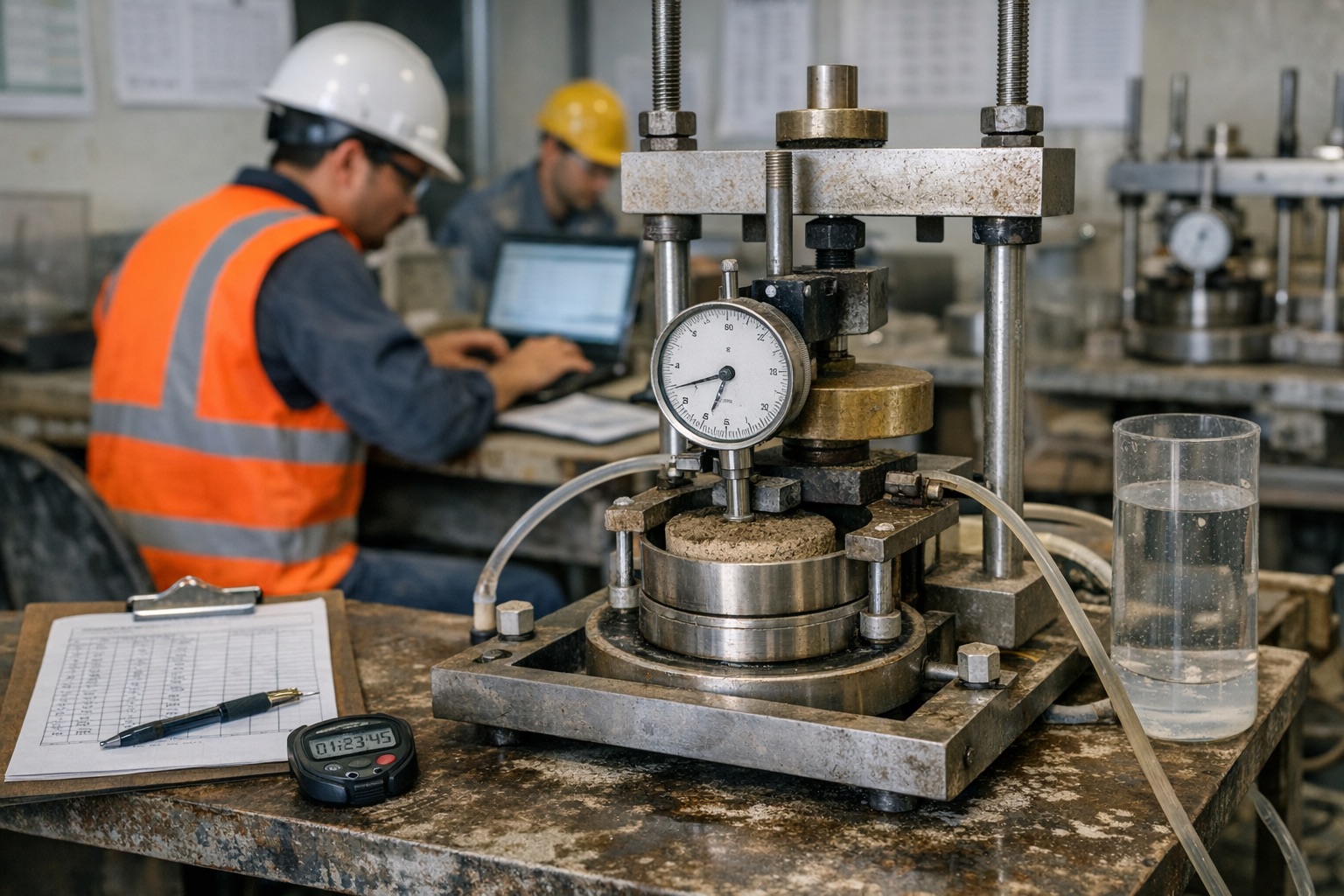
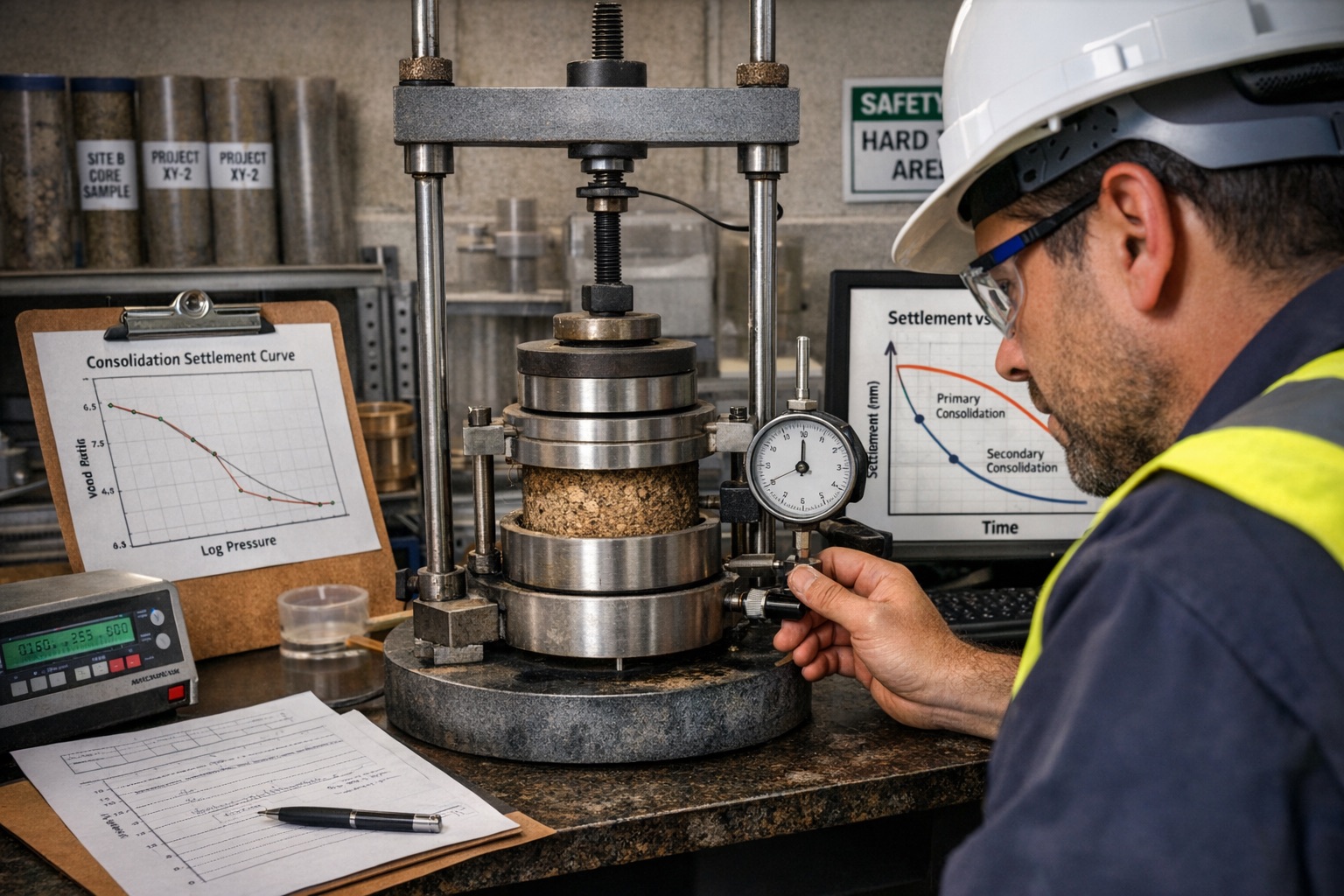
Soil consolidation test in progress using an oedometer apparatus to measure clay compressibility and predict foundation settlement in a civil engineering laboratory.
Procedure: Step-by-Step Consolidation Test
The test follows a strict procedure. Shortcuts reduce accuracy and impose risk lateron. Care always matters. The test may last days. Sometimes more than a week. Patience improves results.
These steps support compliance with California Geological Survey recommendations. Below are the simple steps to carry out the consolidation test for soil.
Step 1: Sample preparation: The soil is trimmed carefully. Edges are smooth. Thickness is controlled. Poor trimming causes errors.
Step 2: Saturation: The sample is placed in water. Air bubbles must escape. Full saturation is essential. Consolidation theory assumes saturated soil.
Step 3: Seating pressure A small load is applied. This removes gaps. Initial movement stabilizes.
Step 4: Load increments Loads are applied in stages. Each stage remains for a set time. Load usually doubles each step.
This is the load increment test for clay. It simulates gradual construction loading.
Step 5: Time-based readings Settlement is recorded over time. Early readings capture rapid compression. Later readings capture slow consolidation.
Step 6: Unloading and reloading Loads are removed gradually. Rebound is observed. This reveals soil history.
Parameters Obtained from the Test
The soil consolidation test provides several key parameters. These parameters are not abstract numbers. They directly influence design decisions. The obtained parameters are:
- Compression index (Cc) This shows how compressible the soil is during virgin loading. Higher values mean more settlement.
- Recompression index (Cr) This applies during unloading and reloading. It shows soil stiffness after stress removal.
- Preconsolidation pressure This is the maximum past effective stress. It tells the soil’s story.
- Coefficient of consolidation (Cv) This controls settlement speed. It combines permeability and stiffness effects.
- Initial void ratio This reflects soil structure at the start. Loose soils compress more.
Interpreting Results to Predict Settlement
Test data must be interpreted carefully. Good interpretation is critical for approvals by Los Angeles County Public Works. Graphs are used. The most common is void ratio versus log pressure. From this curve, engineers identify the following:
- Preconsolidation pressure This separates elastic and plastic behavior. It defines soil history.
- Compression index This controls settlement magnitude. It is used in settlement equations.
- Soil consolidation state Normally consolidated soils behave differently. Over-consolidated soils are stiffer.
Settlement is calculated layer by layer. Each soil layer behaves differently. Primary consolidation settlement is calculated first. This accounts for most movement. Next, the time rate of settlement is estimated.
This helps predict when settlement will occur. Secondary consolidation is then considered. This affects long-term serviceability. Especially for clay-rich sites. Good interpretation is critical. Even good data can give bad results if misread.
Applications in Foundation Design
The soil consolidation test influences many designs. The test also helps plan monitoring programs. It supports risk management. For example:
- Shallow foundations Footings must limit settlement. Differential settlement controls design.
- Raft foundations Large areas increase consolidation effects. Uniform settlement becomes important.
- Pile foundations Consolidation affects pile loads. Negative skin friction may occur.
- Embankments and fills Settlement continues after construction. Staged loading may be required.
- Ground improvement techniques Preloading relies on consolidation behavior. Vertical drains shorten settlement time.
Limitations and Considerations
The soil consolidation test is powerful but it is not perfect. Lab data should be supported by field data. Instrumentation improves confidence. Here are some limitations for consolidation test.
- Laboratory samples are small Field conditions are more complex. Scale effects exist.
- Soil disturbance affects results Sampling alters structure. Compressibility may increase.
- Field drainage differs Real drainage is three-dimensional. Lab tests assume one dimension.
- Secondary consolidation is uncertain Creep varies by soil type. Long-term prediction is difficult.
- Assumptions simplify reality Engineering judgment is always required.
Conclusion
The soil consolidation test is a cornerstone of geotechnical engineering. It explains how soil compresses under load. It explains how time affects settlement. Using the oedometer test, engineers predict settlement before construction.
This protects structures. It saves money. It prevents failure. The consolidation settlement test remains essential. Especially for clay soils. Especially for long-term performance. Understanding consolidation is not optional. It is the foundation of good engineering.
This test protects structures. It saves money. It prevents failure. Because of its importance, agencies rely on the consolidation analysis. LADBS, Caltrans, Los Angeles County Public Works, LA Metro, and the California Geological Survey are some of them.
FAQs
Why is the soil consolidation test important?
The test helps predict foundation settlement. It shows how much a structure may sink. It also shows how fast settlement will occur. Without this test, settlement estimates are uncertain. This increases the risk of cracks and structural damage.
Which soils require a consolidation test?
The test is most important for clay soils. Silt with low permeability may also require testing. Sandy soils usually drain fast. They show little time-dependent settlement. Consolidation tests are rarely needed for clean sand.
What is an oedometer test?
An oedometer test is another name for the soil consolidation test. It uses a device called an oedometer. The test allows vertical compression only. Side movement of soil is prevented. This simulates one-dimensional consolidation in the field.
What is consolidation settlement?
Consolidation settlement is time-dependent settlement. It occurs as water drains from soil pores. This type of settlement is common in clay soils. It may continue for months or years after construction.
Build with knowledge. Build with confidence. Build smart from the ground up.