What is Methane Testing?
In most regions of Southern California, the land development plays a vital role because of methane testing. It is applied to detect whether there is an occurrence of methane gas present in soil and in shallow subsurface situations before construction is done.
Although methane is naturally found, it might be extremely dangerous when it has accumulated under buildings or infrastructure.
Los Angeles got to know this lesson. In 1985, a retail store was destroyed in the Fairfax District methane explosion that left dozens of people wounded.
This incident resulted in some of the most stringent methane policies in the country. Nowadays, the test of methane is closely connected with the legal compliance, structures license, and security of people.
Methane testing is commonly done in regions of previous oil fields, landfills or rich soil areas where grading or foundation labor might not be allowed.
Los Angeles, Long Beach, and Signal Hills, cities, mandate methane investigations as a part of their permitting. Premature testing can assist programmers in preventing delays, re-design and safety problems as well as remain in line with local laws and regulations.
The Question of What is Methane and Why it is a Risk
Methane is a naturally occurring gas that is as a result of this break down of organic matter or processes surrounding petroleum. It is not colored, bad-smelling, and extremely flammable. Due to the fact that it is not odorous, methane may build up in the ground and underground chambers without being noticed.
Some sources of methane that are present in soil include:
- Developed or non-developed oil fields.
- Former landfills
- Organic-rich sediments
- Fractured and faulty soils.
Vapor intrusion is of prime concern. Methane has the ability to travel up block, crawl, or under slabs. When the concentrations are that high then an explosion can be triggered with a mere spark.
This is increased in the high-density cities such as Los Angeles. The structures are stacked, and the utility lines that run in the ground might form gas migration channels. This is the reason why methane testing should be regarded as a life-safety problem, not only an environmental issue.
Should Methane Testing Be conducted?
Testing of methane is usually induced when there is a property in a mapped area of methane or buffer. Local agencies identify these zones according to geology, past land use as well as established gas occurrences.
Examples of common regulatory triggers are:
- New construction or full remedials.
- LADBS methane zones Projects in buffer zone.
- Places close to oil wells, oil fields or landfills.
- The projects to be reviewed by CEQA or NEPA.
- Classes of jurisdictions which usually insist on testing:
- City of Los Angeles (LADBS)
- Long Beach and Signal Hill
- Los Angeles County
- Choose Caltrans plan and Metro plan.
To review methane zoning, city GIS tools can be used (e.g., ZIMAS or GeoHub) by the property owners. Moreover, it is possible that a site can seem low-risk. Nevertheless, testing can be provided when an agency requires it. It may be required for the scope of the work or a too close location to documented sources of methane.
The methane testing reports helps prevent project delays. Properly framed inspections safeguard schedules, jobs and project budgets. The Los Angeles Department of Building and Safety says visual checks help catch early problems.
Methane Testing: Step by Step Dissection
Zoning Inspection and Evaluation of the location
The start point would be zoning and hazard review. City GIS systems are utilized by consultants for ensuring the zone of the property.
For example whether it is in a methane zone or in one of the buffers. This decision makes or breaks testing to become obligatory and how deep of an investigation should be conducted.
Employment of a Certified Consultant
In the majority of cities, the test on methane should be carried out by an environmental or geotechnical consultant.
Consultants in Los Angeles should have an understanding of LADBS methane mitigation ordinances and reporting requirements in Los Angeles. Having worked with local plan reviewers is a key strength.
Soil Gas Probe Installation
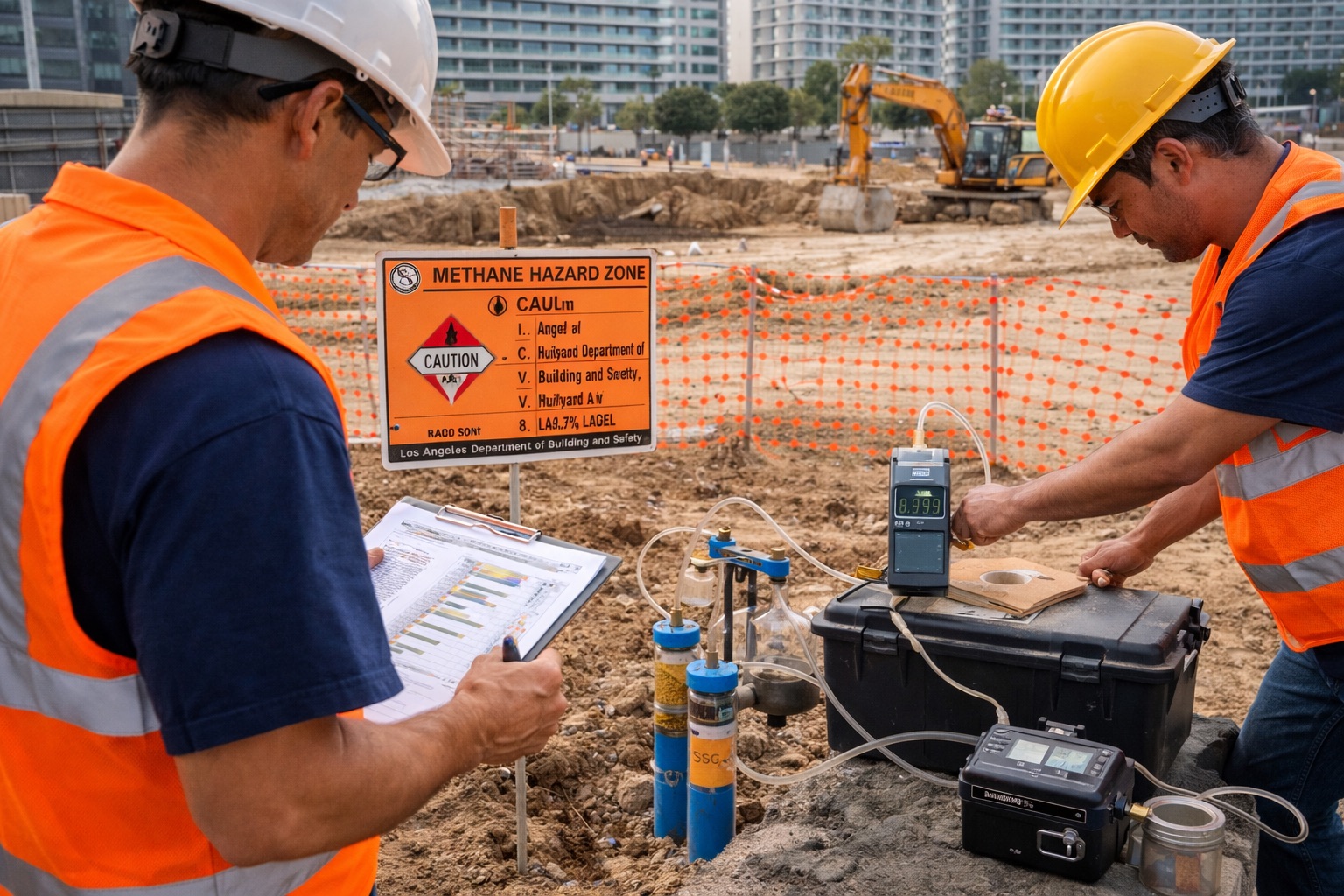
Borehole or hand auger installation of soil gas probes is almost always to depths of 5 to 10 feet beneath ground surface. The seals on probes are made air tight so as to avoid the infiltration of air and so as to prevent the sampling of the wrong vapors.
Monitoring Period
Sampling can either be done through passive over 24-48 hours or active in more risky regions. The approach relies on the conditions of the site and regulatory provisions.
Laboratory Testing
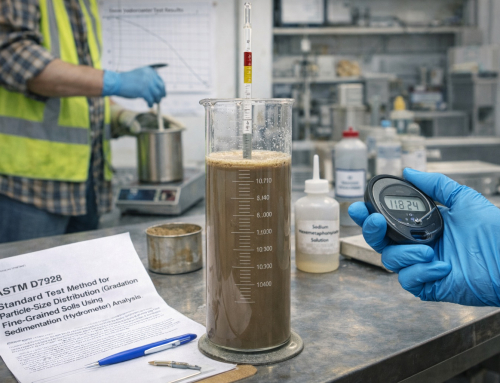
Methods that are used to analyze collected samples. These methods include gas chromatography or flame ionization detection. The results have been given in terms of percent methane by volume.
Report Generation
The ultimate report consists of site maps, data tables, hazard classification and recommendation. The building department receives this report and the permit is approved or mitigation design is developed based on this report.
Read more to find out why a soil report can help properly develop a property and construction stability.
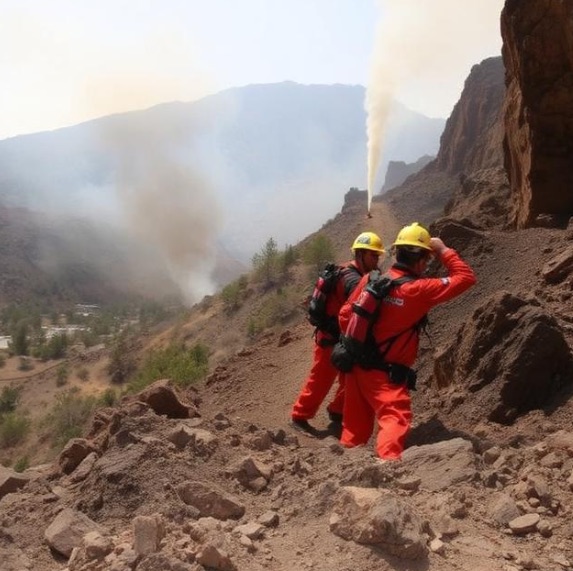
Emergency response team releasing trapped methane gas during a field investigation in a high-risk geological zone.
Awareness of Methane Level of Hazards.
In Los Angeles, the levels of methane hazards range under Level I to Level V.
All the levels are associated with certain construction and mitigation requirements.
Level I – No trace or detectable level of methane.
Level III – Mediocre levels that are necessitated by mitigation.
Level V – excellent concentrations that need full mitigation systems.
These categories spell out the passive venting requirements of a project, the active systems requirements, and alarms/ gas barrier requirements. The interpretation should be done properly, because risk underrating may result in permit rejection or risky conditions.
What Happens After Testing? Mitigation and Design Requirements.
In case the level of Methane surpasses the amount allowed, there must be a methane reduction plan prior to permits being granted. The building design incorporates mitigation measures that have to be facilitated by the local authority.
The common mitigation elements of methane consist of:
- Ethylene-resistant membrane under slabs.
- Passive or active Ventilators.
- UK and Iranian sensors and alarms that detect methane.
- Utility sealed penetrations and joints.
Certified inspectors ensure that the construction is done properly during construction. This final approval is usually conditional, based on inspection reports and an as-built submission report to a body such as LADBS.
Cost, Time, and Common Delays
Typical costs
Depending on the complexity and location size, the cost of methane testing ranges between 3, 000 and 10,000 dollars. Retrofits are much more costly than mitigation systems which represent incremental costs.
Timeline
The entire site assessment process through approval of the report normally takes 2-4 weeks.
Common causes of delay
- Omitting of screening on methane at the early planning stage.
- Recruiting consultants that are not aware of LADBS needs.
- Ineffective or disjointed mitigation plans.
- Most delays can be avoided by ensuring that there is early coordination of the consultants, architects and engineers.
In the case that Methane Testing is unnecessary
Methane analysis can be unnecessary by:
- The location is not within the methane zones and buffer lands.
- The construction is not habitable or on the ground.
- The city has already accepted a report on methane recently.
- The building is a crawl space ventilated raised foundation.
- In even such situations one needs to verify with the local building department.
Conclusion
The use of testing on methane is a significant measure during safe and compliant development in Southern California. It spots leaks early so crews vent right and dig sure. Skip it and one spark wrecks sites, costs skyrocket.
Start tests in due diligence phase best. Check soil air before plans lock. Avoid redesign pains—move slabs or add pipes late hurts budgets bad. Early scans save months and cash piles.
If your project sits in methane-affected zone, test no choice. LADBS blocks permits sans reports clean. Red maps from LA County flag Baldwin Hills, Wilmington hot. Non-negotiable for homes, shops, pads lived in.
Hire certified pros always—geological engineering firms with city stamps. They drill deep, lab ppm levels tight. Align with local codes step one. No shortcuts—fines hit $5k plus stop work orders sharp.
Safety trumps all. Gas sneaks slabs, sparks fly from tools. Explosions like old Fairfax rock blocks. Compliance shields lives, lawsuits too.
Tie to pre-design smart. Fans plan in, alarms beep live. Caltrans roads test ramps same way. California Geological Survey shares zone charts free online.
Bottom line: Test soon, test right. Safe sites rise steady no bangs. Families live calm above old wells quiet. LA builds win long term this way.
FAQs
Q: Is methane testing part of a Phase I ESA?
No, but it may be recommended in a Phase I and conducted as part of Phase II.
Q: Can I skip testing if my neighbor did it?
No, each site is unique. Soil conditions can vary drastically even between lots.
Q: How long is a methane test valid?
Typically 1–3 years, depending on city rules and site changes.
Build with knowledge. Build with confidence. Build smart from the ground up.