A Guide to Ground Anchor Testing & Certification
Across any deep excavation or retaining wall project in a city, you will spot steel rods driven into the ground. These rods at a certain angle, and plates and hardware are the caps on them. The rods are ground anchors.
These rods are tested before anchoring and under load to check the behavior in real conditions. Ground anchor testing & certification is the process that turns a buried steel rod into a great support for soil.
Difference between Tiebacks, Soil Nails, and Ground Anchors
People use all these terms almost interchangeably on site, but they are different. Such as:
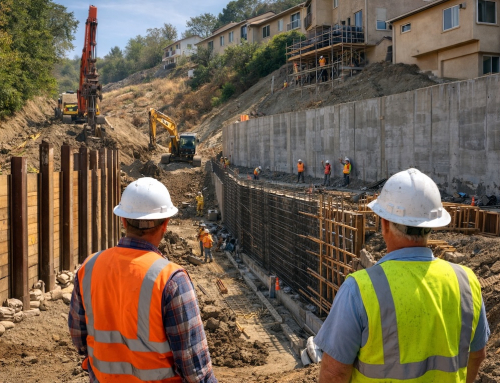
- A tieback is a tensioned, grouted anchor installed behind a retaining wall. A ground anchor system resists the outward soil pressure the wall is holding back. Its bond length has to extend past the potential failure surface, or the anchor has nothing solid to grip.
- Soil nails work on a similar principle but are usually shorter and more closely spaced. These nails go in stages as an excavation goes down. The wall face and the reinforcement get built together, i.e., layer by layer. This staged approach is why shoring wall tieback testing and soil nail testing, while related, aren’t quite interchangeable.
- Ground anchor is the umbrella term for both tiebacks and soil nails. It also includes vertical tie-down anchors used to resist uplift at foundations and bridge structures. However, the terms don’t matter because they all get through the ground anchor load test.
Why Ground Anchor Certification Actually Matters
Ground conditions shift across even a small site; grout bond quality is not always consistent. A tendon looking fine on drawings can still slip or fail under real load. Anchored wall or slope failure happens fast and with little warning. So, ensuring an efficient ground anchor system requires a formal geotechnical anchor certification in Los Angeles, California by Marshall Geoscience.
Certification is not only a safety measure but also protection. All stakeholders, i.e., the contractor, the engineer of record, and the property owner, are in a safe zone. A signed, stamped test report is the difference between “we verified this anchor holds” and “we assumed it probably does.”
Types of Load Tests for Ground Anchor
Most projects end up using a mix of these, not just one. Here are the tests for ground anchor systems.
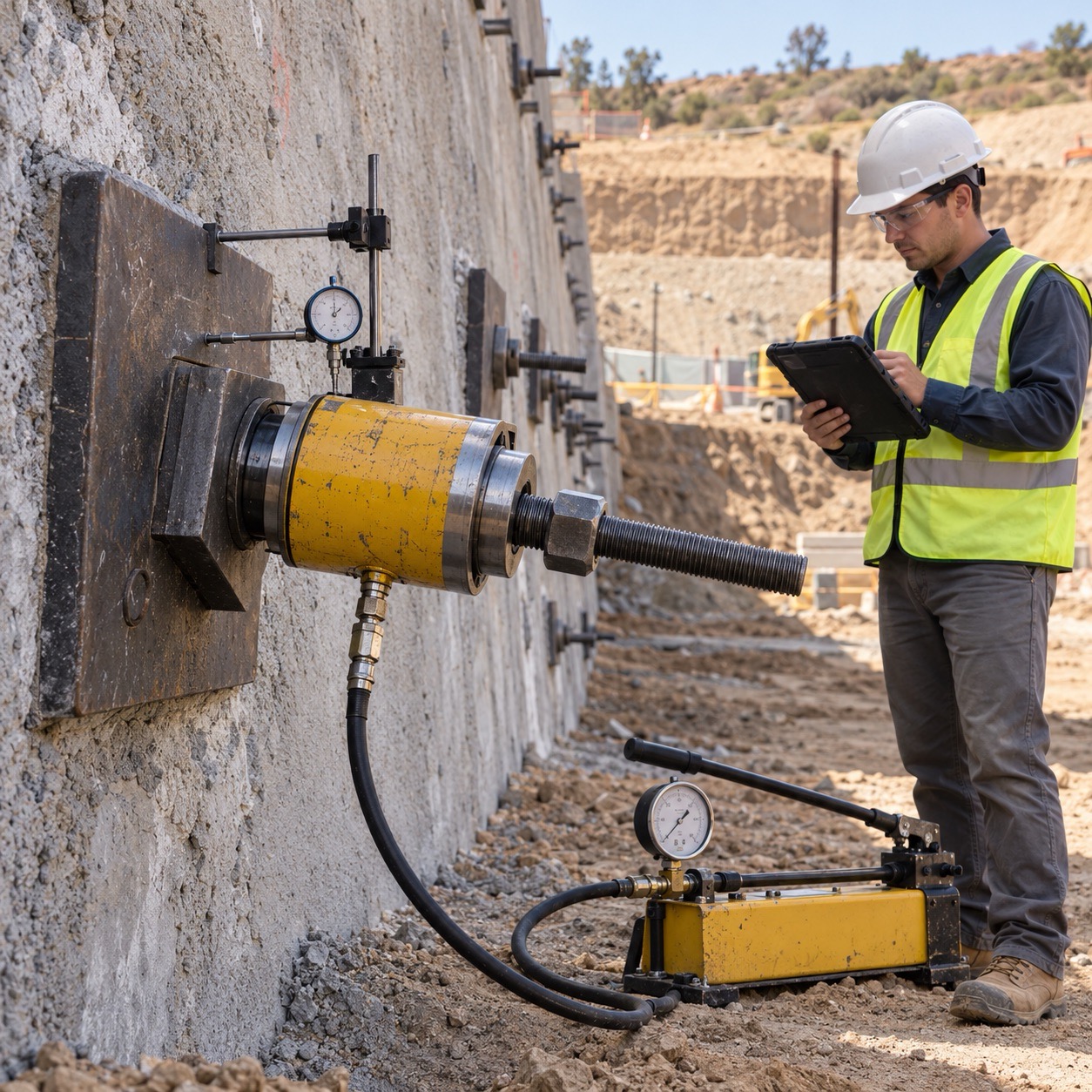
- Proof testing tiebacks is the standard approach for the majority of anchors on a job. A hydraulic jack pushes progressively larger loads onto the anchor while gauges record the resulting load-elongation curve.
Every anchor that is not specifically chosen for a performance test gets a proof test instead. Usually, the test load ranges from 120% to 150% of its anchor design load. However, it depends on which specifications govern the project.
- Performance testing of ground anchors is more involved. In this test, we load and unload the anchor in cycles following a set sequence. It provides a much more reliable picture of how it behaves under stress. This test is not performed on every anchor.
Typical practice tests the first couple installed, then a percentage (often around 5%) of the remaining production anchors. You can add more tests where soil conditions vary noticeably across the site.
- Creep test ground anchor procedures hold a fixed load for a defined period and track how much the anchor continues to move. Ongoing movement under a constant load is one of the clearest signs that the bond zone isn’t behaving as designed.
- A related but distinct step is the tieback pullout test. It is sometimes run during pre-production or as a suitability test before full installation begins. This test confirms that the chosen anchor design will fit in the site’s specific ground. However, this is separate from the anchor acceptance test performed on anchors that stay permanently in place.
The Standards Behind Anchor Testing
Two references dominate this field in The United States
- PTI DC35.1 standards are available with the Post-Tensioning Institute’s Recommendations for Prestressed Rock and Soil Anchors. It is the reference document for design, installation, and testing. Most project specifications for post-tensioning institute anchor testing are built directly around this document.
- The FHWA Geotechnical Engineering Circulars cover much the same ground from a public infrastructure angle. State transportation departments generally layer their own specs on top of these federal circulars.
- In California, Caltrans Geotechnical Services maintains its own geotechnical manual sections for ground anchor systems. It relies directly on the FHWA framework.
- If a project is located close to a mapped fault or other geologic hazard, the California Geological Survey (CGS) is the State agency. The hazard mapping component of it can directly influence the anchor design via the geotechnical report.
All of the geotechnical record and the local building code typically add project-specific acceptance criteria. It includes movement limits, minimum bond lengths, and creep thresholds pulled directly from that site’s soil report.
Our soil testing and geotechnical laboratory services in Los Angeles help achieve your construction goals by avoiding risky project decisions that can cause massive construction issues. Properly framed inspections safeguard schedules, jobs and your project budgets.
Anchor Testing Process
However the paperwork is organized, the field sequence tends to look about the same:
- Equipment setup:
A frame is set up independently from the structure being built. It includes a jack, load cell, and dial gauges (or an electronic equivalent) that get rigged to the tendon.
- Alignment load:
We apply a small nominal load. It is just to seat the equipment and remove slack. This becomes the reference point for every measurement that follows.
- Incremental loading:
We apply the load step by step, with elongation recorded at each stage. For performance tests, this means cycling load up and back down multiple times rather than one continuous ramp.
- Hold periods:
At key load stages, especially the maximum test load, the load becomes steady while watching the movement closely. This is where creep behavior reveals itself.
- Checking against acceptance criteria:
After the procedure, we compare the results to standard movement and creep limits and the site-specific soil report. An anchor not meeting those numbers will not just pass through anyway. It will get retested, redesigned, or replaced.
- Lock-off
Once an anchor passes, we lock off the prestressed load. The load is usually 80 to 100% of the design load, and the test rig comes off. Now the finished element becomes part of the permanent excavation support tieback system.
Find out why every property undergoing construction in Los Angeles requires anchor testing for soil strength because it can heavily affect your foundation, especially when building a permitted foundation for a property in Southern California where underground corrosion can cost you more than just money, it can cost your life!
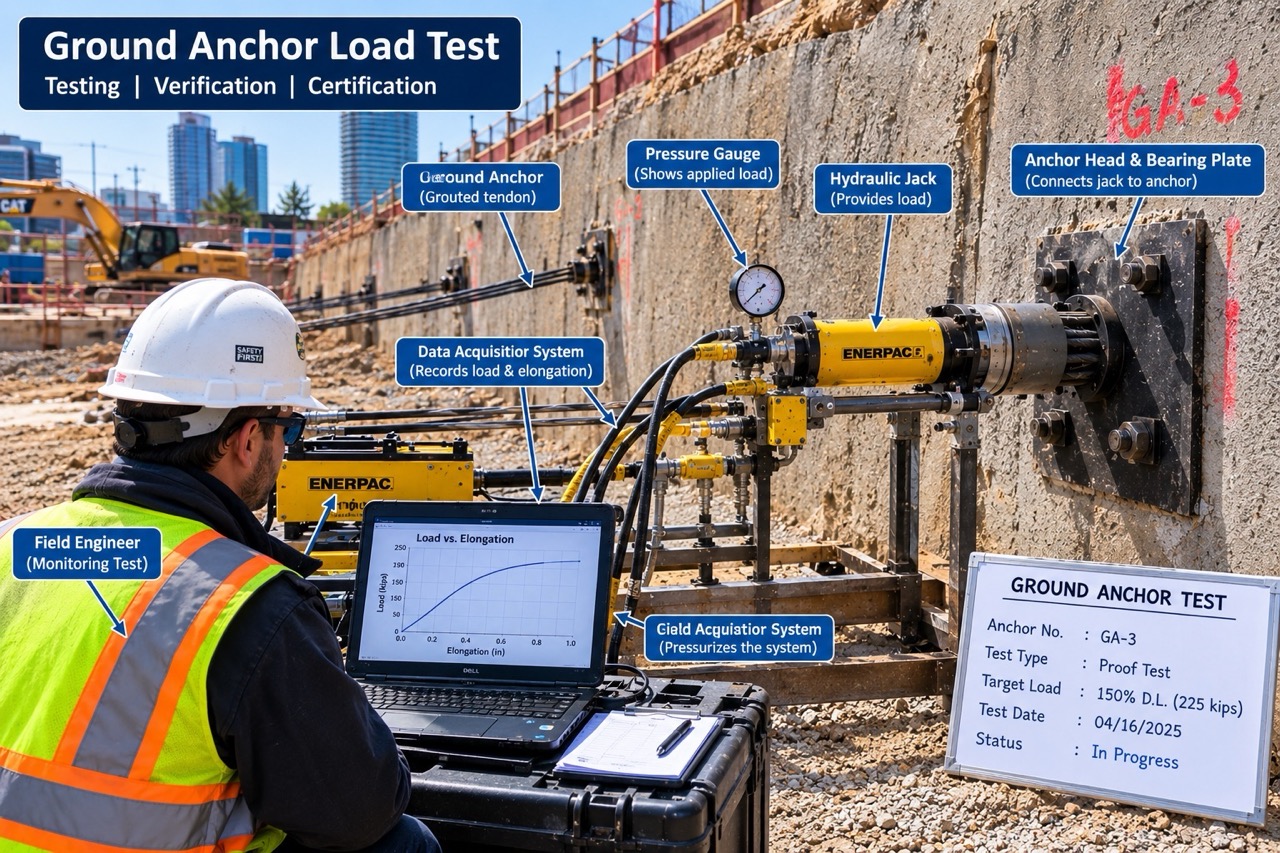
Ground anchor creep testing using hydraulic loading and displacement monitoring to measure anchor movement under sustained load and verify long-term performance.
Who Handles the Certification Paperwork?
A test without proof does not carry much weight later. A complete certification package generally covers:
- Qualifications of the certified anchor installer and crew, including documented training for specialty anchor types
- Tendon, corrosion protection, and grout mill certifications
- Grouting records — cement type, grout volume, and grout pressure for both bonded and unbonded lengths
- Load-elongation curves and full test data for every anchor tested, proof or performance
- As-built records showing each anchor’s location, orientation, capacity, and installed length
- Final review and sign-off from the geotechnical engineer of record confirming results meet the project’s acceptance criteria
For permanent anchors on higher-risk structures, some owners also require periodic long-term monitoring after construction wraps. Ground movement and corrosion keep progressing long after the crew leaves the site.
A related process, soil nail wall inspection, continues through the life of the wall on many public projects. We require this inspection particularly where the FHWA circulars require ongoing performance checks.
When Environmental Testing Overlaps with Geotechnical Work?
We may need environmental screening of the site along with the geotechnical anchor testing. This requirement occurs on sites with a history of industrial or oil-field use. Brownfield redevelopment sites are examples of this scenario. Mostly, a Phase I or Phase II environmental assessment has already flagged subsurface concerns here.
That environmental work looks for things entirely outside the scope of anchor testing, including volatile organic compounds VOCs left behind by past industrial activity. Typically, a different consultant, reporting to a different regulatory framework, handles it.
So, the two processes rarely overlap directly. However, on a complex urban site, it is not unusual for both to be underway at the same time.
Bottom Line Conclusion
Tiebacks, soil nails, and ground anchors are only as trustworthy as the testing standing behind them. PTI DC35.1 governs most private work, and FHWA’s geotechnical circulars carry the same weight on public infrastructure. Both exist because these anchors carry real consequences if they don’t perform.
Proof testing, performance testing, creep monitoring, and thorough certification paperwork aren’t optional add-ons. They are what separates a properly engineered anchor system from a guess buried underground.
F.A.Q.s
What’s the difference between a proof test and a performance test?
A proof test applies one continuously increasing load and covers most anchors on a project. A performance test cycles load up and down repeatedly. It gives a fuller picture of anchor behavior and on a smaller sample. Typically, the criteria is the first few anchors plus a percentage of the rest.
How many anchors actually need performance testing?
It depends on the governing specifications. However, a common benchmark is the first two or three anchors, plus roughly 5% of the remaining production anchors. You can also add more if ground conditions vary across the site.
Are soil nails tested the same way as tiebacks?
The core principles carry over, but soil nails are often tested to different load ratios with somewhat different acceptance criteria. FHWA’s soil nail guidance diverges in places from PTI’s tieback-focused recommendations.
What happens if an anchor fails its test?
It will not be accepted and will go for retest or replacement. Depending on the reason, the engineer may call for additional anchors, a longer bond length, or full replacement.
Who’s qualified to run this testing?
A qualified testing agency should perform the work, and a licensed civil, geotechnical engineer, or geologist should stamp it. Informal, unstamped readings generally won’t satisfy a building department or the engineer of record.
Build with knowledge. Build with confidence. Build smart from the ground up.