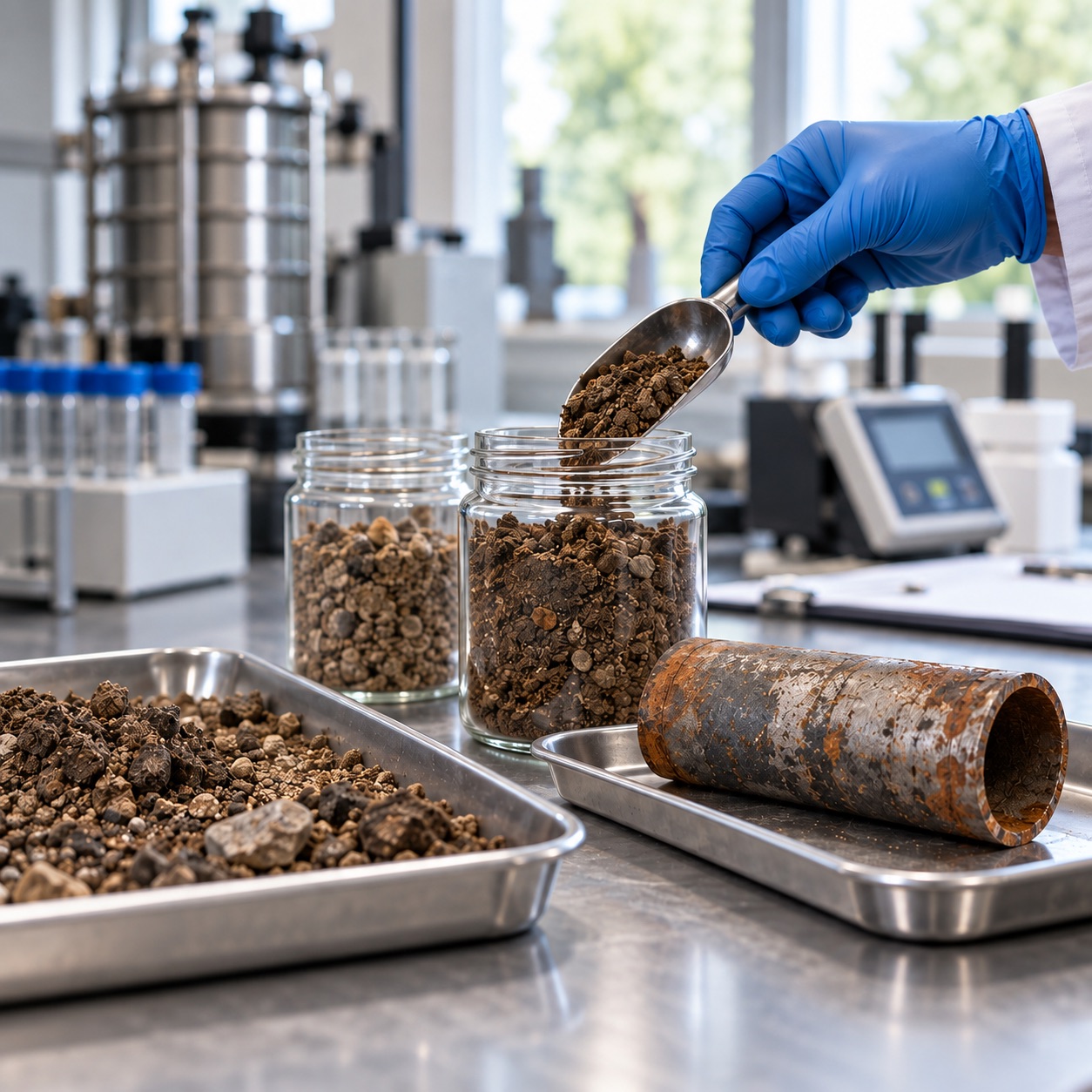
Corrosive Soil Analysis: Protect Buried Structures
Corrosion doesn’t knock before arrival. It moves quietly underground, eating through rebar, pitting pipelines, and hollowing out foundations. However, everything above the surface looks completely fine. By the time something actually fails, the damage has usually been building for years.
The key to avoiding the most common is to know what’s in your soil before you start constructing. In this test primer, you will learn what the test involves, why it is important, and what you can do with the test results. This is why Soil Corrosivity Testing is among the most important pre-construction and post-construction inspections required to maintain property safety and quality.
What Makes Soil Corrosive?
Corrosive soil works like a battery. The moisture and dissolved salts carry electrical current between points of different electrochemical potential. Then metal starts getting consumed at the weak spots. The speed at which this happens is the corrosion rate, and it varies enormously depending on what’s in the ground.
The main corrosive soil indicators to watch for include:
- Low electrical resistivity — the single most reliable predictor of aggressive soil
- High moisture content — saturated ground is almost always more corrosive than dry ground
- Highly acidic (pH < 5.5) – causes losses of metals at a much faster rate than others
- High chloride and sulphate concentrations
- High organic matter content that nourishes anaerobic bacteria that cause microbiologically influenced corrosion
- The poor drainage and erratic water table conditions.
Some sites announce themselves before you even break ground. Low-lying ground near estuaries, old fill material with an admixture of cinders or slag, coastal soils, and clayey soils with poor drainage are trouble spots.
Why Is Underground Infrastructure Damage So Common?
Underground utility failures and foundation corrosion are far more common than most people realize and far more expensive. Pipelines pit and perforate, whereas rebar inside concrete corrodes and expands, cracking the surrounding material from the inside out.
Steel piles quietly lose cross-section and load capacity. Grounding systems and transmission lines degrade at connection points nobody can see.
The problem is that external corrosion is invisible by definition. There’s no warning sign, no gradual deterioration you can spot on a site walk. You find out about it when a water main fails under a completed street, when a foundation shows spalling concrete, or when a gas line releases.
PHMSA regulates the pipelines to have corrosion control and monitoring requirements. The California Department of Transportation (Caltrans) requires corrosion testing of highway structures. Soil reports are necessary for soil corrosivity analysis by the LADBS. In many instances, testing is not an option; it is a code requirement.
The Right Test Method: ASTM G57 Soil Resistivity
The industry-standard test method for evaluating the corrosion potential of soil is the ASTM G57 by ASTM International. It’s the backbone of any serious corrosive soil analysis and works like this:
- Four equally spaced electrodes are pushed into the ground.
- Current passes between the outer two, and you measure the voltage across the inner two.
- The result is soil resistivity measurements in ohm-centimeters
- It tells you how freely electrical current flows through the soil. The more freely it flows, the more aggressively it corrodes buried metal.
Usually, we lay out these along pipeline alignments or across building pads. We provide the electrode spacing adjusted to probe the depth where your foundations and utilities will actually sit.
What do the Numbers Mean?
| Resistivity (ohm-cm) | Corrosivity |
| Below 500 | Very severely corrosive |
| 500 – 1,000 | Severely corrosive |
| 1,000 – 2,000 | Moderately corrosive |
| 2,000 – 10,000 | Mildly corrosive |
| Above 10,000 | Essentially non-corrosive |
Beyond the soil resistivity test and soil corrosivity testing, a complete corrosive soil analysis also covers:
- Soil pH and redox potential — identifying acidic zones and anaerobic conditions where bacteria drive accelerated corrosion
- Chloride content — chlorides destroy the passive film protecting embedded rebar
- Sulfate content — sulfates chemically attack cement paste, mapped to ACI 318 exposure classes that dictate cement type
- Sulfides — a marker for microbially active, anaerobic ground
A soil sample for each of these parameters should come from the same depth where your buried assets will actually live. The most efficient approach is to pull corrosivity samples directly from your geotechnical borings. It will have the same mobilization and holes; moreover, you may not require an extra site visit.
The soil corrosivity testing can assist in inspections to prevent project delays by avoiding risky project decisions that can cause massive construction issues. Properly framed inspections safeguard schedules, jobs and your project budgets.
Soil pH and Redox Potential: The Overlooked Variables
The engineers often ignore the pH and redox potential of soils, but they play a significant role in practice.
Acidic soils have a pH of less than about 5.5 and can allow for the rapid loss of metals. They also may affect grounding resistance for electrical systems. On the other hand, when the pH is very high, it will be corrosive to zinc coatings and aluminium.
Redox potential is an indicator of anaerobic zones of low oxygen levels where sulfate-reducing bacteria thrive. These bacteria increase corrosion of steel that can progress faster than normal soil chemistry would allow.
On wet, low-lying sites with high organic matter content, this is a serious hazard worth testing for specifically. It is the purely resistivity-based assessments that you can miss entirely.
Find out why every property undergoing construction in Los Angeles requires soil corrosivity test and soil analysis as it can heavily affect your construction, especially when building a permitted foundation for a property in Southern California where underground corrosion can cost you more than just money, it can cost your life!
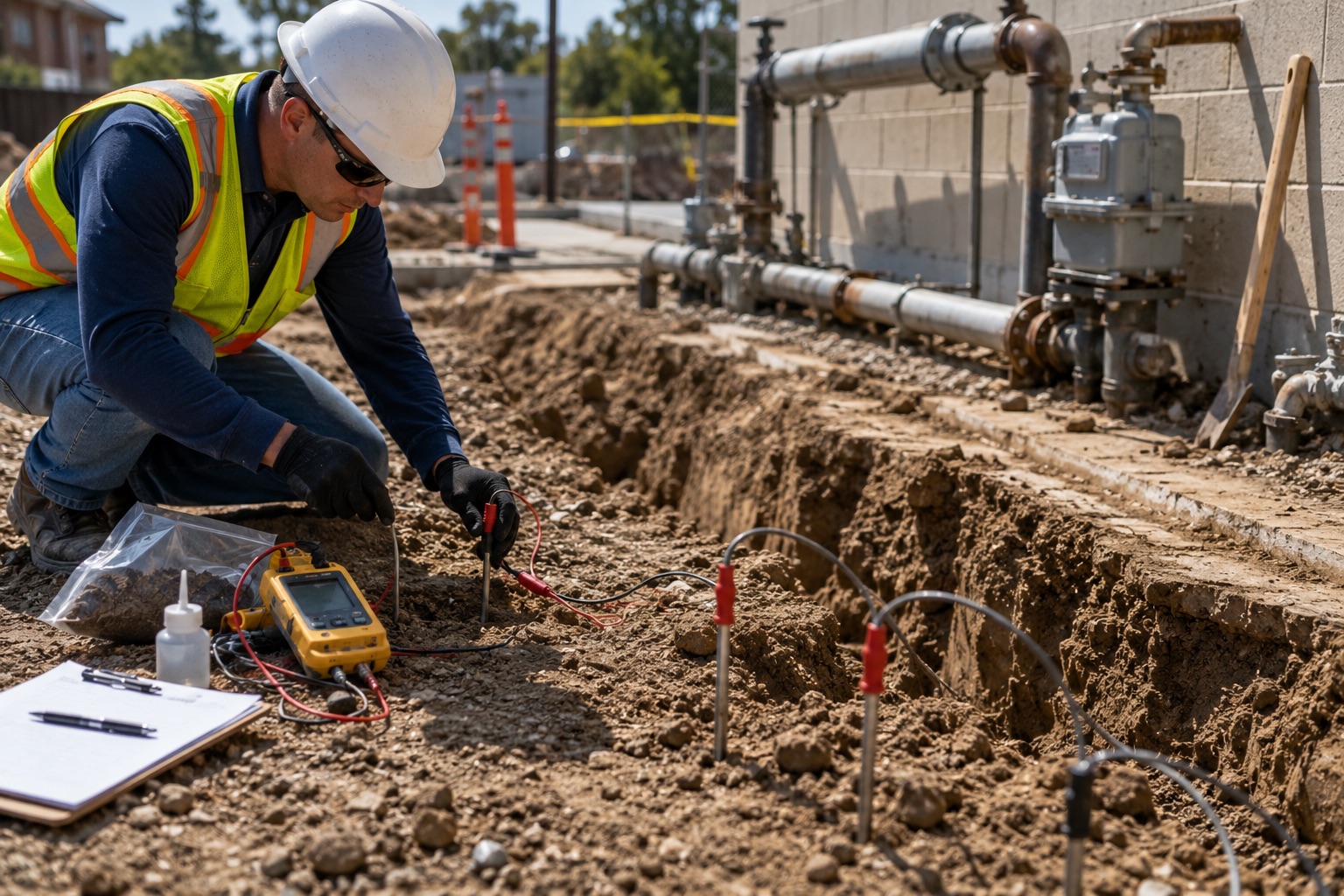
Field engineer performing ASTM G57 soil resistivity testing at an active construction site to evaluate corrosive soil conditions and protect buried pipelines, reinforced concrete foundations, and underground infrastructure from long-term corrosion damage.
Pipeline and Utility Corrosion: A Particular Risk
The cost of pipeline and utility corrosion extends beyond just the cost of the repairs. With water and sewer lines, pitting and perforation result in contamination, infiltration, and leaks. For pressurized gas mains, the stakes are public safety.
The American Water Works Association (AWWA) has developed the AWWA C105 10-point scoring system for ductile iron pipe. It is a composite corrosion risk score based on resistivity, pH, redox, sulfides, and moisture.
Transmission lines and grounding systems face their own version of the problem. High soil corrosivity accelerates degradation at grounding connections. It further degrades buried conductors, increasing grounding resistance over time and compromising system performance. Hence, soil corrosivity poses a risk that electrical engineers and geotechnical teams should evaluate together.
Corrosion Control: What You Can Actually Do About It
Once you know your classification, corrosion control is straightforward. The tools are well-proven and, in most cases, very cost-effective relative to the risk they address.
Choose the right materials from the start
- Type II or Type V cement for concrete in aggressive ground conditions. Concrete with sulfate-resistant types II or V cement in aggressive ground.
- The reduced amount of concrete around the rebar
- Reinforcing steel (after epoxy coating or stainless) when necessary
- Non-metallic piping, except when metal is structurally needed (such as HDPE or PVC pipes)
- Polyethylene encasement for ductile iron pipe in severely corrosive ground
Use protective coatings
Fusion-bonded epoxy and wrap or tape systems create a physical barrier between buried steel and the soil electrolyte. For most buried pipelines, coating is the first and most cost-effective line of defense.
Install a cathodic protection system
A cathodic protection system counteracts the electrochemical process driving corrosion by making the buried asset entirely cathodic — eliminating anodic metal loss. Sacrificial anode systems work well for smaller, well-coated structures.
Impressed current systems are used for long pipelines and large buried structures where anode voltage alone isn’t sufficient. PHMSA regulations require cathodic protection on regulated pipelines precisely because it works.
Control backfills and drainage
Importing clean, non-corrosive backfill around buried assets and improving site drainage can reduce corrosion exposure dramatically without any changes to the structural design. Prohibiting cinder or slag fill is a simple specification line that prevents a surprisingly common problem.
Design in monitoring access
Test stations for future potential measurements, dielectric isolation at dissimilar-metal connections, and corrosion allowances in steel thickness are small details that pay for themselves many times over during the service life of an asset.
Case Studies: When Testing Made the Difference
Case studies from real projects consistently tell the same story.
A residential development on former agricultural land near an estuary ran a full ASTM G57 survey alongside laboratory chemistry from the geotechnical borings. Resistivity came back below 900 ohm-cm at utility depth — severely corrosive — with elevated sulfates at foundation grade.
The response was Type V cement for all foundation concrete. Suggestions were polyethylene-encased ductile iron for water mains, and sacrificial anodes on metallic service connections. Total added cost: a fraction of one percent of the project budget.
Now let’s compare that with projects with no testing. A corroded water main replacement under a completed urban street routinely costs ten to twenty times as much as usual work. It also causes traffic disruption, service outages, and potential liability.
You can use soil and regional geologic data to help identify high-risk areas on the NRCS and CGS platforms. It’s kind of a handy first screen, but nothing more. The real mitigation of issues like this is to get in touch with us at Marshall Geoscience as we are the top experts in soil corrosivity testing for foundations in Southern California.
What You Need to Know
Underground infrastructure damage from soil corrosion is measurable, predictable, and preventable. The only requirement is that someone actually tests for it before construction begins.
Commission a soil resistivity test — following ASTM G57 — as part of every geotechnical investigation that involves buried steel or concrete. Add the chemical analysis suite for pH, chlorides, and sulfates. Let the results drive your material selection, your cathodic protection system design, and you backfill specifications.
The testing costs very little. Skipping it and discovering the problem after the fact costs a great deal more than money. So don’t wait, get in touch with us today!
Build with knowledge. Build with confidence. Build smart from the ground up.