Engineering Insights to Seepage Pit Design in LA
On-site wastewater management is an important aspect of water management in LA County. Soil percolation and seepage pit systems are an important component there.
Private wastewater systems rely on on-site management for treatment and disposal. These systems rely on the capacity of the soil to absorb and treat the effluent and so depend heavily on the soil.
Southern California faces settlement, stringent environmental laws, and increasing awareness of the water conservation issue. So, Soil percolation evaluation is particularly significant in this region. Uncontrolled wastewater discharge may increase groundwater pollution, public health hazards, and environmental pollution.
Several agencies are responsible for septic system design and installation in California. For example, the Environmental Health Division, Los Angeles County Department of Public Health, and the California State Water Resources Control Board.
They have regulations for wastewater systems to safeguard public health and environmental resources. In Los Angeles County, the design requirements for a seepage pit and understanding soil percolation are critical.
Why Does Soil Percolation Matter?
The percolation of soil is the speed at which water moves through soil and is usually referred to as the number of minutes per inch (MPI). The percolation test is a measure of the ground’s rate of infiltration under controlled conditions.
A percolation test is an important factor to consider when designing a septic system. They aid engineers in deciding if the ground can absorb any wastewater and the dimensions of the disposal system.
Percolation testing helps to serve several important purposes:
- Evaluates drainage feasibility
- Supports septic system design
- Protects groundwater resources
- Prevents wastewater surfacing
- Helps comply with environmental regulations
The soil’s ability to absorb effluent directly affects system sizing. Faster soils may require smaller disposal areas, while slower soils typically require larger systems or alternative treatment methods. Different soil types have different infiltration characteristics.
- The ideal soil type is loamy soils, which give a balance of drainage and treatment.
- Water will move quickly through the soils with higher sand content. They have fast percolation rates and good drainage. But over-fast infiltration could be insufficient to meet the desired treatment prior to reaching groundwater.
- Clay soils are unique because they have small pores and they have slow infiltration rates. If the soil cannot absorb water efficiently, it can pond or come up to the surface as wastewater.
Significance of Seepage Pit in LA County
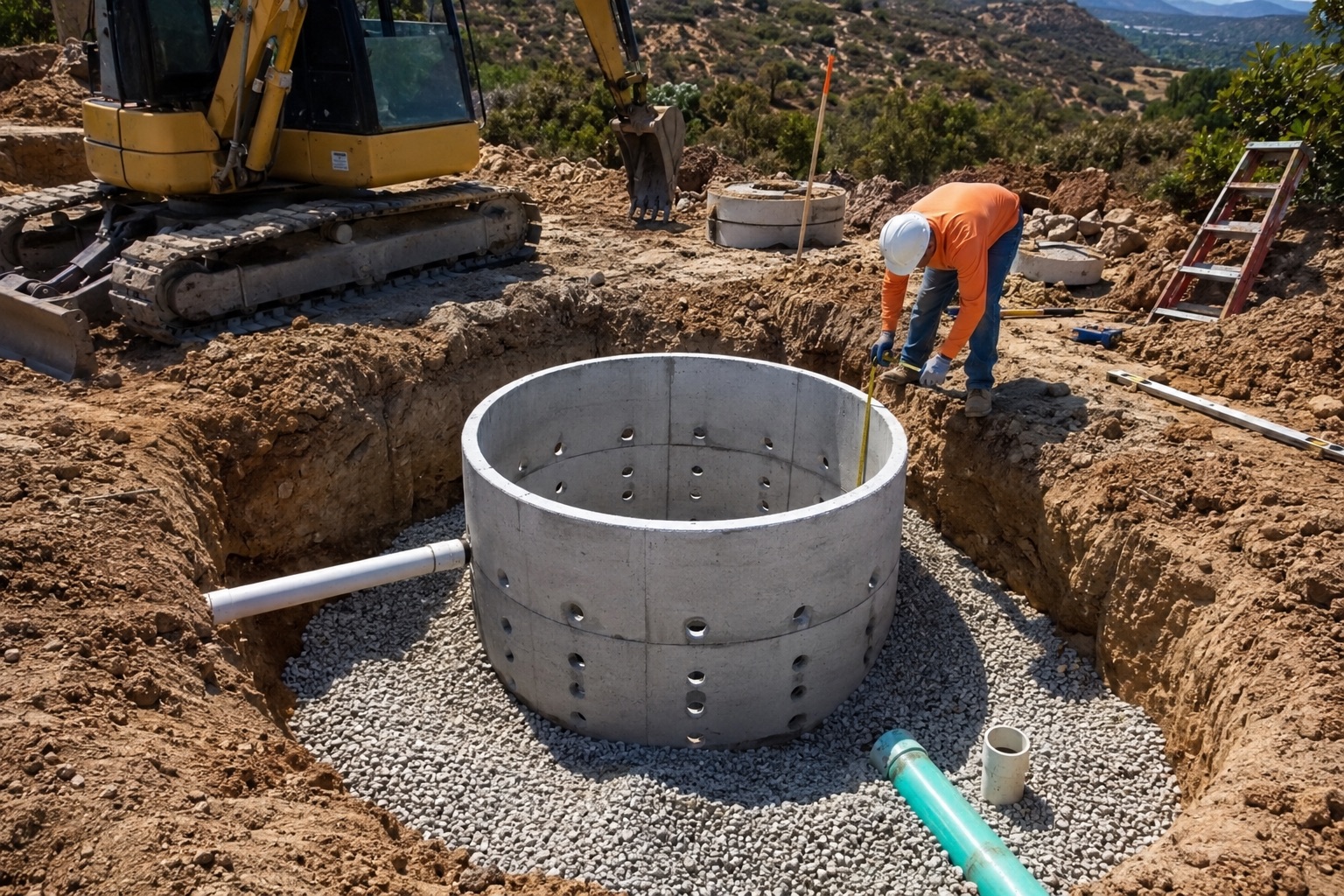
A seepage pit is a deep vertical box to dispose of treated wastewater below the ground surface. Engineers provide perforated concrete rings lining and surround it by gravels. These gravels allow wastewater to infiltrate into the surrounding soils.
These systems are frequently found in residential septic installations throughout Southern California. Engineers recommend these pits on hillside developments where land availability is limited.
The use of seepage pits is controlled under the State’s Onsite Wastewater Treatment Systems (OWTS) Policy. Site-specific requirements may also be imposed by the local jurisdiction(s). Good design is a main factor for avoiding groundwater pollution and long-term system performance.
Seepage pits are commonly used when:
- Property size is limited
- Surface infiltration is poor
- Site conditions restrict conventional leach fields
- Hillside development reduces the available disposal area
The correct geotechnical site assessments prevent project delays and avoid risky project budget issues. Properly framed inspections safeguard schedules, jobs and your project budgets.
LA County Requirements for Percolation Testing
Percolation testing in Los Angeles County must follow procedures established by the Los Angeles County Department of Public Health.
The test accurately evaluates the infiltration characteristics of the soil at the proposed wastewater disposal system site. Typical requirements include:
- Multiple test holes
- Specific test depths
- Soil saturation procedures
- Controlled testing conditions
- Detailed documentation
The number of test holes depends on site conditions and project requirements. Multiple tests provide a better understanding of soil variability across the property.
The engineers excavate the test holes to depths corresponding to the proposed seepage pit or leach field location. This helps engineers evaluate the soil that will actually receive wastewater.
Sometimes, at the beginning of measurement, we require pre-soaking. Saturating the soil helps simulate long-term operating conditions and provides more reliable results.
The testing process may take several hours or multiple days, depending on soil conditions and regulatory requirements. Field observations and documentation are critical components of the approval process.
Read more to find out why it is necessary to perform a seepage pit design assessment before any contstruction can occur.
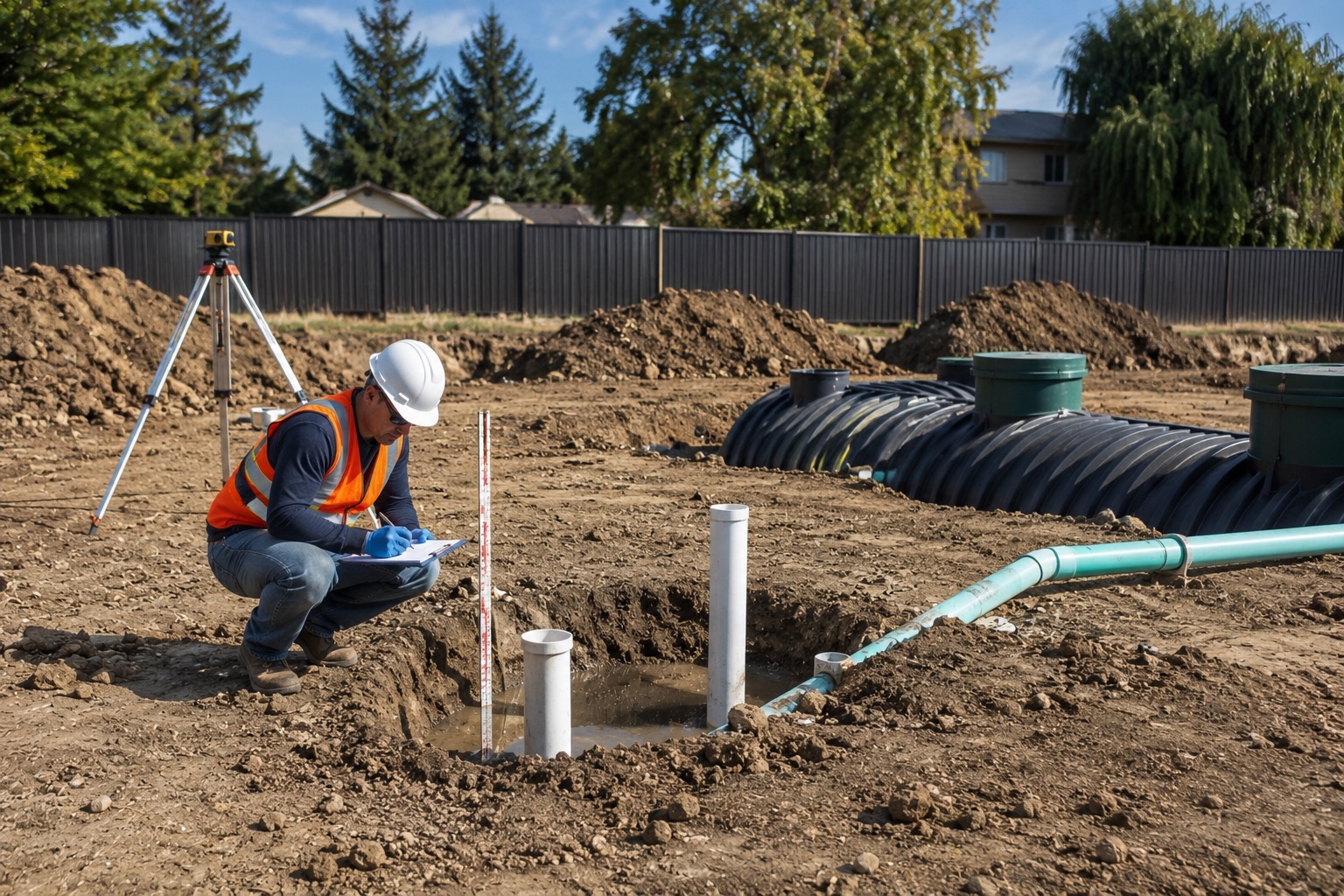
Worker inspecting a concrete seepage pit installation during soil percolation testing and septic system construction in Los Angeles County, California.
Interpreting Percolation Test Results
The results of percolation tests are usually reported in minutes per inch (MPI). This number is the time it takes water to fall 1 in. into the test hole.
The results enable assessment of the site suitability for the use of a conventional septic disposal system. General classifications include:
Fast Percolation:
Engineers consider the infiltration of less than 5 MPI as fast percolation. It causes wastewater to flow to groundwater without treatment. These conditions could create pollution issues and necessitate special design considerations.
Ideal Percolation: 5–30 MPI
This range is generally favorable for many septic system applications. The soil provides both adequate drainage and sufficient treatment.
Slow Percolation: Greater than 60 MPI
Slow infiltration indicates poor drainage characteristics. Wastewater may accumulate in the disposal area, causing system failure or surfacing.
Designing a Seepage Pit System
The design of a seepage pit involves several engineering calculations and site-specific evaluations.
Determining Wastewater Flow
The first step is estimating the expected wastewater flow. Commercial projects may require more detailed calculations based on facility type and expected usage.
Accurate flow estimates are essential because undersized systems can fail prematurely. Residential flow estimates are generally based on:
- Number of bedrooms
- Occupancy levels
- Water usage patterns
- Local regulatory requirements
Pit Dimensions
Engineers determine the required diameter and depth of the seepage pit based on wastewater flow and soil absorption capacity. Typical considerations include:
- Pit diameter
- Pit depth
- Sidewall infiltration area
- Structural stability
In seepage pit design, the sidewall area often provides the wastewater absorption. Bottom area contributes less and may receive limited credit depending on local regulations.
Soil Absorption Area Calculation
We calculate the required absorption area using the percolation rate and projected wastewater flow. Slower soils require larger absorption areas to ensure wastewater disperses safely into the surrounding soil. Engineers use approved design formulas and regulatory standards to determine the minimum required seepage surface area.
Construction Materials
The materials must be durable and capable of supporting surrounding soil loads while allowing wastewater infiltration. Proper construction is essential for long-term system performance. Common seepage pit construction materials include:
- Perforated concrete rings
- Reinforced concrete structures
- Crushed rock or gravel backfill
- Distribution piping
Engineering Considerations in Seepage Pit Design
Seepage pit design requires more than simply calculating dimensions. Engineers must evaluate numerous site-specific factors.
Soil Stratification
The properties of subsurface soils are usually different from one depth to another. Several layers of sand, silt, clay, or disintegrated rock may exist in the same trench/opening. These fluctuations can also affect wastewater flow and system operation.
Groundwater Table Depth
One of the major design considerations is the depth to groundwater. Good separation between the seepage pit and groundwater allows natural soil treatment before entering the groundwater.
Setback Distances
These setbacks help protect structures and environmental resources. Seepage pits must maintain required setbacks from the following:
- Property lines
- Buildings
- Wells
- Watercourses
- Retaining walls
- Other infrastructure
Structural Stability
Deep excavations require evaluation of soil stability and collapse potential. Engineers assess:
- Soil strength
- Slope stability
- Excavation safety
- Long-term performance
Load Considerations
Additional loads from buildings, driveways, and vehicles can affect seepage pit performance. Under heavily loaded unloading conditions, it can cause damage to the system parts and decrease the infiltration rate.
A geotechnical report may be required depending upon the site. It can support design decisions and permit approval.
Environmental and Health Department Requirements
Seepage pit systems must comply with numerous environmental and public health regulations. Los Angeles County Environmental Health officials review system designs to verify compliance with applicable standards. Requirements often address:
- Wastewater treatment performance
- Groundwater protection
- Public health safeguards
- Site suitability
- Long-term system reliability
The California Environmental Protection Agency and State Water Resources Control Board also establish statewide wastewater management policies.
What are the challenges?
One challenge is to ensure sufficient vertical separation between the site of wastewater disposal and the groundwater level. Such separation gives time for natural soil processes to remove contaminants before they get to groundwater resources.
Failure to meet these requirements may delay permits or require redesign. Projects typically require:
- Site evaluation
- Percolation testing
- Design review
- Field inspection
- Final approval
Final Thoughts
In Los Angeles County, soil percolation testing is an essential element of the design of onsite wastewater systems. Improper testing will not give the required information to determine the site suitability for a seepage pit or disposal system.
The use of engineering judgment is an important component in understanding test results and creating effective designs. Each property has its own challenges that must be considered in design, i.e., the soil, groundwater, and regulations.
Meeting Los Angeles County and California requirements ensures protection of public health and environmental resources, and a reliable system.
The benefits of a proper site investigation, geotechnical evaluation, and professional design include a protected environment, reduced maintenance costs, and extended system life.
Build with knowledge. Build with confidence. Build smart from the ground up.