A Laboratory Guide to Concrete Quality Control Testing
Concrete is one of the most important materials. The main constituent of any building, road, or infrastructure. Maintaining quality is important, and testing the concrete in the lab is critical. This guarantees that it will do the job.
Failing to manage concrete quality effectively can lead to cracking, damage, and repair issues. In some cases, it can even lead to collapse. Tests allow engineers to check that the concrete aligns with the design and long service life. Tests follow ASTM International and the American Concrete Institute (ACI).
We also use these standards globally. In places like California, local standards are also mandatory. For example, the standards of the Los Angeles Department of Building and Safety and the California Department of Transportation.
Concrete Strength and Durability
Concrete Strength
The strength of concrete is its resistance to loads. The key consideration for designing concrete structures is. The major characteristic is compressive strength. We define this as the load required to destroy the concrete. High-strength concrete can have high load-bearing capacity.
Concrete Durability
Durability is the ability of concrete to withstand environmental factors. This means it can withstand water, chemicals, and temperature variations. Durable concrete lasts longer. It can bear the effects of cracking, corrosion, and wear. It leads to less costly repairs in the future.
Why is Concrete Laboratory Testing important?
Testing of concrete is important in construction projects. It confirms the quality of concrete to design requirements. It helps to prevent structural failures. It helps engineers to detect and correct issues. You can use it for quality assurance and quality control.
Testing ensures safe, confident construction. Moreover, you must obtain material approvals for the construction projects. The Los Angeles County Department of Public Works want documentation to give approvals.
The correct geotechnical site assessments prevent project delays and avoid risky project budget issues. Properly framed inspections safeguard schedules, jobs and your project budgets.
Types of Concrete Strength Tests
Compressive Strength Test
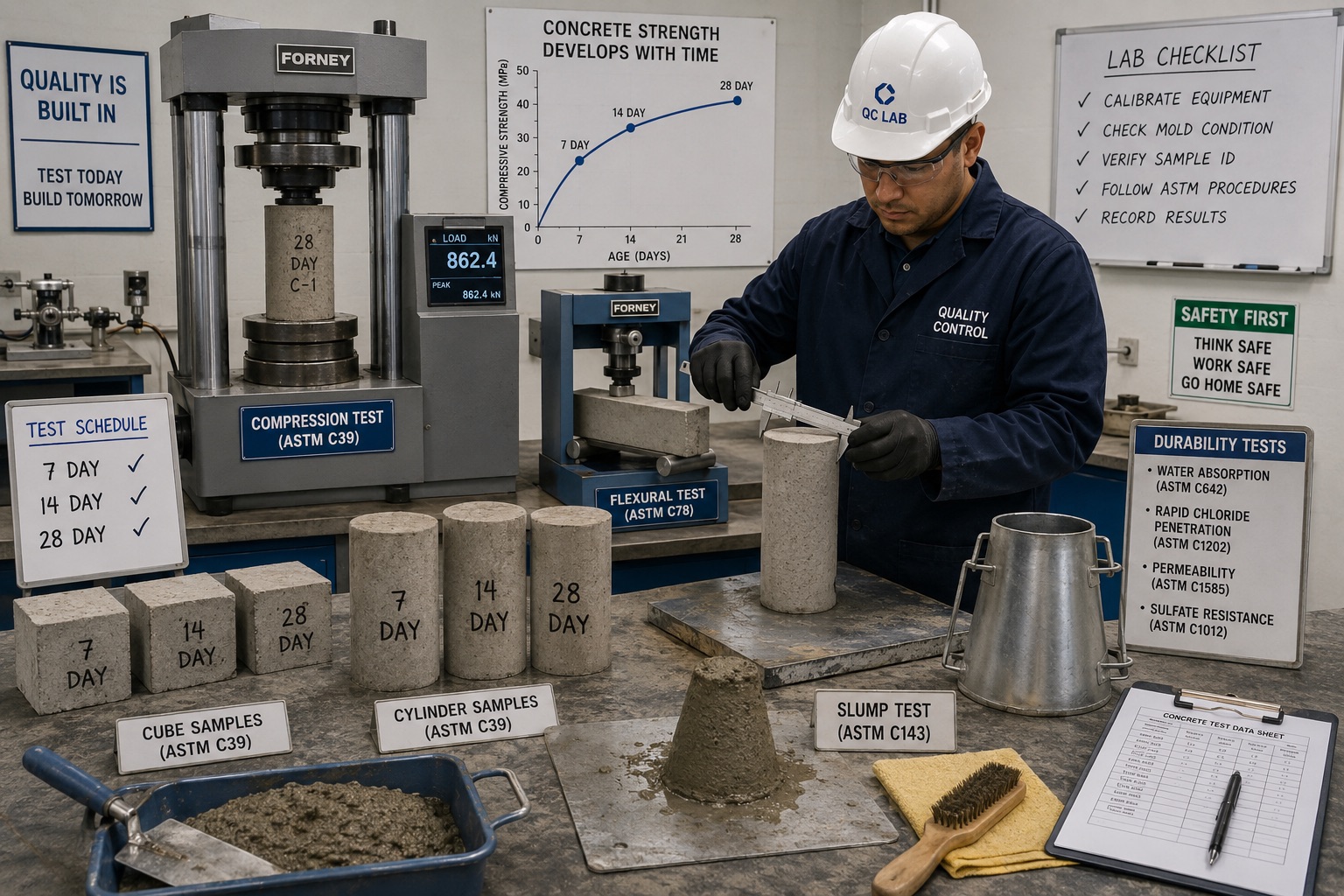
This is the most common test. This test determines the load-bearing capacity of concrete. Workers cast concrete into forms such as cubes or cylinders.
They cure for 7, 14, and 28 days, and we test them in a compression testing machine. The technician will note the maximum load. Cube tests are widespread in many countries. Engineers use the following cylinder tests in the US.
Split Tensile Strength Test
Concrete is weak in tension. This test measures its tensile strength. The technician loads a cylindrical specimen along its diameter. This test supports the study of crack propagation, and engineers use it for members subjected to tension.
Flexural Strength Test
This test determines the flexural strength of concrete. You can perform this test for slabs, roads, and beams. A beam (sometimes also called a flexural sample) is bent until it breaks. Flexural strength is important for roads and highways. Road and highway agencies use this test (such as Caltrans).
Read more to find out why Concrete Quality Control Testing is important for structural and foundational analysis before any construction can begin.
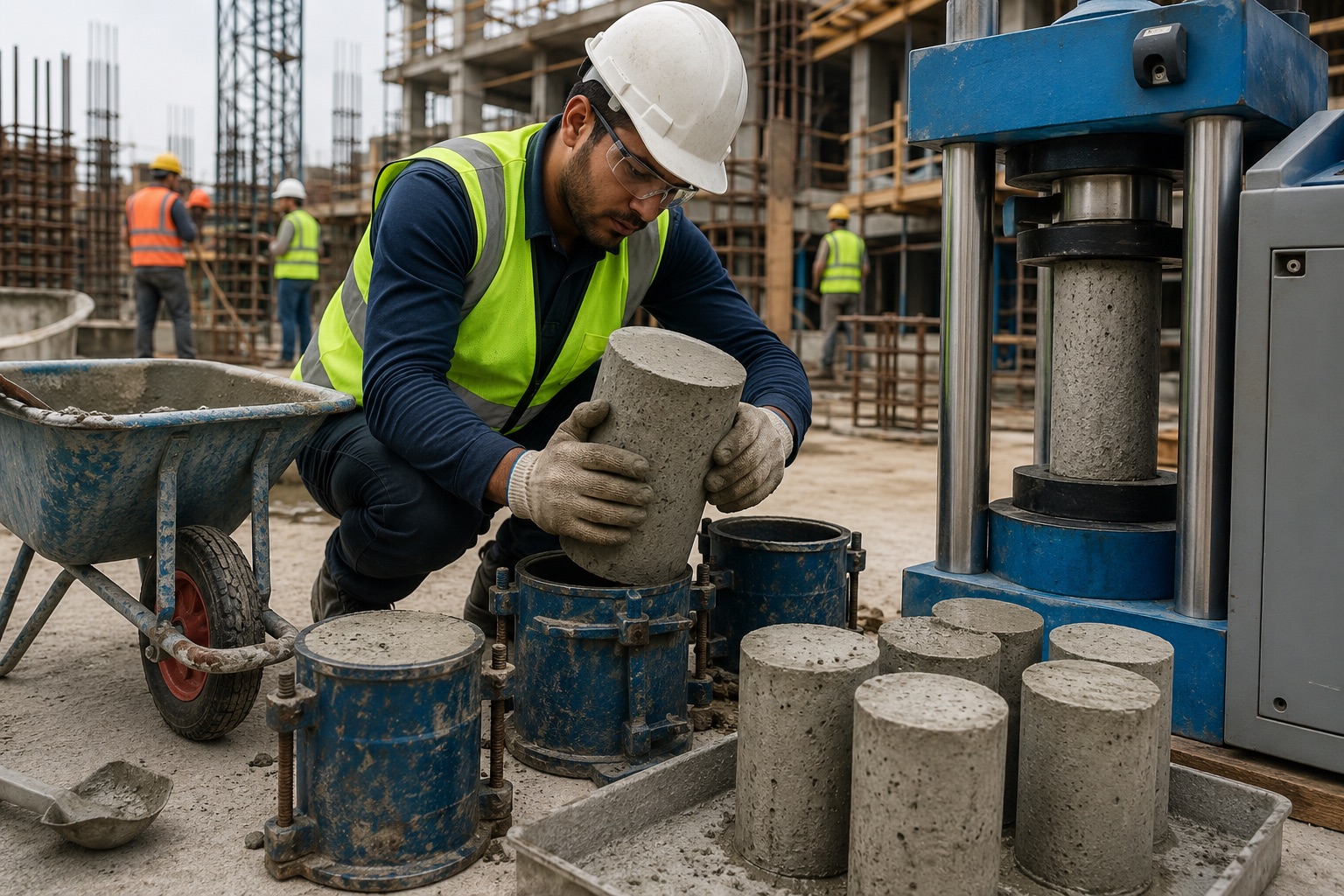
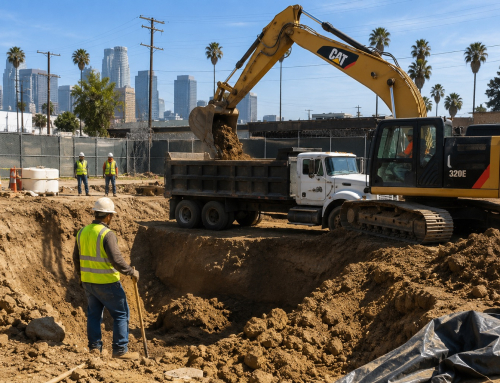
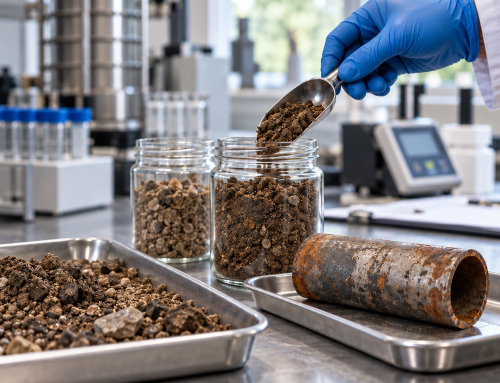
Geotechnical engineers conducting site assessment, soil sampling, and land surveying to evaluate ground conditions for construction project feasibility.Quality control technician conducting concrete cylinder testing and material evaluation to ensure strength, durability, and long-term structural reliability
Concrete Durability Testing Methods
Water Absorption Test: We use this test to determine the amount of water absorbed. High water absorption indicates higher porosity in concrete. Similarly, more porous concrete isn’t as strong or durable.
Permeability Test: The permeability test is a measure of water flow. Low permeability is the best geo-technical condition. This test helps in preventing water and chemicals from passing through.
Chloride Penetration Test: This is a test for chloride resistance as chlorides can corrode steel bars. However, this is issue especially exist in coastal areas.
Sulfate Resistance Test: Someone carries out a sulfate test. Sulfates occur in the ground or water and can damage structures.
Methods of Laboratory Testing
Laboratory testing follows the procedure below:
Sample Preparation
First, you need to prepare concrete samples. Then you will cast specimens in molds that will be cubes or cylinders. Compacting is necessary to eliminate air bubbles.
Curing Process
Curing is carried out in a controlled environment. Good curing results in strong concrete. If not cured properly, the concrete is weak.
Testing Equipment
Various machines are used for testing. Compression testers measure strength. The permeability apparatus measures fluid flow. You must inspect all machines regularly and check them before testing.
Standards for Concrete Testing
Concrete testing is highly regulated procedure in construction. The American Concrete Institute has design and testing guidelines. ASTM International is a common code for concrete standards like ASTM C39 (compression).
In California, local building departments (e.g., LADBS in Los Angeles) and the California building codes. These agencies adhere to safety codes.
Interpretation of Test Results
Interpreting test results possesses a high significance as it involves comparing the results to the acceptance criteria outlined in the standards. Concrete strength increases with time.
Usually, engineers consider 28-day strength for concrete structures. The durability criteria are the absorption and permeability test results. In case of unexpected results, you may need to repeat the tests or you may also need a structural assessment.
Factors Affecting Concrete
Several factors impact concrete. Water-cement ratio is important. More water makes concrete weaker. Aggregate quality is important. Low-quality aggregates make low-quality concrete.
Curing conditions affect hydration. Good curing produces strong concrete. Admixtures can increase the workability, durability, and other properties of concrete. Moreover, the proper workmanship (mixing and placement) is also important for achieving the targeted strength and durability.
Common Issues Identified in Lab Testing
- Common ones include low compressive strength. This may be because of the mix design or curing.
- Permeability relates to durability. It allows water and chemicals to enter. It can lead to weak and failing concrete.
- Variations in materials can also be the reason. Early detection of such problems prevents failure.
Laboratory Testing for Quality Control
Testing is an important part of quality control because it ensures the consistent compliance of the product, material and/or operation with the standards of safety, performance and reliability. Early risks identification by testing can minimize defects, safeguard users, and help build trust and credibility for organizations.
Moreover, the Los Angeles County Department of Public Works projects have rigorous quality testing. Some of the key benefits to lab testing:
- Hazard, weak points and failure areas are identified in the lab prior to products reaching customers. It reduces accident occurrences, recalls and expensive warranty costs.
- Testing offers evidence for approvals and audits, as well as evidence that products satisfy industry requirements, regulations and standards. Regular testing ensures consistent raw materials and production, so each batch meets identical specifications and performance.
- Laboratory methods identify sources of impurity and degradation issues, enabling faster corrective actions and preventing recurring problems.
- Testing needs an upfront investment. It can reduce long-term costs with production failures prevention. Similarly, it also reduces rework, and improves efficiency.
- Testing verifies products perform as intended and provides data for design improvements, innovation, and optimization.
- Accurate lab data enables better decisions on materials, suppliers, process changes, and product release readiness.
Best Practices for Concrete Testing
Proper testing procedures are important. Such procedures assure quality results. Here are some useful tips for concrete testing.
- Test Methods must be followed properly
- Sampling should be done carefully.
- Adequate training of technicians.
- Tests require instrumented calibration.
Real-World Applications and Case Examples
These case studies indicate the need for testing. One example involved a building with cracks caused by low compressive strength. If tests show that the concrete mix was too wet, we must repair it. In a separate project, a bridge had durability problems. This was because of high porosity, which allowed water and chlorides to penetrate. This caused corrosion of the reinforcement.
Future Trends in Concrete Testing
Concrete testing is evolving. New technologies are emerging that are cost and time effective in the long run. The technologies improve accuracy and efficiency. Such as:
- A new trend is non-destructive testing. These include ultrasonic testing and the rebound hammer.
- IoT sensors can constantly measure concrete.
- Machine learning can process and predict behavior.
Conclusions
Testing and determining concrete strength and durability are critical for safe building. It guarantees material design criteria.
It minimizes risk and enhances performance. Labs help speed up problem-solving. In the long term, it is economical and efficient. Established standards and processes ensure durable designs.
F.A.Q.s
Which ASTM standard do people use to test the compressive strength of concrete?
Engineers load concrete cylinders in compression until they fail. We follow ASTM C39 for the compressive strength test.
How do you test concrete durability?
Durability testing uses permeability, water absorption, and RCPT tests.
What is the difference between the cube and cylinder tests?
Cube tests actually refer to the tests performed on cube samples. Cylinder tests use cylinders. Shape may affect results.
Why do we need to cure concrete?
Curing allows proper hydration. It increases strength and durability. Inadequate curing results in low strength.
What are the codes used for concrete testing?
Concrete testing uses ASTM, ACI, and other state and city codes. For example, Caltrans and the LA Department of Building and Safety.
Build with knowledge. Build with confidence. Build smart from the ground up.