Why Soils Reports and Geological Reports Matter
If you are planning to build an accessory dwelling unit in the City of Los Angeles, your permit path may be ministerial under California’s ADU laws, but that does not mean your site is simple from an engineering standpoint. In Los Angeles, many ADU delays are driven not by the floor plan, but by the ground beneath it: hillside conditions, fill, retaining walls, lateral support, liquefaction exposure, landslide risk, and fault-zone issues. Los Angeles City Planning’s current ADU memo confirms that ADUs are processed ministerially in eligible residential areas, while the California HCD handbook reflects the current state-law framework, including the completeness and approval timelines for ADU applications.
For property owners, architects, and builders, the practical question is usually not whether an ADU is allowed. The real question is whether the lot will require a soils report, engineering geologic report, combined soils-and-geology report, slope stability evaluation, or grading permit before LADBS will sign off on the project. That is where early geotechnical planning can save months of redesign and permit corrections.
City of Los Angeles vs. Unincorporated Los Angeles County
This article is written for projects in the City of Los Angeles. If the parcel is in unincorporated Los Angeles County, the process is different, and the County’s ADU guide says applicants should follow the County’s own ADU pathway instead of the City’s.
Are ADUs in Los Angeles still subject to site-specific engineering review?
Yes. Even when an applicant uses one of LADBS’ approved ADU standard plans, LADBS still reviews site-specific factors, including foundation requirements and zoning compliance. In other words, a preapproved ADU plan can shorten plan check, but it does not eliminate geotechnical review when the lot conditions call for it.
The percolation testing and analysis for septic tank construction helps prevent project delays and closures. Properly framed inspections safeguard schedules, jobs and project budgets. The Los Angeles Department of Building and Safety says visual checks help catch early problems.
When a soils report is commonly required for an LA ADU
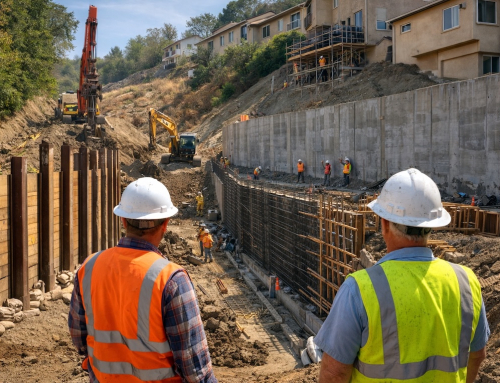
LADBS states that a soils report is needed for construction on a slope steeper than 3:1 (horizontal to vertical), for excavations that remove lateral support, when a structure cannot be designed using code-prescribed soil values, when the structure does not conform to Chapter 18 criteria, and for certain sites within mapped seismic hazard zones that are not exempt. For many ADU projects, those triggers come up when the project includes a detached unit on sloping terrain, retaining walls, cut-and-fill pad work, or foundations near a descending slope.
Read more to find out why a percolation testing can help properly develop a property and construction stability, along with avoiding health concerns.
Geotechnical Report Requirements
The end geotechnical report is fundamental. LA County has been depending on it to approve decisions.
The plan should contain a proper site plan. All test locations should be displayed. Boundaries of property are mandatory.
Each test hole has soil profiles attached to it. Such profiles should align with field logs.
There is a compulsory condition of groundwater observations. These encompass perched water, seepage, or records.
The geologist will be required to give a narrative assessment. This is a simple explanation of site conditions. It describes restrictions as well.
The LA County Environmental Health reviews the report. Other agencies in the hillside areas can also review it.
Designing Seepage Pits or Septic Fields Based on Test Data
The Seepage Pits or Septic Fields are to be designed using Test Data. The development of septic systems is not a geologist's responsibility. Engineers do.
Yet it is built on geologists' work. The geologist can advise on the rate of soil absorption based on test data. These rates regulate the size of systems.
They are also detecting minimum setbacks. This covers the area around buildings, gradients, and property boundary lines.
Poor soil classification results in failure. A common mistake is taking clay for sand. The assistance of a geologist avoids this.
Design is a team effort. Civil engineers and installers work in geology. Each role matters
LA County Permit Review Process
Reviewing the permit begins with submission. There is a need to have percolation information and the geotechnical report.
Review timelines vary. Simple sites move faster. Hillside sites take longer. Missing signatures, incoherent logs, or inconsistent data are the common types of corrections.
Sometimes testing fails. In such cases, redesign or re-testing may be necessary. There are also instances when the location is considered to be unsuitable.
Common Pitfalls and Red Flags in Percolation Testing
The absence of the geologist's signature is also a significant difficulty. Reports that are not signed are rejected.
Another issue is the bad description of geology. Bread and butter language is suspicious.
Wet-season testing may yield distorted results. LA County frequently questions such information.
Shallow groundwater is occasionally neglected. This leads to unsafe designs.
It is not permitted to use old or borrowed data. Site-specific testing is required at every site.
Why Hiring a Qualified Geologist Matters
Hiring a good geologist is one way to reduce risk. The failure of septic systems often results from misconceptions about the conditions underground. A geologist can improve percolation testing as follows:
- A geologist can identify such dangers in advance. A developing geologist has a professional responsibility. The state licensing laws defend their practice. Their interpretations and conclusions are their responsibility. This is a vital responsibility for safeguarding people's health. Geologists assist in preventing system failure.
- An incorrect soil classification is more frequently the cause of septic malfunction. Slow-draining clay soils have often been confused with one another.
- A geologist could tell the difference between sand, silt, and clay layers. They also help reduce code violations. The OWTS requirements in LA County are tough. A geologist ensures that testing is conducted in accordance with the County's existing standards.
- Local knowledge matters. The geology of LA County is complicated and diverse. Soil conditions can vary over a short distance. There could be fill, native soil, and bedrock in the same disposal area on a single property.
- Hillside sands behave differently from coastal sands. Widespread clay contracts and expands with changes in moisture. This movement can destroy seepage pits and leach lines. Sandy soils have higher drainage rates but may have poor filtration. A geologist comprehends these behaviors.
- The seasoned geologists are also conversant with LA County plan review expectations. They are familiar with what the Environmental Health reviewers seek.
- They understand how to make presentable soil logs and draw justifiable conclusions. This minimizes the number of comments and revisions. This is, in most instances, a time- and money-saver.
- Fewer approvals take shorter periods. Avoiding re-testing or costly redesigning is also due to proper testing. A qualified geologist safeguards the environment and the property owner in the long run.
Conclusion
Geologists are also critical in the percolation test. Their effort safeguards groundwater and human health. A
Approval of septic systems in LA County is based on proper soil assessment. This cannot be rushed.
The LA County OWTS Manual should be adhered to. When in need, one should always have a licensed geologist on hand.
Good data lead to good design. Safe systems result from proper testing.
F.A.Q.s
Is a geologist required for all percolation tests in LA County?
Not always. Simple sites may allow other professionals. Complex sites usually require a geologist.
What license must a geologist hold in California?
The State of California must license them. Engineering geologists hold additional certification.
How do I find a qualified geologist near Los Angeles?
Look for professionals experienced with LA County Environmental Health reviews.
Can an engineer sign off without a geologist?
Only in limited cases. Many sites still require geologic evaluation.
What happens if groundwater is found?
The system design must change. In some cases, the site may be denied.
Build with knowledge. Build with confidence. Build smart from the ground up.